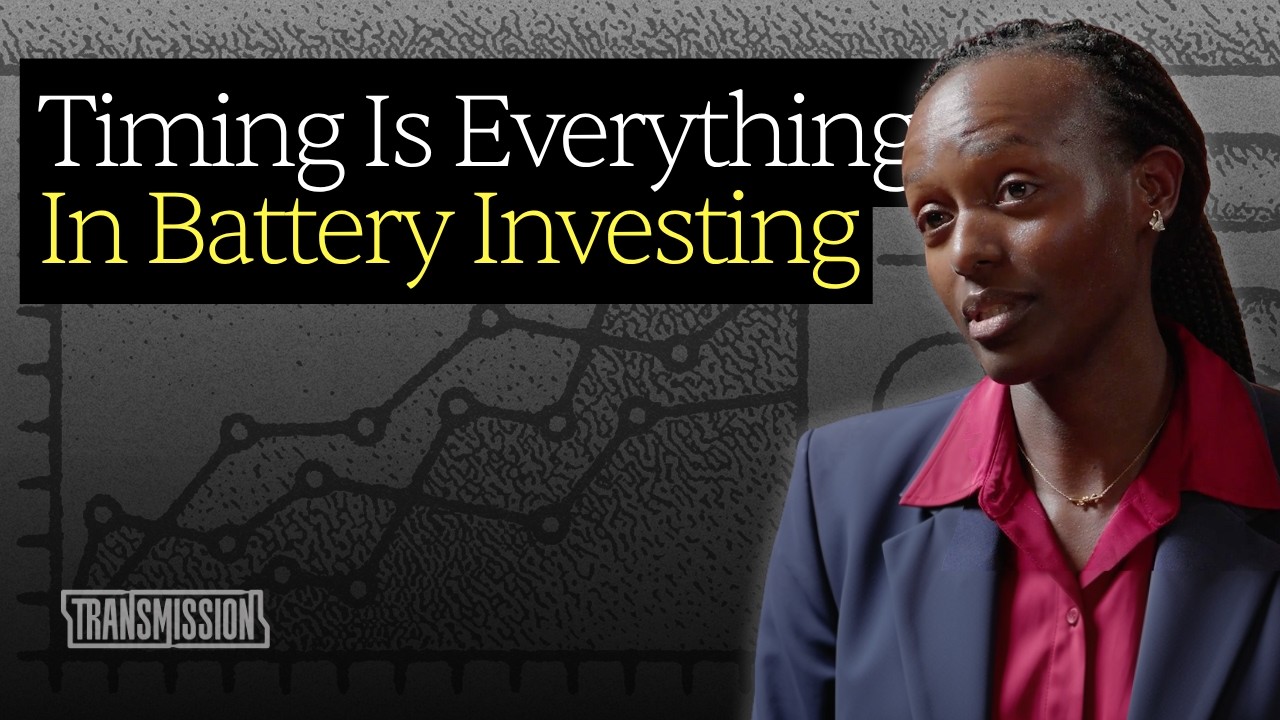
Financing Merchant Batteries When Contracts Run Out - Aquila Clean Energy
Keywords
Summary
213 words
Critical Evaluation
Value of the Information & Strength of the Argument
The video provides substantial value by offering a practitioner’s perspective on a niche but critical topic: financing battery storage without guaranteed contracts. Grace Kankindi’s arguments are well-structured and grounded in concrete examples, such as the specifics of the MACSE auction, lender behaviour in Germany, and the role of the optimiser. She articulates nuanced points, like why the lowest profit share is not always the best deal and why contracted revenue carries hidden risks. The reasoning is coherent, and she supports her claims with references to market observations and her own experience, making the argumentation solid. However, some assertions are subjective and may not be universally applicable, though they are presented with appropriate caution.
Scientific Rigor, Source Quality, Title Accuracy
The rigour of the content is high for an expert opinion piece: the guest is directly involved in investment decisions, and her views are informed by real market data and transactions. The podcast is part of Modo Energy’s reputable series, known for professional analysis. The description provides links to a product (Ko) and a full transcript, which serve as primary sources, but no external academic or peer-reviewed sources are cited. The title accurately matches the content, as the entire discussion revolves around financing merchant batteries when contracts run out. There is no discernible mismatch between the title and the actual topics covered, and the video successfully addresses the intended theme.
238 words
Title / Content Match
The title accurately reflects the central theme of how to finance battery projects when contracts like MACSE are not available, and the discussion covers this in depth.
Quality & Reliability
8/10
The video offers expert insights from a professional with direct involvement in battery storage investment across Europe. The discussion is detailed and grounded in market experience, but relies on personal opinion and limited public data, so it is generally reliable but not fully verifiable.
Chapters
- Intro
- MACSE Auction Results and What People Got Wrong
- Italy Battery Storage Investment Beyond MACSE
- MACSE vs Merchant by Italian Price Zone
- Battery Revenue Strategies Without a MACSE Contract
- Battery Project Finance: MACSE, Tolling and Merchant
- Second MACSE Auction and Anti-Concentration Rules
- Merchant Battery Financing in Germany
- What Lenders Want From a Merchant BESS Project
- German Battery Revenue Saturation
- Battery Optimiser Risk and Profit Share
- Dynamic Grid Fees in Germany
- Diversifying a Battery Portfolio Across 12 Markets
- Lithuania and Finland Battery Storage Markets
- Where to Invest Next: Poland
- Best Performing Battery Assets in 10 Years
- The Hidden Risk in Contracted Battery Revenue
Cited Sources
- Modo Energy Ko product page — Mentioned as a tool for stress-testing battery revenues.
- Transcript of this episode — Full transcript of the podcast episode.
External References
Contribution & Novelties
The video brings a fresh perspective on the financing of battery storage projects in a transitioning market, specifically addressing the shift from contracted to merchant revenue models. It highlights practical considerations that are often overlooked, such as the critical role of the optimiser and the hidden risks in contracted revenue. The discussion of Italy’s MACSE auction and its consequences provides current, actionable insights for investors.
Pour aller plus loin :
- Energy storage — Overview of energy storage technologies and their applications.
- Merchant plant — Explanation of merchant power plants and their financing structures.
- Capacity market — How capacity markets function and their relevance to energy storage.
- Project finance — Structure of project financing, relevant to understanding debt terms discussed.
119 words
Radar Profile
The profile shows a balanced score with high reliability and information quality, indicating a content-rich and trustworthy discussion. Technical depth is moderately high, making it suitable for a professional audience.