FMSZ 2026 Annual Congress Presentation by Dr Mureriwa
Title history
- FMSZ 2026 Annual Congress Presentation by Dr Mureriwa — observed on 20261111-1337 UTC (YouTube)
Keywords
Summary
127 words
Critical Evaluation
Value of the Information & Strength of the Argument
The value of this presentation lies in its practical clinical insights into a rare but life-threatening condition. Dr Mureriwa effectively uses a real case to illustrate the diagnostic challenges and the importance of early recognition. Her argumentation is built on solid endocrinological principles, explaining the underlying enzyme deficiency and its consequences. She stresses the need for early intervention, multidisciplinary teams, and newborn screening, which are evidence-based recommendations. However, the presentation is primarily based on her personal experience and local context, and it does not include a critical discussion of alternative viewpoints or comparative management strategies.
Scientific Rigor, Source Quality, Title Accuracy
The scientific rigor is demonstrated through the accurate biochemical explanation and the detailed case report. The speaker clearly references the 17-hydroxyprogesterone levels and confirms the diagnosis with chromosomal analysis. However, no external sources or references are cited in the transcript, limiting the verifiability of the claims. The title is quite generic and does not convey the specific topic; the description partially corrects this. Given the alignment between the talk’s content and the stated theme of gender-related medical urgency, the overall adequacy is moderate, but the generic title reduces clarity.
199 words
Title / Content Match
The title is generic and does not reflect the specific content about gender determination and adrenal hyperplasia. The description adds clarity, but the title alone is insufficient.
Quality & Reliability
8/10
The speaker is a pediatric endocrinologist and epidemiologist, providing expert-level medical detail on congenital adrenal hyperplasia. The presentation is well-structured and clinically accurate, but it relies on personal expertise and a case study without citing external references.
Key Moments
Markers derived by PSI from the transcript: the creator did not define chapters.
- Introduction and speaker introduction; Dr Mureriwa sets the stage for discussing gender and adrenal conditions.
- Presentation of the index case: a 3-month-old with ambiguous genitalia and hyperpigmentation, plus history of a sibling's death.
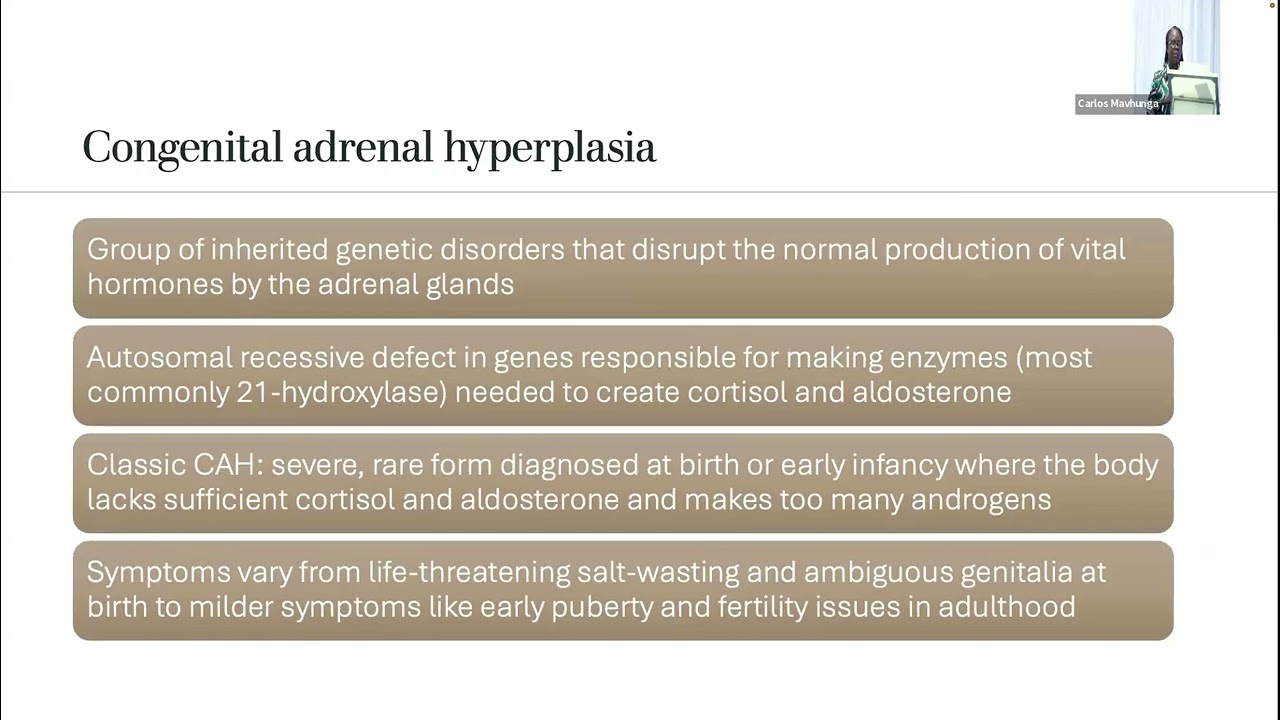
- Explanation of adrenal biochemistry and the role of 21-hydroxylase in cortisol and aldosterone synthesis.
- Discussion of symptoms, diagnostic tests (17-OHP, electrolytes), and the classic salt-wasting form of CAH.
- Overview of services at Salugal Hospital, including the first family workshop and partnership with CLAN for medication supply.
- Concluding remarks on the importance of early referral and multidisciplinary management for ambiguous genitalia.
Contribution & Novelties
This presentation contributes by highlighting the challenges of diagnosing congenital adrenal hyperplasia in resource-limited settings, particularly in Zimbabwe. It provides a local perspective on the clinical presentation and management, and emphasizes the need for targeted newborn screening and multidisciplinary care. The sharing of a successful partnership to secure free medication is an innovative approach worth noting.
Pour aller plus loin :
- Congenital adrenal hyperplasia — Overview of CAH, its types, and management.
- 21-Hydroxylase deficiency — Detailed explanation of the enzyme defect and its consequences.
- Newborn screening — General information on newborn screening programs, relevant to the speaker’s advocacy.
98 words
Radar Profile
The radar profile shows high scores in technical level and reliability, reflecting expert delivery and accurate medical content. Quantity and quality of information are also strong, but the lack of cited external sources keeps reliability slightly lower than the technical level.