FMSZ 2026 Annual Congress Presentation by Dr Munyaradzi Rutsate
Title history
- FMSZ 2026 Annual Congress Presentation by Dr Munyaradzi Rutsate — observed on 20261026-1137 UTC (YouTube)
Keywords
Summary
131 words
Critical Evaluation
Value of the Information & Strength of the Argument
The value of this information lies in its practical application: it addresses real clinical workflow inefficiencies and offers a novel approach to data integration in fetal medicine. The argumentation is clear and logical, supported by concrete clinical scenarios that illustrate the system’s potential benefits. However, the presentation lacks quantitative evidence, control studies, or clinical outcomes, making it an expert opinion rather than a validated study. The logic is persuasive, but the lack of rigorous testing and independent validation weakens the overall scientific value.
Scientific Rigor, Source Quality, Title Accuracy
The presentation references local guidelines and NICE guidelines, but does not provide specific citations or external links. The reliance on expert experience and guidelines is appropriate, but the absence of peer-reviewed references or data on system performance limits the scientific rigor. The title accurately describes the content, and there is no evidence of misleading information. The speaker is transparent about the prototype status and limitations, which enhances credibility. However, the lack of formal evaluation and the anecdotal nature of examples prevent a high score for source quality.
185 words
Title / Content Match
The title accurately reflects the content, which is a presentation on a decision-support system for fetal medicine.
Quality & Reliability
6/10
The presentation is from a professional conference, but it describes an operational prototype with no clinical validation or data. The content is based on expert opinion and local/NICE guidelines, but lacks rigorous scientific evidence.
Key Moments
Markers derived by PSI from the transcript: the creator did not define chapters.
- Introduction to problems with fragmented patient information in fetal medicine clinics.
- Explanation of the hybrid model that integrates clinical guidelines and collates patient data.
- Example: chronic hypertension case triggering drug change alert (losartan to nifedipine).
- Example: 33-week scan with low EFW and raised umbilical artery PI, prompting weekly review protocol.
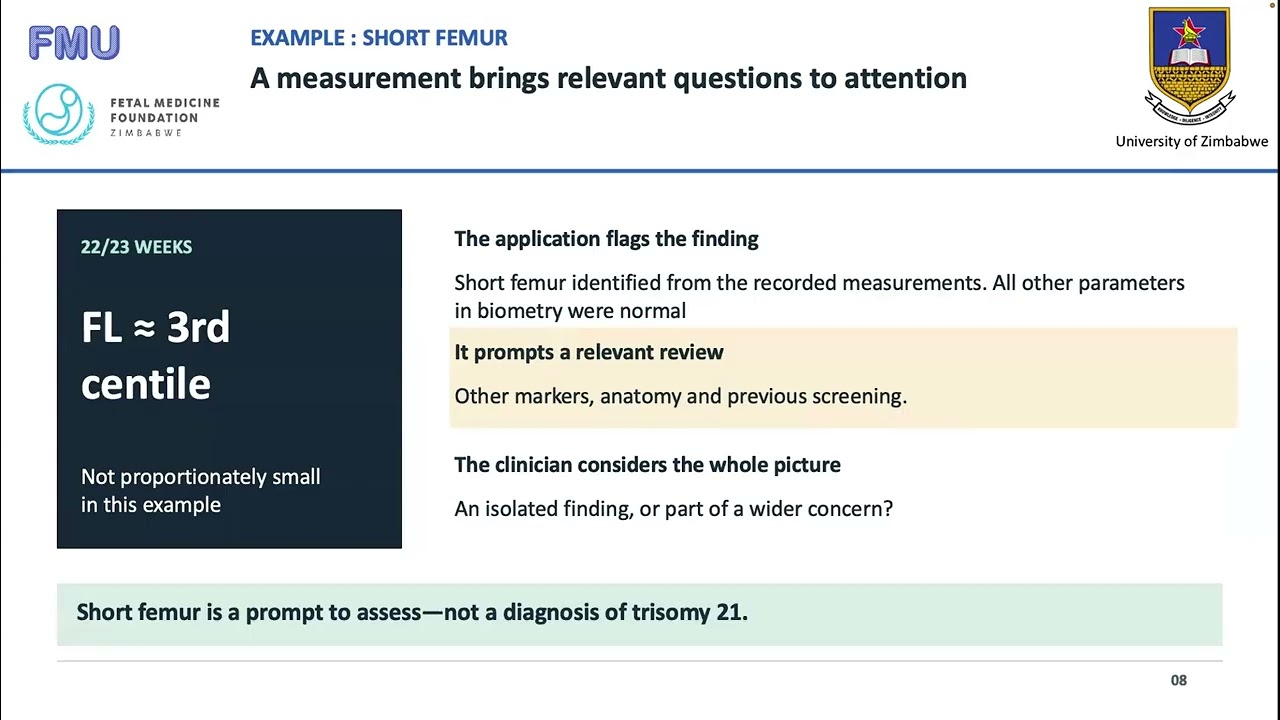
- Example: short femur noted, system flags risk for Down syndrome and provides checklist.
- Example: polyhydramnios with incomplete history, system generates risk factor checklist.
- Discussion of QR code for storing patient history and enhancing continuity of care.
- Current status: operational prototype, offline capability, and need for rigorous testing.
Cited Sources
- NICE Guidelines — Mentioned as reference for clinical guidelines used by the system.
Contribution & Novelties
The presentation introduces a prototype that combines clinical guidelines, patient data integration, and automated report generation in a single tool, which is a practical innovation in fetal medicine. The approach of using a customizable QR code for patient history is original. The main novelty lies in the seamless integration of multiple data sources and the real-time decision support that prioritizes relevant information.
Pour aller plus loin :
- Clinical decision support system — Provides background on DSS and their role in healthcare, relevant to the described tool.
- Maternal-fetal medicine — Explains the specialty and its scope, useful for understanding the context.
- NICE guidelines — The referenced clinical guidelines, which are widely used in the UK and elsewhere.
116 words
Radar Profile
The radar profile shows moderate scores across information quantity, quality, technical level, and reliability, with reliability being the lowest. This reflects a presentation that is informative and technically oriented but lacks robust evidence and validation, typical of an expert opinion on a prototype.