FMSZ 2026 Annual Congress Presentation by Dr S. Mukandiona
Keywords
Summary
170 words
Critical Evaluation
Value of the Information & Strength of the Argument
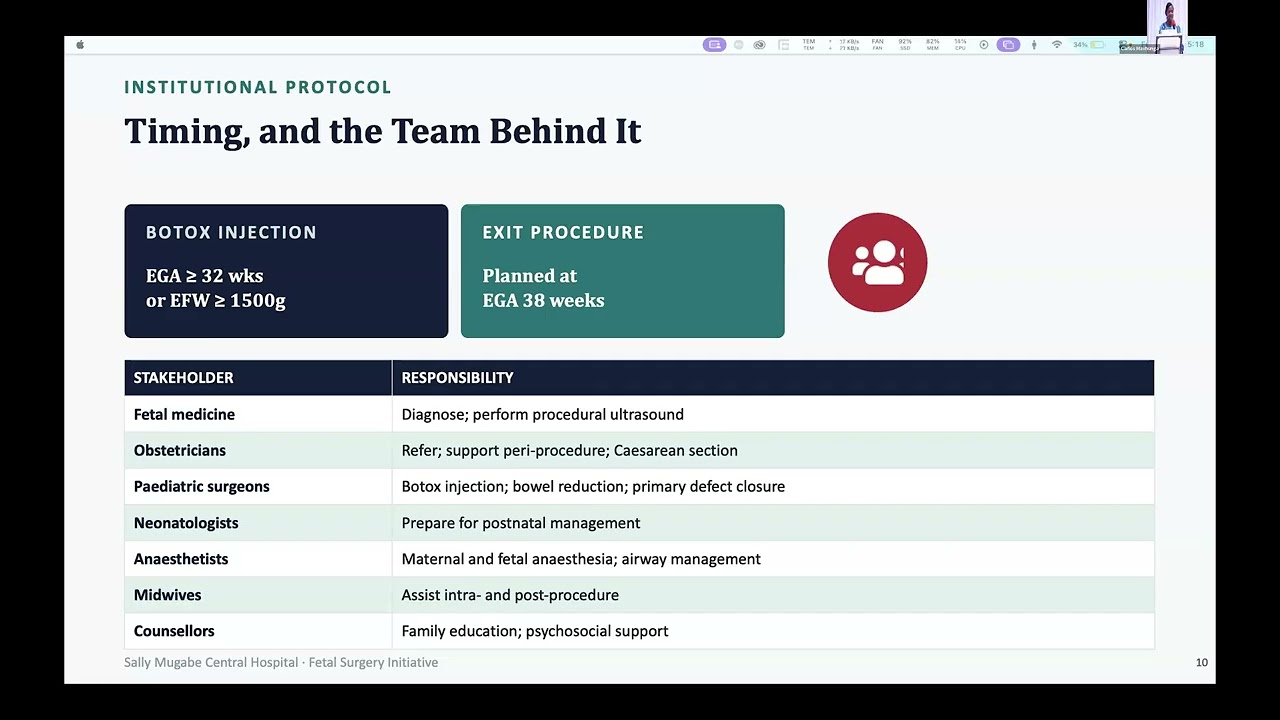
The value of the information lies in its highly contextualized approach to a significant public health problem. The speaker presents local data showing a drastic gap in survival, making a strong case for novel, low-cost interventions. The argumentation is scientific: she reviews the pathophysiology, current management challenges, and the rationale for botulinum toxin based on its mechanism of action and existing uses in surgery. The protocol is detailed, with clear inclusion/exclusion criteria, procedural steps, and a multidisciplinary team approach, which adds credibility. However, the presentation is largely descriptive and does not yet include any outcome data from the protocol, so its efficacy remains unproven. The speaker acknowledges the experimental nature and the need for institutional approval and further research, which is honest and scientifically sound.
Scientific Rigor, Source Quality, Title Accuracy
The scientific rigor is moderate. The speaker cites a local study from 2013 (Mr. boy et al.) and mentions global incidence rates, but does not provide specific references or DOI links. The title accurately represents the content, and the presentation follows a logical structure. While the methodology is described in detail, the lack of pilot data and the small number of cases limit the strength of the conclusions. The speaker appropriately highlights the limitations and calls for further investigation, which reflects scientific integrity. The sources used are not explicitly listed in the description, but internal references are mentioned, and no external sources are provided. Overall, the title-content fit is excellent, and the scientific reasoning is sound, though verification of cited works would strengthen the presentation.
265 words
Title / Content Match
The title accurately reflects the content: a congress presentation by Dr S. Mukandiona on a specific fetal intervention.
Quality & Reliability
8/10
The presentation is a professional medical lecture detailing a novel protocol for in-utero botulinum toxin injection in gastroschisis, grounded in local statistics and existing literature. Limitations include lack of outcome data, small sample sizes, and the experimental nature of the intervention, but the methodology is transparent and logically structured.
Key Moments
Markers derived by PSI from the transcript: the creator did not define chapters.
- Introduction of the speaker and topic
- Definition of gastroschisis and global vs local survival statistics
- Challenges in current management: prolonged hospital stay and complications
- Rationale for botulinum toxin: mechanism and existing applications
- Protocol outline: patient selection, inclusion and exclusion criteria
- Procedure details: preparation, injection technique, and monitoring
- EXIT procedure steps and potential risks
- Future directions: extension to other defects and fetal surgery
Contribution & Novelties
The main novelty is the application of an established drug (botulinum toxin) for a novel intrauterine indication in a resource-limited setting, aiming to simplify postnatal closure and reduce mortality. The presentation also proposes a structured protocol adaptable to low-income countries, and highlights the importance of local data and capacity building.
Pour aller plus loin :
- Gastroschisis - Wikipedia — Overview of the condition and current management.
- Botulinum toxin - Wikipedia — Mechanism of action and therapeutic uses.
- Ex utero intrapartum treatment (EXIT) procedure - National Library of Medicine — Detailed overview of the EXIT procedure and its indications.
- Fetal surgery - Wikipedia — Context on the broader field of prenatal interventions.
111 words
Radar Profile
The radar profile shows high scores for information quantity and quality, reflecting the detailed protocol and local data. Technical level is also high, but fiability (global reliability) is slightly lower due to the experimental nature and lack of outcome data. Overall, the presentation is scientifically sound but requires validation.