FMSZ 2026 Annual Congress Presentation by Tinotenda Manyere
Title history
- FMSZ 2026 Annual Congress Presentation by Tinotenda Manyere — observed on 20261111-1539 UTC (YouTube)
Keywords
Summary
193 words
Critical Evaluation
Value of the Information & Strength of the Argument
The presentation provides valuable local data on a neglected intersection of infertility, mental health, and prenatal care. The statistical contrasts (3.4-7.8% vs 0.5-0.6%) and the patient-reported outcomes (depression, stigma, gender-based violence) strengthen the argument for integrated care. The qualitative findings from interviews add depth, though the lack of methodological detail limits critical appraisal. The argumentation is coherent: it identifies a gap, supports it with data, and proposes a structured pathway. However, the evidence is presented as preliminary and requires further validation.
Scientific Rigor, Source Quality, Title Accuracy
The presenter references ’large cohort studies’ and ‘Nelson and Holland’ but provides no citations or direct links. The absence of a bibliography in the video or description diminishes the scientific rigor. The title accurately describes the content, an original research presentation, and the content matches the title. No public comments were available for analysis.
150 words
Title / Content Match
The title accurately reflects the content: a congress presentation describing a multidisciplinary fetal medicine pathway for infertility patients in Zimbabwe.
Quality & Reliability
7/10
Presentation of clinical research data with specific statistics and qualitative interviews, though details on methodology and sample sizes are not fully provided. References to published work (e.g., Nelson and Holland) are mentioned but not cited in the video or description.
Key Moments
Markers derived by PSI from the transcript: the creator did not define chapters.
- Introduction and recap of last year's presentation 'Beyond the Womb'.
- Statistics on infertility burden: 17.5% of adults globally, psychosocial impact.
- Genetic gap: chromosomal abnormalities in 3.4-7.8% of infertile couples vs 0.5-0.6% in newborns.
- Description of the disconnected system: antenatal pathways lack psychosocial and genetic counseling links.
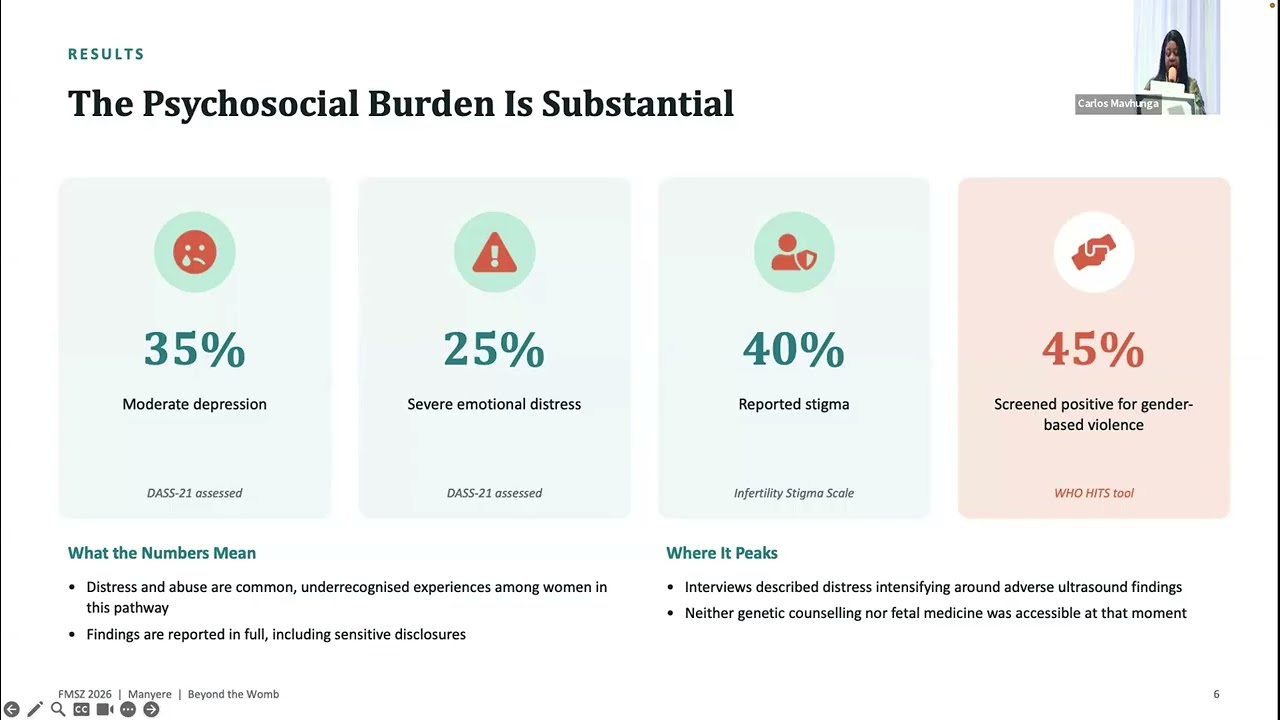
- Study results: depression (35%), emotional distress (25%), stigma (40%), gender-based violence (45%).
- Interviews reveal distress intensifies around adverse ultrasound findings, with no access to genetic counseling or fetal medicine.
- Proposed multidisciplinary referral pathway: mental health provider, genetic counselor, fetal medicine specialist.
- Recommendations: piloting the pathway, training sonographers, and scaling internationally.
Contribution & Novelties
This presentation brings attention to the critical but often ignored psychological and genetic counseling gaps in infertility care within Zimbabwe, proposing a concrete, scalable multidisciplinary pathway. It combines quantitative and qualitative data to advocate for integrated services.
Pour aller plus loin :
- Fetal medicine - Wikipedia — Overview of the specialty relevant to the proposed pathway.
- Infertility - Wikipedia — Background on infertility prevalence and causes.
- Prenatal depression - Wikipedia — Addresses the mental health aspect highlighted in the study.
80 words
Radar Profile
The radar profile shows moderate scores across all dimensions, with slightly higher quantitative and qualitative information, indicating a solid presentation but with room for improvement in technical depth and source documentation.