¿Ya no vale la pena el prompt engineering?
Is prompt engineering no longer worth it?
Keywords
Summary
308 words
Critical Evaluation
Value of the Information & Strength of the Argument
The informational value lies mainly in the operational framing rather than in facts. The most transferable contribution is the decomposition of AI-assisted work into stages with distinct ownership: a planning stage where the human and the model negotiate criteria before any output is produced; an execution stage delegated to the model; a review stage explicitly reserved for the human; and a consolidation stage where the accumulated corrections are written back into a reusable procedural document. That last move — turning a one-off correction cycle into a persistent asset that improves with each iteration and can eventually be scheduled — is the genuinely useful idea, because it reframes quality as a function of accumulated process rather than of a single well-crafted instruction. The three-part anatomy of an agent (context, procedural skills, tools) is a clean, teachable abstraction that maps well onto how contemporary assistant products actually behave, and the deliberately weak recruiting prompt used as a demonstration is an effective pedagogical device: it isolates the variable by showing that a poor request succeeds when context, procedure and tool access compensate for it. The argumentation itself is rhetorical rather than demonstrative. Its main device is contrast: an old world (detailed prompts, friction, repeated fights with the model) against a new world (conversation, agents, workflow). The transition is asserted rather than measured — no comparison of outputs with and without structured prompts, no failure rates, no evaluation of how often conversational requests actually succeed on complex professional tasks. The demonstration relies on the audience recognising a familiar experience, which is persuasive in a keynote setting but is not evidence. A second weakness is that the thesis is stated in absolute terms (’the prompts are dead’, ’this is no longer used’) while the underlying advice quietly retains the substance of prompt engineering under other names: the planning conversation is requirement elicitation, the skill is a specification, and the emphasis on clarity, checking for misunderstanding and asking the model to restate in its own words is exactly the discipline the talk declares obsolete. The reframing is therefore more a change of level — from the single instruction to the procedure that generates instructions — than an abandonment. Two arguments are stronger than the rest. The first is the observation that the value of a skilled operator is now read off the workflow rather than off the prompt (which model, with which skill, connected to which tool, in what order), because that is where the leverage visibly sits once models are commoditised. The second is the rebuttal of the cognitive-decline narrative: the claim that AI demands supervision rather than passivity, and that producing garbage is easy while producing professional work is not, is a defensible position that follows from the review requirement built into the loop. The weakest passage is the confident assertion that setting up agents requires no work at all — that simply asking an assistant causes an agent to ‘wake up’ — which conflates a chat interface’s automatic tool use with the engineering of a reliable, auditable agent pipeline, a distinction the talk itself needs in order to make sense of its own skills-and-tools framework.
Scientific Rigor, Source Quality, Title Accuracy
No citation apparatus is used anywhere in the talk: no paper, benchmark, documentation page or dataset is displayed, and the references that do appear are named in passing and left unverifiable from the video itself — an OpenAI reasoning-model launch placed in September 2024, a connector protocol dated to late 2024, an agent product presented as the first functional one, a model version described as the first fully agentic one, and an MIT study invoked only to be dismissed. The one quantitative claim (a complex mathematical problem solved in about a week using ten thousand agents) is hedged by the speaker himself (‘if I remember correctly’) and cannot be audited. The historical scaffolding is nonetheless reasonable in outline and correctly identifies the three technical developments that changed practice — self-checking reasoning models, standardised tool-connection layers, and long-running agent harnesses — and the description links are limited to the channel’s own course and social pages, so they provide no external corroboration. Rigour is therefore that of a well-informed practitioner keynote: coherent, experience-based, transparently opinionated, but not evidence-backed, and occasionally imprecise in its absolute formulations. A short promotional segment of roughly forty seconds appears mid-video, and a sponsor mention opens the recording; neither affects the assessment. On title/content fit, the question posed in the title is answered directly and without digression, the thesis is announced in the first two minutes and defended throughout, and the mismatch is only one of emphasis: ’no longer worth it’ would be more accurate than ‘dead’, since the talk’s own recipe — planning, clarifying, specifying, iterating — preserves most of the underlying discipline under a new vocabulary.
807 words
Title / Content Match
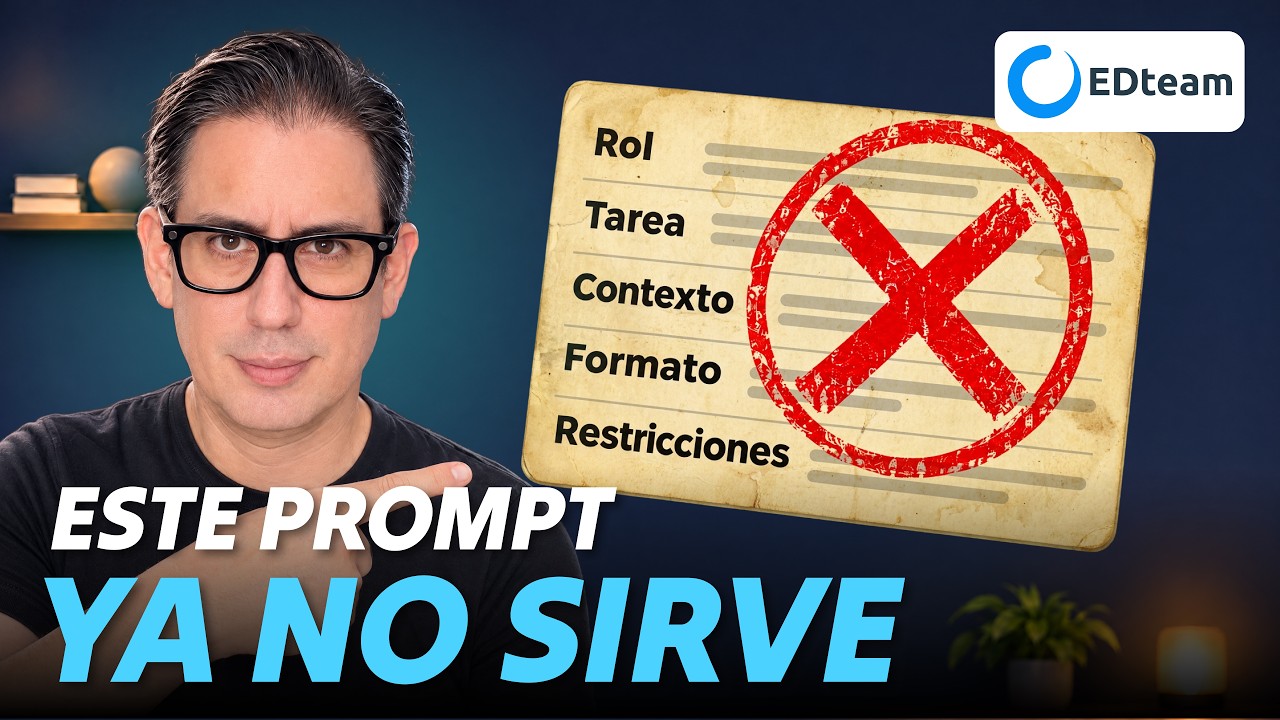
The title asks a question and the talk answers it head-on from the first minutes, with a clear thesis (structured role/context/format/restriction prompts are obsolete) and a replacement (workflow, skills, agents). The match is strong, although the deliberately provocative 'dead' framing overstates a more nuanced shift.
Quality & Reliability
5/10
The talk is a practitioner keynote, not a documented study: no figure, benchmark, paper or primary reference is shown, and the strongest empirical claims (a model launch date, a model version, a week-long 10,000-agent run, an MIT study on cognitive decline) are asserted orally and cannot be checked from the material supplied. Several statements are forward-dated to a 2026 present, which makes part of the vocabulary (agentic model versions, 'agents everywhere') plausible but unverifiable in absolute terms. The overall narrative is broadly consistent with the publicly observable trajectory of LLM tooling between 2023 and 2026 — long-context models, reasoning models, tool-calling connectors, agent harnesses — and the practical workflow advice is internally coherent and immediately testable by the viewer. Reliability is therefore that of informed expert testimony: directionally sound, but with no auditable evidence base and occasional rhetorical overreach ('the prompts are dead').
Key Moments
Markers derived by PSI from the transcript: the creator did not define chapters.
- Thesis stated bluntly: 'the prompts are dead', followed by the speaker's framing of why this claim unsettles practitioners.
- Reconstruction of the early era: first-generation models required exhaustive, literal instructions, illustrated by the classic survivors/burial trick question they failed.
- Demonstration that vague, informal requests ('make me a beautiful page that sells a lot') now produce usable results, violating every classical prompt-engineering rule.
- Reasoning models explained: the model evaluates and revises its own answer internally before returning it, which removes the need for exhaustive specification.
- The infrastructure turn: a standardised connector layer between applications and models, then finished agent products and long-running agentic models.
- Functional definition of an agent through the maze metaphor: objective given, goal decomposed, plan drafted, executed, corrected when a step fails.
- The three ingredients of an agent — context, procedural skills (recipe metaphor) and tools — and why each one bounds the agent's behaviour.
- Behavioural prescription: stop typing, open the microphone and talk to the model as to a colleague; ask 'do you understand?' and invite clarifying questions.
- The six-stage loop presented step by step: plan, execute, review, crystallise into a skill, improve the skill, then automate on a schedule.
- Rebuttal of the 'AI makes us dumb' narrative: professional use requires sustained attention and review, so the cognitive-decline framing misfires.
Cited Sources
- OpenAI reasoning-model launch (dated September 2024 in the talk) — Presented as one of the most important but least noticed releases in AI history; the model is described as evaluating its own answer before delivering it. No document, paper or announcement page is shown.
- Model Context Protocol (MCP), described as launched at the end of 2024 — Explained as an invisible connection layer between applications and the assistant, allowing the model to trigger actions inside tools such as a video editor.
- Manus, presented as the first functional agent product (2025) — Used to date the arrival of finished agent products, distinguished from the connector layer, which is invisible to the user.
- Claude Opus 4.6, presented as the first fully agentic model (end of the previous year) — Cited as the point where a model could be left working autonomously for hours, which the speaker identifies as the turning point for workflows.
- MIT study on AI and cognitive effort ('AI makes us dumb') — Mentioned only to be dismissed as a tired narrative; no authors, title, date or link are given, so the study cannot be identified from the video.
- EDteam course catalogue and training pages — The only links in the description are the channel's own course, scholarship and social pages (edy.to/...); they support the promotional segments and the speaker's affiliation but contain no external documentation of the technical claims.
Concurring Sources
- Prompt engineering — Wikipedia — Confirms that the role/context/format/restriction templates belong to a specific early period, and documents the later shift toward conversational iteration, tool use and agentic patterns.
- Model Context Protocol (official site) — Corroborates the existence and function of the connector standard described in the talk as the link between applications and models.
- Multi-agent system — Wikipedia — Provides the academic background for the definition of an agent as a goal-directed system that decomposes objectives, plans and revises its plan.
Dissenting Sources
- Empirical literature on prompt sensitivity and structured prompting — A substantial body of evaluation work shows that output quality remains highly sensitive to instruction phrasing, ordering and formatting, and that structured specifications still improve reliability on complex or high-stakes tasks. The talk's absolute formulation ('the prompts are dead') describes consumer-facing chat use well but generalises poorly to production pipelines, where explicit constraints remain a robustness mechanism.
- 'Your Brain on ChatGPT' — MIT Media Lab study on cognitive debt — The speaker reduces a specific, methodologically bounded study on essay writing to a lazy slogan and dismisses it in one sentence. The counter-argument he offers (that AI work demands concentration) is a plausible criticism but is not an engagement with the study's design, sample or measured effects, so a contested empirical question is settled rhetorically rather than examined.
External References
Contribution & Novelties
The talk’s genuine contribution is not the headline claim but the operational layer beneath it: it converts a diffuse intuition (‘prompts matter less now’) into a repeatable six-stage procedure — plan collaboratively, delegate execution, review rigorously, crystallise the corrections into a reusable procedural document, ask the model to improve that document on every cycle, then schedule the stabilised process. The most interesting conceptual move is treating the accumulated human corrections as a capital asset rather than as one-off labour: the skill file is where review effort is stored, so the second execution of a task costs less than the first. This reframing of quality as a function of accumulated process rather than of a single instruction is what distinguishes the talk from generic prompt-engineering content, and it also explains the shift in the evaluation question it proposes — from ‘what was your prompt?’ to ‘which model, with which procedure, connected to which tools, in what order?’.
Pour aller plus loin :
- Model Context Protocol — Official documentation for the connector layer the talk describes as the invisible bridge between assistants and applications; useful to judge how much of the ‘agents need tools’ argument rests on a real standard.
- Prompt engineering — Wikipedia — Overview of the techniques the talk declares obsolete; worth reading to see how much of role/context/format guidance survives inside the ‘planning conversation’ and ‘skill’ concepts.
- Multi-agent system — Wikipedia — Broader academic framing of goal-driven, planning systems, useful to separate the older agent literature from the current product-led use of the word.
- ‘Building effective agents’, Anthropic engineering note — directly relevant to the talk’s claim that agents need no setup; it documents the opposite position, namely that reliability comes from explicit workflow design and constrained tool use.
- ‘Your Brain on ChatGPT’ (MIT Media Lab study on cognitive debt in essay writing) — the study the speaker dismisses in a single sentence; consulting the original would allow a fairer assessment of the cognitive-effort argument he counters.
328 words
Radar Profile
The profile is that of a persuasive practitioner keynote: high on density of actionable concepts and moderately high on information volume, but only mid-range on technical depth and reliability, since the technical apparatus is explained by metaphor rather than by mechanism and no evidence base is displayed. The gap between the high practical usefulness and the moderate reliability scores reflects the format itself — a conference talk optimised for adoption and memorability, not for auditability.