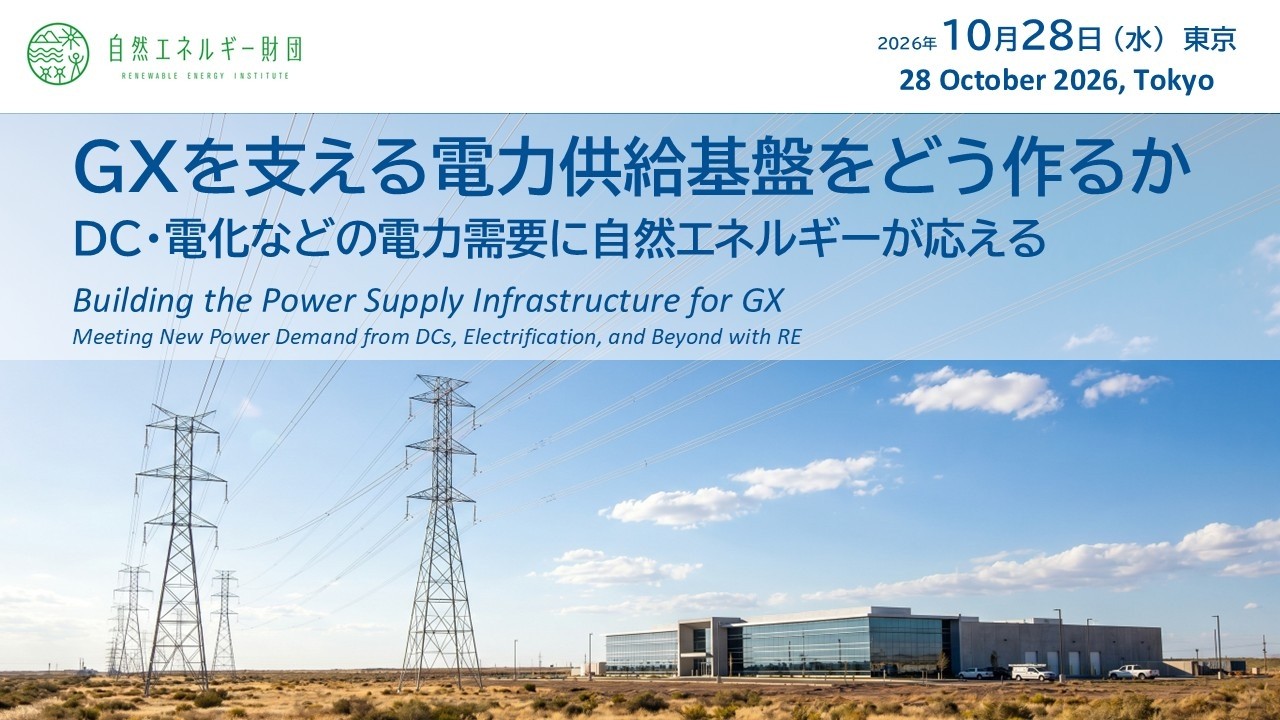
OCT26_Building the Power Supply Infrastructure for GX (data centers, Electrification, and more w/ RE
Title history
- OCT26_Building the Power Supply Infrastructure for GX (data centers, Electrification, and more w/ RE — observed on 20261105-0236 UTC (YouTube)
Keywords
Summary
147 words
Critical Evaluation
Value of the Information & Strength of the Argument
The value of the content lies in its combination of strategic vision with concrete technical and economic considerations. Komiyama’s backcasting approach provides a coherent pathway to a renewable-dominant system, supported by quantitative estimates for solar potential, hydrogen costs, and grid balancing. The argumentation is logically structured, linking energy, food security, and self-sufficiency. Panel discussions offer diverse perspectives, though some claims lack peer-reviewed backing. The presentation of interconnector incentives adds a crucial policy dimension, arguing for market mechanisms to facilitate renewable deployment. Overall, the reasoning is robust, drawing on expert knowledge and plausible models, but remains forward-looking and scenario-based.
Scientific Rigor, Source Quality, Title Accuracy
The symposium benefits from the credibility of the Renewable Energy Institute and its expert speakers, including academics and industry leaders. However, specific data points, such as the 80% renewable electricity target and hydrogen cost projections, are not fully referenced in the video, though they likely rely on institutional research. The title accurately reflects the content, focusing on infrastructure for GX. The description provides a link to the event page, which likely includes more detailed sources. No contradictions with established scientific consensus were noted; the discussions align with mainstream energy transition literature. While not formally peer-reviewed, the presentations are rigorous and well-argued, making the video a valuable resource for understanding Japan’s energy policy challenges.
226 words
Title / Content Match
The title accurately reflects the symposium's focus on building power supply infrastructure for GX, covering data centers, electrification, and renewable energy.
Quality & Reliability
8/10
The video features expert presentations from a reputable research institute, with data-driven scenarios and policy discussions. However, some projections are necessarily speculative, and the format is a symposium, not peer-reviewed research. Overall high reliability but with caveats.
Key Moments
Markers derived by PSI from the transcript: the creator did not define chapters.
- Welcome and opening remarks by Masaya Ishida.
- Keynote by Hiroshi Komiyama on Energy Vision 2050.
- Discussion of solar sharing (agrivoltaics) potential.
- Cost projections for hydrogen and electrolyzers.
- Seiichiro Kimura's presentation on interconnector investment incentives.
- Panel discussion with experts on meeting electricity demand.
Cited Sources
- Event page: Building the Power Supply Infrastructure for GX — Organizer's page with event details and links to presentation materials.
Contribution & Novelties
The symposium provides a forward-looking analysis of Japan’s energy infrastructure needs, integrating policy, technology, and economics. It introduces the concept of agrivoltaics as a key component of solar expansion, with quantitative estimates for increased self-sufficiency. The backcasting methodology offers a plausible pathway to an 80% renewable electricity system. The discussion on interconnector incentives highlights a lesser-known policy mechanism. The contribution is original in synthesizing these elements for Japan’s specific context.
Pour aller plus loin :
- Agrivoltaics — Pertinent for understanding solar sharing potential.
- Demand response — Relevant to the grid balancing strategies discussed.
- Green transformation — Context for the GX policy in Japan.
- Hydrogen economy — For hydrogen storage and cost projections.
112 words
Radar Profile
The radar profile shows strong performance in information quantity and reliability, with moderately high technical level. The content is rich and authoritative, though technical depth is limited by the policy-oriented format. The balance between breadth and depth is well managed, leading to a high overall evaluation.