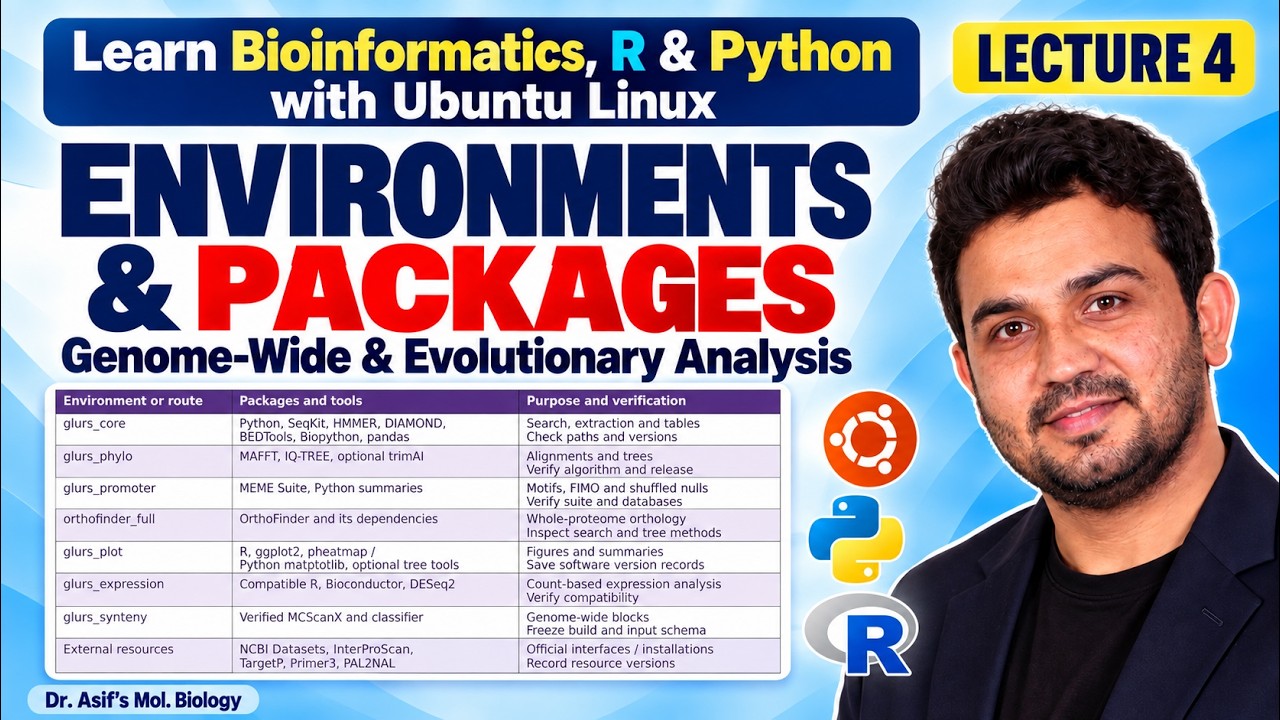
Understanding Bioinformatics Environments & Packages for Genome wide analysis | Lecture_4
Keywords
Summary
143 words
Critical Evaluation
Value of the Information & Strength of the Argument
The video offers practical value by demystifying software environments and package management, a critical skill for reproducible bioinformatics research. The analogical explanation (building manager, rooms, equipment) effectively makes abstract concepts tangible. The argumentation is largely based on personal experience and practical demonstration rather than formal evidence, which is acceptable for a tutorial but limits its scientific weight. The instructor reinforces learning by linking tools to specific bioinformatics tasks (e.g., MAFFT for alignment, IQ-TREE for phylogeny) and encourages the use of AI assistants to lower the barrier to entry. The reasoning is coherent and structured, though occasionally repetitive.
Scientific Rigor, Source Quality, Title Accuracy
The video does not cite external sources or literature; it is a pedagogical presentation based on the author’s expertise. The scientific rigor is moderate: concepts are correctly explained, but no verification or references are provided. The title precisely matches the content, describing an introduction to environments and packages for genome-wide analysis. The lack of formal citations means viewers should cross-check details with official documentation, but the explanations are consistent with standard bioinformatics practice. No comments were provided for analysis.
191 words
Title / Content Match
The title accurately reflects the content, as the video explains software environments, packages, and tools relevant to genome-wide analysis.
Quality & Reliability
6/10
The video provides clear and accessible explanations of bioinformatics environments and package management, using analogies and practical examples. However, it lacks formal citations and relies on personal experience, which limits its scientific rigor. The content is generally accurate and suitable for beginners.
Key Moments
Markers derived by PSI from the transcript: the creator did not define chapters.
- Introduction and learning objectives
- Explanation of software environments with building analogy
- Definition of Conda, environments, packages, and dependencies
- Explanation of sudo apt install and common commands
- Demonstration of creating and managing Conda environments
- Introduction to common bioinformatics tools (MAFFT, IQ-TREE, etc.)
- Usage of head, grep, and echo commands and final advice
Contribution & Novelties
The video’s original contribution lies in its accessible explanation of environment and package management specifically for bioinformatics, using a clear analogy and practical examples. It integrates the use of AI tools like ChatGPT to facilitate command generation, which is a modern approach for non-specialists. The presentation also bridges theoretical concepts with concrete workflows for genome-wide and evolutionary analyses.
Pour aller plus loin :
- Conda Documentation — Official reference for Conda commands and environment management.
- Bioconda — Repository of bioinformatics packages installable via Conda.
- Bioconductor — R-based package ecosystem for bioinformatics.
- Windows Subsystem for Linux (WSL) — Official guide for running Linux environments on Windows, relevant to the course’s setup.
109 words
Radar Profile
The radar profile shows moderate scores across all dimensions, indicating a balanced yet introductory resource. Technical depth and information quantity are relatively higher than reliability, reflecting the tutorial's practical nature but lack of formal sourcing.