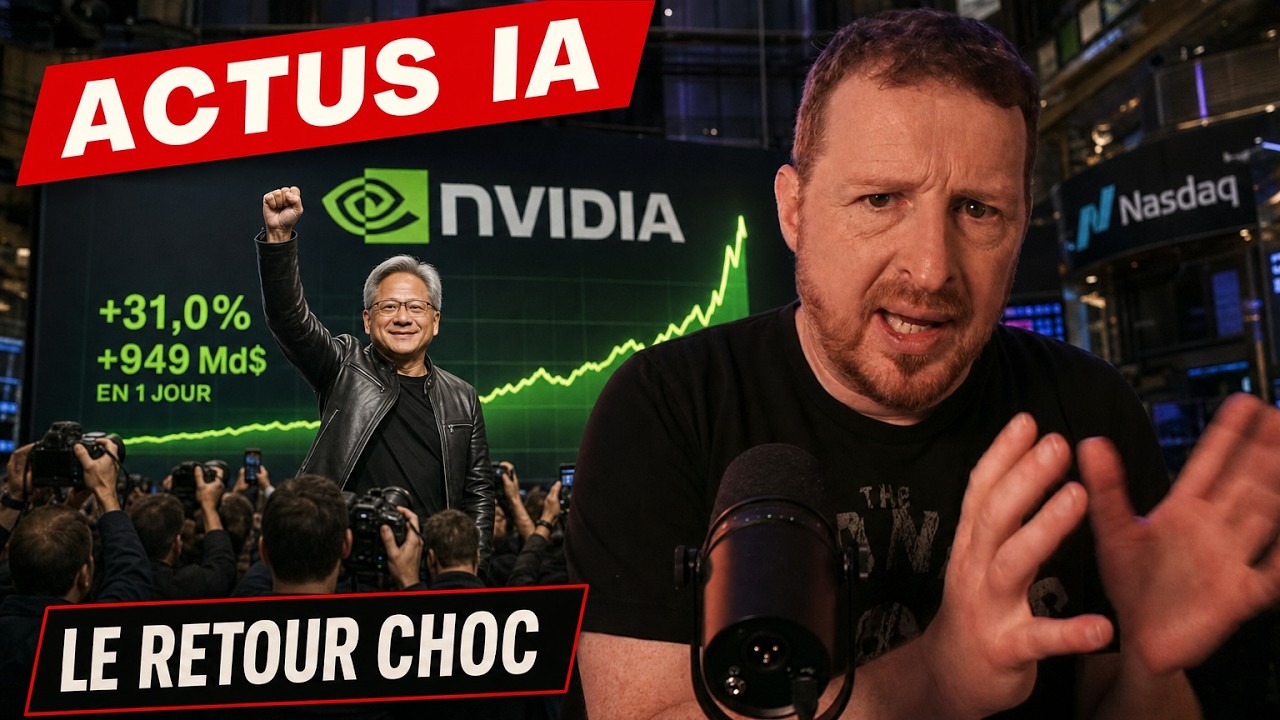
Jensen is back, la Super-Intelligence aussi ! L'actu IA est dingue
Jensen is back, and so is Superintelligence! The AI news is crazy
Keywords
Summary
288 words
Critical Evaluation
Value of the Information & Strength of the Argument
The informational value lies mainly in the framing rather than in the facts: the video gives a readable map of the live debates of the moment — whether machine-checked formal proofs constitute mathematical discovery, whether benchmark-style stunts by labs bypass peer review, whether agentic tools should be allowed to validate developers’ work, and how dual-use commercial robotics ends up on a battlefield. On the first point, the explanation of the Lean workflow is genuinely useful: the distinction between a natural-language proof, a formalised translation and a kernel that either accepts or rejects a file is the correct axis for judging such announcements, and the presenter correctly notes that acceptance by a kernel is not the same as acceptance by the mathematical community. The argumentation, however, is weak. It proceeds by assertion and anecdote: unnamed model versions, no preprint, no repository, no institutional statement, no date of the alleged announcement beyond ‘a few days ago’. The narrative repeatedly undercuts itself — the presenter states that the author of the proof called it partly a joke, then concludes a few sentences later that the hypothesis ‘has indeed been fully proven’ — and the resolution of this contradiction is delegated to the audience (‘correct me in the comments’). Causal claims about the Nvidia share price are supported only by a screenshot described orally, with no figures, dates or data source, and the market explanation mixes corporate governance, national security and personal scandal without separating what is documented from what is rumour. The super-intelligence chain of reasoning is a classic slippery slope: a contested mathematical result is treated as established, then used to infer recursive self-improvement, then loss of control, with no intermediate evidence. The strongest passages are the ones where the presenter inserts his own caveats, admits he does not master the mathematics, and recommends that viewers check for themselves; the weakest are those where rhetorical momentum replaces verification.
Scientific Rigor, Source Quality, Title Accuracy
Scientific rigour is the main casualty of the format. Two of the five items rest on claims that would be extraordinary if true — the removal and reinstatement of the CEO of the world’s most valuable chip company, and a proof of a Millennium Prize problem — and neither is supported by a single named, checkable reference: no board statement, no filing, no press release, no arXiv identifier, no Lean repository, no author name spelled consistently. The presenter does name the mathematician involved and refers to his posts on X, which is at least a traceable pointer, but he does not reproduce or link them, and the audience is asked to trust an oral summary of a document running to six figures of pages. The treatment of the Lean verification is the most substantive part of the video and also the most over-interpreted: kernel acceptance is presented as proof of mathematical truth, when it only certifies that the formal statements follow from the formal axioms as encoded, which leaves entirely open the correctness of the encoding and of the statement being formalised. Source quality is further weakened by the absence of any linked documentation in the description beyond the creator’s own website and paid community, and by a brief self-promotional passage for that community around the introduction, the presence of which does not affect the rating. The ad-equacy between title and content is acceptable: the announced return of Jensen Huang and the super-intelligence angle do structure the opening and the longest segment, even if the remaining items are only loosely covered by the catch-all headline. On methodology, the video is a commentary format, not a verification format, and it should be read as such.
615 words
Title / Content Match
The title announces Jensen Huang's return and a super-intelligence angle, both of which are indeed the opening and the red thread of the second segment; the remaining three topics are only loosely covered by the catch-all 'the AI news is wild'.
Quality & Reliability
2/10
The video strings together five news items of which the two most developed are presented as extraordinary scoops, yet both rest on claims the presenter never corroborates: Jensen Huang's resignation and reinstatement at Nvidia, and a Lean-verified proof of the Riemann hypothesis by Anthropic's Claude. The presenter himself concedes mid-segment that the mathematician behind the proof described large parts of the work as a joke, yet he keeps asserting that the proof 'holds' because it compiled, without any published reference, preprint, institutional statement or named model version. No external source is linked in the description beyond the creator's own website and paid community. The underlying topics are real (Lean proof assistants, open-weight local models, militarised commercial robots, AI-assisted coding review), but the factual layer is essentially unverifiable and partly self-contradictory, which places the note in the low-reliability band.
Chapters
Cited Sources
- Renaud Dékode — creator's website — Only non-promotional external link given in the description; it points to the creator's own platform, not to any document supporting the claims made in the video.
Concurring Sources
- Lean (proof assistant) — Confirms that the video's description of the tooling is broadly accurate: Lean is a real interactive theorem prover whose kernel checks formal proofs, and it is genuinely used for large-scale formalisation projects.
- Yann LeCun — Corroborates the video's summary of LeCun's long-standing position that autoregressive language models alone are insufficient and that world models are needed.
- AI safety — Provides the general frame — loss of control, oversight, governance timing — within which the reactions quoted in the second segment are usually discussed.
Dissenting Sources
- Riemann hypothesis — The reference page records the hypothesis as still unresolved and lists no accepted proof; no verified formal proof by Anthropic, by the named mathematician, or by any other group is recorded. The video's central assertion is therefore contradicted by the standard reference summary of the problem.
- Nvidia — The documented corporate history contains no resignation and reinstatement of Jensen Huang, and no event matching the described 31% single-day surge; the narrative presented in the opening segment is not corroborated by any standard account of the company.
External References
Contribution & Novelties
The video’s real contribution is pedagogical rather than factual: it takes a highly technical verification pipeline — an LLM producing a candidate proof, the proof being translated into a formal language, and a kernel deciding whether it compiles — and explains its logic in plain language. That framing is the most transferable idea in the episode, because it gives viewers a concrete criterion (was the statement formalised and kernel-checked, and by whom?) to apply to the next wave of ‘AI solved a famous problem’ announcements. The other useful thread is the discussion of verification authority in software: if a model reviews and approves changes to code, the question shifts from model capability to who is accountable when the approval is wrong. The segments on dual-use commercial robotics and on open-weight models running offline on consumer hardware point at two structural trends worth following. What the video does not supply is any primary material, so the novelty is interpretive, not evidential.
Pour aller plus loin :
- Riemann hypothesis — Reference page on the Millennium Prize problem at the centre of the second segment; it records the hypothesis as open, which is the baseline against which the video’s claim must be judged.
- Lean (proof assistant) — Explains what a formal proof assistant and its kernel actually certify, and therefore what ‘it compiled’ does and does not prove.
- Yann LeCun — Background on the world-model versus LLM-scaling argument that the video summarises in its closing discussion of the second item.
- AI safety — Context for the loss-of-control and governance questions raised through the quoted reactions of Meta’s Alexandr Wang and Elon Musk.
- Formalised mathematics and the gap between kernel acceptance and community acceptance — a concept worth reading up on directly, cited here by name rather than by a guessed address.
298 words
Radar Profile
The profile is broad but shallow: an above-average volume of information spread across five distinct topics, paired with a low technical ceiling because each item is summarised rather than analysed. Quality and reliability sit low for the same reason — the two flagship stories are extraordinary claims delivered without primary evidence — so the radar shows a commentator tracking many threads quickly rather than a channel able to substantiate the ones it elevates.