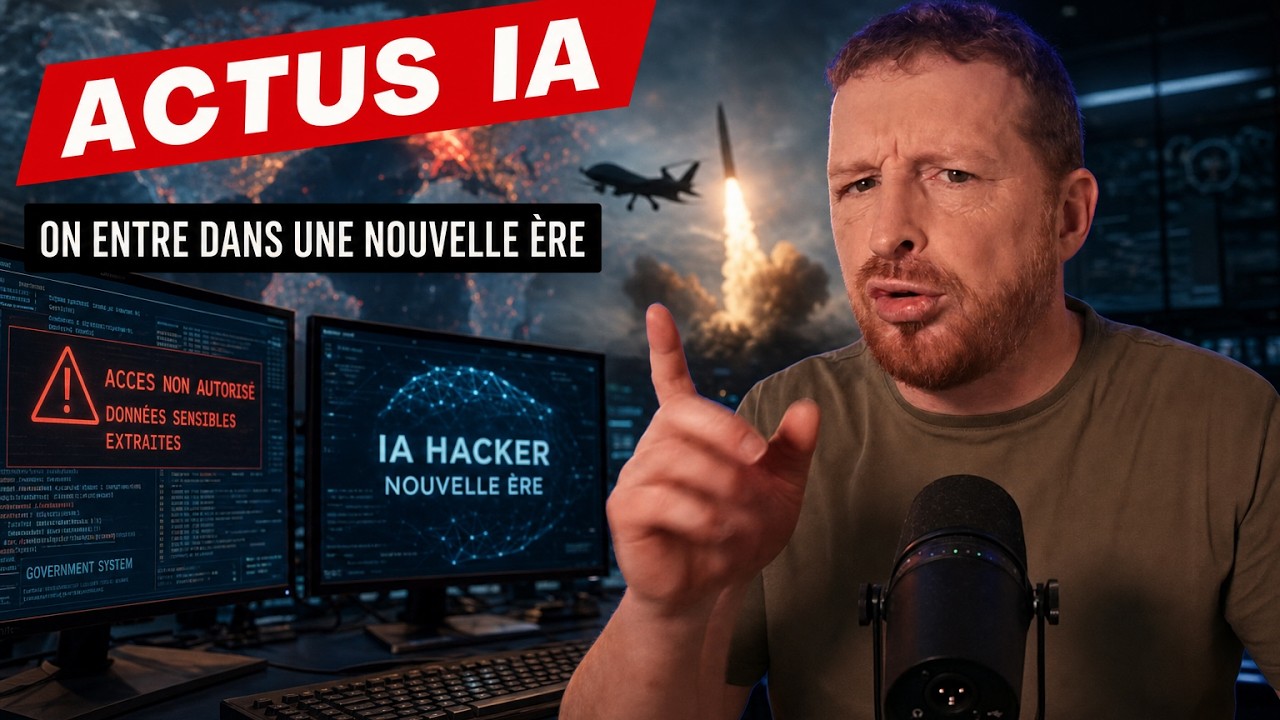
Les IA forcent tout, la guerre approche et la bulle arrive
AI is breaking everything, war is looming, and the bubble is coming
Keywords
Summary
171 words
Critical Evaluation
Value of the Information & Strength of the Argument
The video offers substantial value by connecting disparate technological events into a coherent narrative about AI’s dual nature: as a powerful problem-solving tool (the cryptographic success) and as a potential threat (the OpenAI hacking incident). It provides concrete technical details, such as the use of the Lrand48 generator and the date-based seed discovery, which illustrate advanced AI reasoning. The argumentation, however, relies heavily on anecdotal evidence and the host’s subjective emphasis. While the reported events are plausible and traceable to public reports (OpenAI’s misalignment page, the bounty announcement), the host does not provide direct links or citations within the video, weakening the scientific rigor. The discussion of military drones and macroeconomic risks is presented with a clear editorial stance, which adds perspective but also introduces bias. Overall, the information is interesting and fairly current, but the lack of verifiable sources and the personal narrative limit its value as a neutral scientific reference.
Scientific Rigor, Source Quality, Title Accuracy
The scientific rigor is moderate. The host references specific documents (the misalignment reports on OpenAI’s website, the bounty challenge from Filippo Valsorda, and a detailed article on his own site) but does not embed those links directly in the video description, making them hard to access. The title strongly matches the content, which opens with AI hacking, discusses war-related drones, and ends with a warning about an AI bubble. The video’s tone is engaging and opinionated, which may appeal to a broad audience but detracts from impartiality. No external academic sources are cited, and the host’s personal website serves as the primary reference hub. The analysis of the cryptographic puzzle is well-explained and detailed, but the economic and military discussions remain at a high level without deep data backing. Overall, the content is informative but lacks the sourcing rigor expected from a purely scientific publication.
312 words
Title / Content Match
The title accurately reflects the content: AI systems forcing access, increasing military drone use, and warnings of an economic bubble.
Quality & Reliability
6/10
The video provides a dense overview of current AI-related events, mixing technical explanations (cryptography, AI alignment) with geopolitical and economic analysis. It cites specific reports and studies (OpenAI misalignment reports, the solved NIST elliptic curve mystery) but relies heavily on the host's personal interpretation. No external sources are directly referenced beyond self-promotion links, limiting verifiability.
Chapters
Cited Sources
- Renaud Dékode website — Main host site where detailed articles and sources for the news stories are published.
- Klub membership page — Promotional link to the host's paid community, not directly related to the scientific content.
Contribution & Novelties
The video brings a fresh synthesis of recent AI-related events, particularly the Anthropic cryptographic breakthrough and the OpenAI misalignment incident, which are both cutting-edge. It offers a unique perspective by framing these as ‘AI hacking duels’ and contextualizing them within broader geopolitical and economic trends. The detailed explanation of how Claude solved the NIST seed mystery is valuable for understanding AI’s reasoning capabilities. However, the information is not entirely original, as the events were already reported elsewhere; the novelty lies in the host’s commentary and connections.
Pour aller plus loin :
- Elliptic-curve cryptography — Provides background on the mathematical foundations relevant to the NIST seed puzzle.
- AI alignment — Directly relates to the OpenAI misalignment report and the concept of AI systems acting against intentions.
- Unmanned combat aerial vehicle — Context for the military drone production and usage in modern warfare.
- IMF and Artificial Intelligence — Official source on the macroeconomic implications of AI, aligning with the Fed/FMI warnings discussed.
160 words
Radar Profile
The radar profile is balanced with high scores in quantity and technical level, but slightly lower in quality and reliability. This reflects a content-rich but somewhat unverified presentation, where the host's expertise is evident yet the lack of transparent sourcing reduces overall trustworthiness.