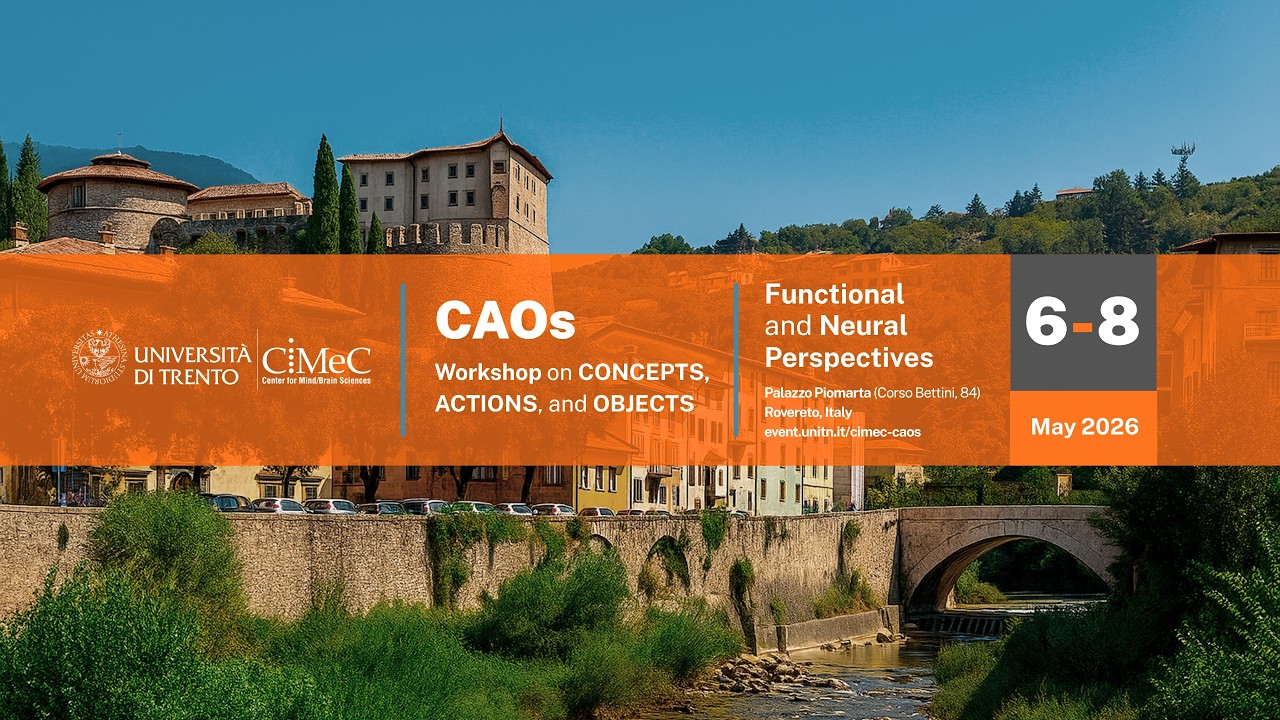
CAOS 2026 - Part 1 | Rovereto, 6 - 8 May | Domenica Bueti
Keywords
Summary
150 words
Critical Evaluation
Value of the Information & Strength of the Argument
The talk provides valuable insights into the neural basis of time perception, advancing the argument that time coding is multi-staged and begins at sensory levels. The argumentation is solid, supported by complementary psychophysical and neuroimaging data. The speaker logically builds from behavioral biases to neural models, carefully interpreting pRF results and acknowledging the complexity of the transition zones. The emphasis on linking sensory features (contrast, speed) to time judgments and then mapping them to neural selectivities offers a compelling framework. The research addresses a fundamental question in perception and contributes to refining models of temporal processing.
Scientific Rigor, Source Quality, Title Accuracy
The talk references several previous studies and includes appropriate citations, though no explicit URLs are provided in the talk itself. The workshop description provides a link to the event site, which is included. The scientific rigor is high: the methods (7T fMRI, pRF modeling) are state-of-the-art, and the results are carefully quantified. The title adequacy is acceptable but generic; the actual talk title from the description better reflects the content. The video is technically well-produced, with clear slides and presentation.
191 words
Title / Content Match
The video title indicates the workshop and speaker, while the actual talk title in the description specifies the scientific topic. The content matches the talk title well.
Quality & Reliability
8/10
The talk presents original research with clear methodology, references previous studies, and uses rigorous neuroimaging and psychophysical approaches. The speaker is an established researcher in time perception.
Key Moments
Markers derived by PSI from the transcript: the creator did not define chapters.
- Introduction by organizer, workshop format explanation.
- Bueti starts her talk, outlines main messages.
- Presentation of first study on contrast and time perception (Anna Tomapani).
- Second study on speed and time perception (Francesca).
- Transition to second part: relationship between sensory coding and time coding.
- fMRI study design and pRF modeling, presentation of results.
- Discussion of hierarchy and selectivity to space/time across cortical areas.
Cited Sources
- CIMeC CAOS Workshop — Workshop website with talk details and program.
Contribution & Novelties
The talk presents original findings from ongoing research, particularly the use of pRF modeling to simultaneously assess spatial and temporal selectivity. This approach reveals a distinct gradient in how space and time are coded across the visual hierarchy, with early visual cortex showing space-dependent monotonic responses and frontal areas showing time-tuned Gaussian responses. The identification of intermediate zones (e.g., IPS) where both dimensions and transitions interplay offers a fresh perspective on temporal processing. The psychophysical data also reinforce the influence of low-level features on time perception, suggesting a sensory grounding.
Pour aller plus loin :
- Time perception - Wikipedia — Overview of the field and key concepts.
- Population receptive field - Wikipedia — Explanation of pRF modeling technique.
- Neural timekeeping - PMC — Neuroscience review on timekeeping mechanisms.
128 words
Radar Profile
The radar profile shows high scores in quality and reliability, with good information quantity and technical level. The strength lies in the strong argumentation and neuroscientific rigor, while the lower quantity score reflects the focused scope of the talk, which is appropriate for a workshop presentation.