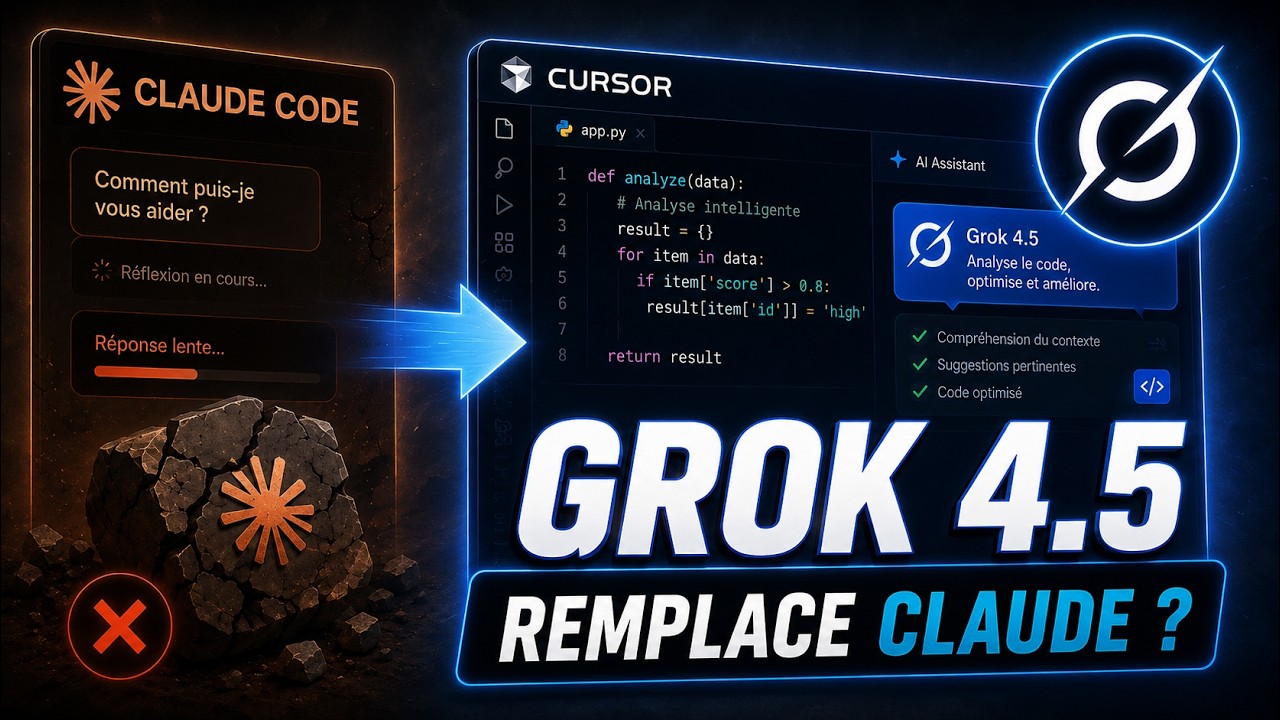
J’ai remplacé Claude Code par Grok 4.5 dans Cursor
I replaced Claude Code with Grok 4.5 in Cursor
Title history
- J’ai remplacé Claude Code par Grok 4.5 dans Cursor — observed on 20261110-0254 UTC (YouTube)
Keywords
Summary
202 words
Critical Evaluation
Value of the Information & Strength of the Argument
The video provides a genuine, hands‑on assessment of Grok 4.5, going beyond vendor claims. The author tests the model on a realistic development task with a well‑defined issue, giving concrete evidence of its capabilities and limitations. He explains the benchmarking pitfalls, such as the difference between model-only and model+agent evaluations, and highlights the cost savings as a major advantage. The argumentation is clear and structured: he compares official benchmarks, analyses the pricing, shows the setup process, and then demonstrates a complete workflow from planning to pull request. His personal workflow (using multiple AIs interchangeably) adds practical context. However, the evaluation is subjective and covers only one type of task (a moderately simple front‑end change); more demanding projects might reveal different results. The video would be stronger with a more rigorous methodology, e.g., comparing multiple attempts or including error cases.
Scientific Rigor, Source Quality, Title Accuracy
The video relies primarily on the official xAI blog post for benchmarks and pricing, which are vendor‑provided and therefore not independent. The author cites the blog and the Grok Build website but does not point to third‑party evaluations. The open‑source code is the author’s own project, available on GitHub, which reinforces transparency. The title accurately matches the content: it is indeed about replacing Claude Code with Grok 4.5 in Cursor. The reviewer’s own experience is consistent with the official claims, but the lack of external verification is a minor weakness. The video would benefit from citing independent benchmark analyses (e.g., from AI research groups) and addressing potential criticisms from the community. Overall, the source quality is acceptable for an opinion/test video, but not sufficient for a rigorous scientific assessment.
283 words
Title / Content Match
The title accurately reflects the video: the author tests Grok 4.5 as a direct replacement for Claude Code in the Cursor IDE.
Quality & Reliability
7/10
The review is based on a real‑world test on an open‑source project, but the presented benchmarks come directly from the vendor's blog, introducing potential bias. The author is transparent about his subjective experience and usage costs.
Key Moments
Markers derived by PSI from the transcript: the creator did not define chapters.
- Introduction: Grok 4.5 released on July 16, 2026, and the video's purpose to test it in Cursor.
- Review of benchmark results from the xAI blog: DeepSWE, SWE-Marathon, Terminal-Bench 2.0, and SWE-Bench Pro.
- Discussion on speed (80 tokens/s) and token efficiency – Grok claims 4x lower token consumption than Opus 4.8.
- Pricing comparison: Grok 4.5 at $2/$6 per million tokens vs Claude Opus at $5/$25, making it up to 4x cheaper.
- Announcement of Grok Build being open‑source (written in Rust) and quick installation demo.
- Configuration and integration with existing .adjinns skills and MCP servers in the home directory.
- Testing Grok 4.5 inside Cursor: selecting the model, enabling Fast mode, and checking usage meter.
- Planning phase: presenting the GitHub issue and letting Grok generate a plan to add Tailwind style abstraction.
- Implementation and live coding – watching Grok modify files and create branches; results verified in the browser.
- Creating the pull request and final summary: expected usage cost (1% of Cursor quota) and overall satisfaction.
Cited Sources
- Grok 4.5 announcement on xAI — Official blog post presenting the new model, benchmarks, and features.
- Grok Build — Official site for the open‑source terminal agent compatible with Grok models.
- UX DataTables repository — The open‑source Symfony bundle used for the live test; the GitHub issue resolved in the video.
External References
Contribution & Novelties
The video offers a practical, real‑world evaluation of Grok 4.5 in a development environment, which is more convincing than raw benchmarks. The creator demonstrates a complete workflow – from planning to code review – on an actual open‑source issue, providing concrete evidence of the model’s strengths (speed, cost, correctness) and its integration with Cursor and existing tools. The highlight is the low resource consumption (1% of usage) and the ability to produce a mergeable pull request autonomously. This kind of hands‑on feedback is valuable for developers considering a switch, as it goes beyond synthetic tests.
Pour aller plus loin :
- Grok (chatbot) – Wikipedia — For background on the xAI chatbot family.
- SWE-bench — The widely cited benchmark for coding agents, which the video references indirectly.
- Cursor IDE — The AI‑powered editor used in the video; official site for features and pricing.
- Claude Code – Anthropic — The reference tool that Grok 4.5 is compared against.
156 words
Radar Profile
The radar profile shows a well‑balanced video: a good amount of information (8/10) with accurate practical details, moderate technical depth (7/10) suitable for intermediate developers, and a reliability score (7/10) reflecting a subjective but honest test. The quality of information (7/10) is slightly below the quantity because the data partially stems from vendor claims. Overall, the video is a strong practical addition to the AI coding discourse.