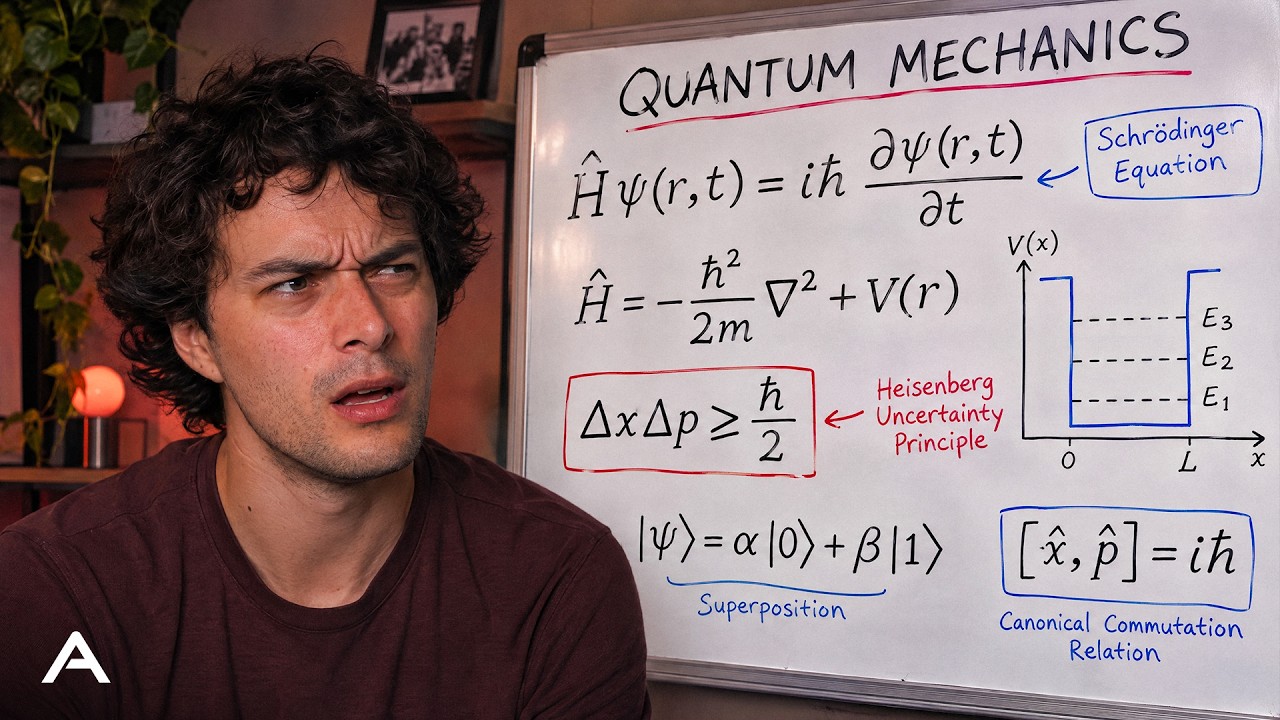
Once you understand quantum mechanics, you understand reality
Keywords
Summary
205 words
Critical Evaluation
Value of the Information & Strength of the Argument
The informational value is high for a general-audience treatment. The video does not settle for a list of curiosities: it builds a single causal chain in which each breakdown of classical physics creates the next problem, and each quantum rule is introduced as the solution to a concrete failure. The chain Planck → Bohr → Pauli → Dyson-Lenard → tunnelling → chemical bonding → cosmology is broadly the correct historical and logical spine of the field, and it is rare to see the stability-of-matter result and the fusion lottery presented as consequences of the same formalism. The dates and attributions are dense and mostly correct, and the video is honest where certainty is lacking, notably on inflation’s missing gravitational-wave signature and on the fact that the three interpretations are empirically indistinguishable.
The argumentative technique rests almost entirely on analogy, and the analogies are uneven. The dinner-party image for the equipartition of energy across modes is an effective way to make the ultraviolet catastrophe feel inevitable rather than absurd. The deflated balloon for inflationary stretching of quantum fluctuations, the two gloves for EPR, and the cookie jars for Bell’s inequality all do real work and are correctly mapped. The rolling-ball-up-a-hill image for tunnelling is the weakest, since it silently replaces a probabilistic amplitude with a rare event and gives no sense of exponential suppression with barrier width; the ‘you are held together by uncertainty’ formulation compresses the virial/kinetic-energy argument into a slogan that survives only as long as nobody asks what ‘jitter’ costs in energy.
The final five minutes shift register. The physics establishes that nature is probabilistic at the microscopic level; the conclusion that ‘maybe you don’t need certainty’ is a moral inference about human psychology that the preceding content does not support and does not attempt to argue. It is a legitimate essayistic move, but it should be read as the author’s framing rather than as a result of the science presented. Between these two poles the exposition is disciplined, keeps the mathematics out as announced, and never over-claims experimental confirmation beyond what the cited history shows.
Scientific Rigor, Source Quality, Title Accuracy
The scientific content is handled with genuine care for attribution. Named results are attached to the people and years that produced them, and the video distinguishes clearly between what is experimentally settled (Bell tests, the 2022 Nobel Prize, the CMB anisotropies) and what is not (inflation without primordial gravitational waves, the measurement problem). It also pre-empts a common misunderstanding by specifying that ‘measurement’ in physics means interaction with an apparatus or another particle, not observation by a mind — a point frequently muddled in popular treatments.
The source apparatus, however, is essentially absent. Nothing is cited on screen, the description contains only a sponsor link, and no paper, preprint, textbook or institutional page is referenced. The 2025 survey of more than a thousand researchers is quoted with precise percentages (36 % Copenhagen, 15 % many-worlds, 7 % pilot wave) but without the study’s name, authors or methodology, so a viewer cannot check whether the sample was representative or self-selected. The Klinman enzyme-tunnelling work, the 2021 cryptochrome-4 result and the Dyson-Lenard calculation are described accurately in substance but left untraceable. Several quantitative claims are approximations presented as facts: the classical collapse time for a Rutherford atom (given as ‘a hundred billionths of a second’, roughly three orders of magnitude away from the standard estimate), the classical fusion threshold of 11 billion degrees, and the ’equal share’ rule as the whole of classical equipartition. The compression of the interpretation landscape into three options omits relational and QBist approaches, which are presented as if the list were exhaustive.
On title and content: the video does what the title advertises in the sense of a guided conceptual tour, but the title’s promise of understanding ‘reality’ is delivered as a rhetorical payoff rather than a demonstrated result.
655 words
Title / Content Match
The title promises a strong epistemic payoff ('you understand reality'), and the video does deliver a coherent tour from determinism to the measurement problem, closing on an existential moral; the final philosophical claim is asserted rather than argued, so the title slightly overreaches what the content establishes.
Quality & Reliability
7/10
The historical and physical content is broadly accurate and correctly dated: Le Verrier and Galle (1846), Planck's October and December 1900 papers, Rutherford (1911), Bohr (1913), Pauli's exclusion principle (1925), Heitler-London (1927), Atkinson-Houtermans (1929), the EPR paper (1935), Everett (1957), Bell (1964), the Dyson-Lenard stability-of-matter result (1967), Klinman's enzyme tunnelling work (1989), COBE's 1992 anisotropy detection, the 2022 Nobel Prize. No source is cited on screen or in the description, and several quantitative statements are loose or simplified (the classical lifetime of a Rutherford atom, the classical fusion temperature threshold, the reduction of Pauli's principle to 'two electrons per step', the compression of the measurement problem into three named 'interpretations'). The 2025 survey of researchers is reported without naming the study, its sample or its methodology. Popularisation of good factual quality, therefore, but without traceable references.
Chapters
Cited Sources
- Einstein, Podolsky & Rosen, 'Can Quantum-Mechanical Description of Physical Reality Be Considered Complete?' (Physical Review, 1935) — The EPR argument is presented in the video as Einstein's challenge to the completeness of quantum mechanics, illustrated by the split pair of gloves.
- Bell, 'On the Einstein Podolsky Rosen Paradox' (1964) — Introduced as the step that turned Einstein's philosophical objection into a laboratory-testable inequality.
- Nobel Prize in Physics 2022 — Clauser, Aspect, Zeilinger — Cited at the end of the Bell-test sequence as the official recognition of the entanglement experiments.
- Dyson & Lenard, 'Stability of Matter I' (Journal of Mathematical Physics, 1967) — Invoked for the claim that ordinary matter would collapse without the Pauli exclusion principle, with Dyson's comparison to an atomic-bomb-scale energy release.
- Heitler & London (1927) on the quantum-mechanical origin of the covalent bond — Presented as the calculation showing why two hydrogen atoms bond and two helium atoms do not, grounding chemistry in quantum rules.
- Atkinson & Houtermans (1929) on quantum tunnelling and stellar fusion — Used to explain how the Sun fuses hydrogen at a core temperature far below the classical threshold.
- Klinman and colleagues (1989) on hydrogen tunnelling in enzymatic reactions — Brought in as evidence that quantum tunnelling operates inside living organisms, not only in stars.
- Xu et al. (2021) on cryptochrome 4 and magnetic-field sensitivity in the European robin — Cited as the leading candidate mechanism for avian magnetoreception.
- COBE satellite anisotropy detection (1992) and the cosmic microwave background — Used to introduce the temperature ripples later attributed to stretched quantum fluctuations under inflation.
- 2025 survey of researchers on interpretations of quantum mechanics (unnamed in the video) — Quoted for the percentages 36 % Copenhagen, 15 % many-worlds, 7 % pilot wave; the study itself is not identified, so it cannot be checked.
Concurring Sources
- Quantum mechanics (Wikipedia) — General overview consistent with the video's treatment of quantisation, uncertainty, entanglement and the measurement problem.
- Ultraviolet catastrophe (Wikipedia) — Corroborates the historical sequence of the black-body problem and Planck's 1900 quantisation of energy exchange.
- Pauli exclusion principle (Wikipedia) — Supports the claim that the exclusion principle underlies the spatial extension of matter and the stability of white dwarfs.
- Copenhagen interpretation (Wikipedia) — Matches the description of the Bohr-Heisenberg interpretation as the historically dominant teaching framework.
Dissenting Sources
- Critiques of the 'three interpretations' framing in philosophy of physics — Presenting Copenhagen, many-worlds and pilot-wave as the three main answers, all matching every experiment, omits relational, QBist and objective-collapse approaches; specialists would also contest the claim that these options are empirically indistinguishable in principle, since collapse models make testable predictions.
- Reservations on the 'held together by uncertainty' formulation — The stability of the atom follows from the kinetic-energy cost of localisation, usually derived from the uncertainty relation but strictly a consequence of the wave nature of the electron; the popular shorthand 'you are held together by uncertainty' is defensible as pedagogy but not as a physical statement, and the video does not flag the simplification.
- Methodological caveat on the 2025 survey quoted in the video — Percentages from a voluntary survey of researchers are reported without sample size for each option, response rate or selection effects, so they should not be read as a measurement of consensus among physicists.
External References
Radar Profile
The profile is that of a well-researched popularisation: information density and reliability are strong, driven by correct dating and correct causal linking of results, while the technical level stays deliberately moderate because the mathematics is excluded by design. Quality sits just below quantity, reflecting accurate content presented through uneven analogies and without citable references, which caps overall reliability despite the absence of any serious factual error.