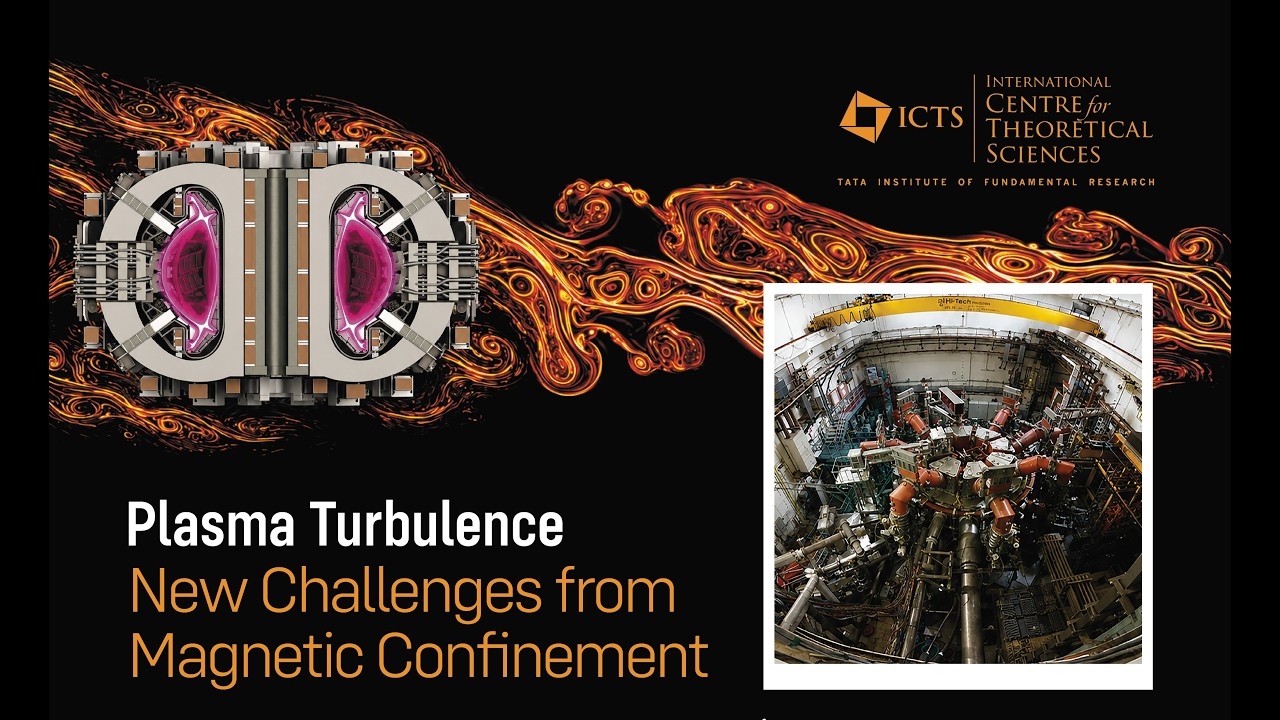
Recent Progress in Understanding Electromagnetic Turbulence in Conceptual..... by Colin Roach
Keywords
Summary
149 words
Critical Evaluation
Value of the Information & Strength of the Argument
The talk provides high-value information by synthesizing recent theoretical and computational progress on a critical physics issue for compact fusion devices. The argumentation is solid, grounded in gyrokinetic theory and backed by extensive simulations across multiple codes. The speaker clearly explains the physical mechanisms (e.g., beta threshold for electromagnetic turbulence, beta-prime stabilization) and supports claims with quantitative results. He also acknowledges uncertainties, such as the need for global simulations and the sensitivity to equilibrium parameters, which strengthens the credibility. The presentation is logically structured, moving from fundamentals to specific predictions and implications for STEP.
Scientific Rigor, Source Quality, Title Accuracy
The scientific rigor is high: the talk is based on peer-reviewed publications and state-of-the-art simulation tools. The speaker cites key papers (e.g., Atkins’ analytic work, Kayal’s review) and refers to databases like IPB98(y,2) scaling. The sources used in the description are reputable fusion research programs. The title accurately represents the content, though the ‘…..’ makes it slightly ambiguous. The talk is well-aligned with the title’s promise of ‘recent progress’ and ‘conceptual’ aspects. There is a minor issue: the title might be misinterpreted without the full context, but overall it is adequate.
200 words
Title / Content Match
The title is somewhat truncated ('.....') but accurately reflects the content: a review of recent progress in understanding electromagnetic turbulence in high-beta spherical tokamaks, focusing on the STEP concept. The title is appropriate but could be more explicit.
Quality & Reliability
8/10
Presentation by an expert in plasma physics, based on peer-reviewed research and rigorous gyrokinetic simulations. The talk is well-structured, cites key references, and provides a balanced review of current understanding. Some claims are specific to conceptual designs (STEP) and may evolve with further work.
Key Moments
Markers derived by PSI from the transcript: the creator did not define chapters.
- Introduction and outline of the talk
- Explanation of spherical tokamak geometry and its advantages for high beta
- Derivation of bootstrap fraction and fusion power scaling, emphasizing spherical tokamak benefits
- Theoretical basis for electromagnetic turbulence onset at high beta
- Review of turbulence and transport in existing spherical experiments (MAST, NSTX)
- Introduction of STEP fusion power plant concept and STEP ECD parameters
- Microinstabilities in STEP: hybrid kinetic ballooning modes and microtearing modes
- Nonlinear gyrokinetic simulations showing large heat fluxes and beta dependence
- Mechanisms of beta-prime stabilization and implications for access to high performance
- Role of zonal flows, Maxwell stress, and new reduced transport model
- Conclusions and future priorities
Cited Sources
- ITER website — Mentioned as example of large tokamak collaboration
- EU fusion for energy — Related to ITER program
- LLNL inertial fusion — Reference to laser-driven inertial confinement
- SPARC at CFS — Example of high-field tokamak
- MIT PSFC SPARC — MIT's SPARC program
- Helion Energy — Private fusion company
- MAST-U at UKAEA — UK spherical tokamak
- EAST (China) — Chinese superconducting tokamak
- ICTS program page — Workshop program link
Contribution & Novelties
The talk provides a comprehensive synthesis of recent advances in understanding electromagnetic turbulence in spherical tokamaks, particularly the identification and analysis of hybrid kinetic ballooning modes (KBMs) and microtearing modes in high-beta conditions. It presents novel nonlinear gyrokinetic simulation results showing large heat fluxes and the stabilizing effect of beta prime, and introduces a reduced core transport model enabling physics-based transport predictions for STEP. The discussion of zonal flow and Maxwell stress contributions to turbulence saturation offers deeper insight into saturation mechanisms.
Pour aller plus loin :
- Spherical tokamak — Background on ST concept and advantages.
- Gyrokinetics — Theoretical framework used in simulations.
- Zonal flow (plasma) — Role of flows in turbulence regulation.
- Microtearing instability (if exists) — but I’m not certain, so I’ll mention it without URL.
- ITER — Reference for conventional tokamak approach.
135 words
Radar Profile
The profile shows very high technical level and information quantity, with high quality and reliability scores. The talk is highly specialized, assuming a solid physics background, which is reflected in the radar's strong 'niveau_technique' and 'quantite_information' while 'qualite' and 'fiabilite' are also high but slightly lower due to the conceptual and evolving nature of some results.