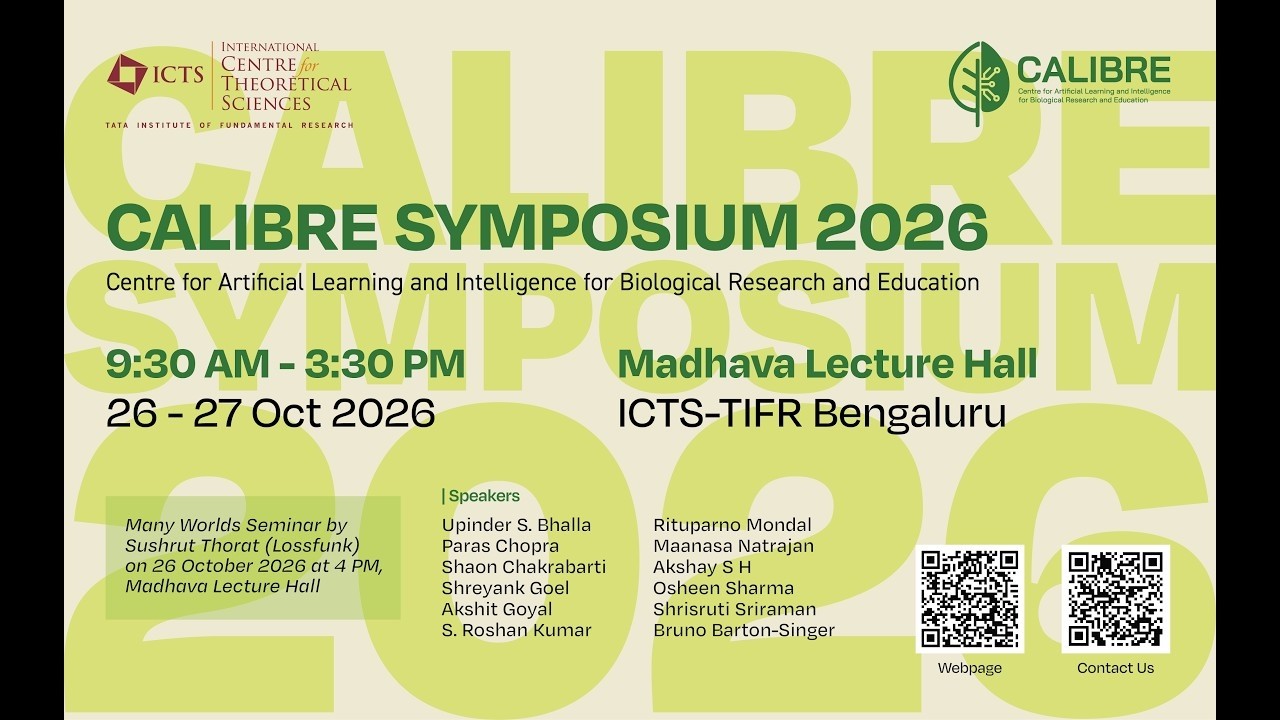
From Cellular Phenotypes to Cell States: Understanding Drug Response Across... by Osheen Sharma
Keywords
Summary
234 words
Critical Evaluation
Value of the Information & Strength of the Argument
The main value of the talk lies in its concrete, end-to-end account of how image-based profiling can be used to study drug response. It connects a broad pharmacological problem, namely the low success rate of drug discovery, to specific experimental choices: co-culture with fibroblasts, drug concentration, staining, segmentation, feature extraction and mechanism-of-action enrichment. The comparison between handcrafted CellProfiler features and deep-learning embeddings is useful because it makes a methodological point that is often glossed over: a model can appear to perform well or poorly depending on whether the input crop contains only the target cell or also its neighbours. The discussion of cell-line-specific morphology and of concentration-dependent effects is also valuable, since it warns against treating all cancer cell lines or all drug doses as interchangeable. The argumentation is generally coherent and the speaker explicitly acknowledges confounding factors such as low-dose subtlety, high-dose toxicity and cell-line variability. Its weakness is that the evidence is presented largely qualitatively. The audience is shown UMAP separations, radar plots and F1-score changes, but not replicate counts, confidence intervals, effect sizes or full statistical models. Several interpretive steps, such as assigning biological meaning to embedding differences or to enrichment scores, are plausible but not fully demonstrated in the talk. The reasoning is therefore strongest as a rationale and workflow description, and weaker as definitive proof of the proposed claims.
Scientific Rigor, Source Quality, Title Accuracy
Scientific rigour is moderate. The speaker describes original experiments and gives enough methodological detail to make the pipeline understandable, including illumination correction, single-cell masking, transfer learning and permutation-based enrichment testing. However, the talk does not cite peer-reviewed articles or preprints for the drug-discovery paradigms, the Cell Painting protocol, the FIMM library, the Proben dataset or the specific biological claims. The only link supplied in the description is the symposium programme, which provides event context rather than scientific substantiation. No information is given about replication, batch effects, plate normalisation or statistical power, although the speaker does mention confounding factors such as concentration and cell-line morphology. The title/content match is good: the presentation is indeed about cellular phenotypes and drug response, and it moves from morphological phenotypes toward cell states and mechanism-of-action inference. The subtitle promises a broader scope than the two main studies deliver, but this is a minor mismatch rather than a substantive problem.
393 words
Title / Content Match
The title accurately announces a talk on cellular phenotypes, cell states and drug response, and the presentation delivers that content. The subtitle is somewhat broader than the specific co-culture and Cell Painting studies actually shown.
Quality & Reliability
6/10
The talk gives a detailed first-hand account of original PhD work, including experimental design, image-analysis pipelines and caveats. However, it cites no peer-reviewed papers, reports few effect sizes or replicate statistics, and several findings are presented as preliminary or unpublished.
Key Moments
Markers derived by PSI from the transcript: the creator did not define chapters.
- Introduction of the speaker, her PhD at Karolinska Institute and her current postdoctoral position at NCBS.
- Overview of the drug-discovery funnel and the three paradigms: target-based, phenotypic and ligand-based discovery.
- Discussion of cancer heterogeneity, tumour microenvironment and why simple viability assays miss important drug-response states.
- Explanation of image-based profiling and chemistry-based profiling, including their complementary strengths and knowledge gaps.
- Design of the co-culture study: 528 oncology drugs at five concentrations, cancer cell lines and fibroblast co-cultures.
- Imaging and feature-extraction pipeline using CellProfiler, EfficientNet embeddings and mechanism-of-action enrichment.
- Results on fibroblast influence over cancer-cell morphology, drug sensitivity and cell-line-specific responses.
- Second study using Cell Painting, six dyes, 364 curated drugs and analysis of data-splitting and seeding-density effects.
- Drug-library curation from large compound datasets down to a single-target, higher-activity set for wet-lab screening.
Cited Sources
- CALIBRE Symposium 2026 programme — Official event page linked in the video description; gives the symposium context and programme.
- FIMM drug library — Mentioned as the source of 528 oncology-approved drugs screened at five concentrations in the co-culture study.
- CellProfiler — Open-source image-analysis software mentioned as the handcrafted-feature benchmark for morphological profiling.
- Cell Painting protocol (Broad Institute) — Mentioned as the six-dye morphological profiling protocol used in the second study.
- Proben drug dataset — Mentioned as one of the large compound datasets used for drug-library curation.
Contribution & Novelties
The talk’s originality lies in combining co-culture experiments with image-based profiling and a direct comparison between handcrafted morphological features and deep-learning embeddings. It shows, with concrete examples, that the apparent performance of a morphological model can depend on whether the input crop includes neighbouring cells, and it links this to mechanism-of-action enrichment across drug concentrations. The second study extends the discussion to Cell Painting, data-splitting strategies, seeding density and library curation, which are practical issues rarely detailed in short research talks. The work is presented as an ongoing research programme rather than a completed consensus, so its main contribution is methodological and exploratory: it maps the choices that affect whether image-based drug-response models recover biologically meaningful mechanisms.
Further reading:
- CellProfiler — Documentation for the open-source image-analysis platform used here for handcrafted morphological features and benchmarking.
- Mechanism of action — Background on the pharmacological concept central to the enrichment analysis discussed in the talk.
- Drug discovery — Context for the target-based, phenotypic and ligand-based paradigms described at the start.
- Cell Painting protocol (Broad Institute), without a stable URL given in the talk — relevant to the six-dye morphological profiling study and its feature-extraction workflow.
193 words
Radar Profile
The profile is skewed toward high information density and technical depth, with lower scores for source quality and reliability. This is consistent with a specialised research seminar that presents original, unpublished work rather than a sourced literature review.