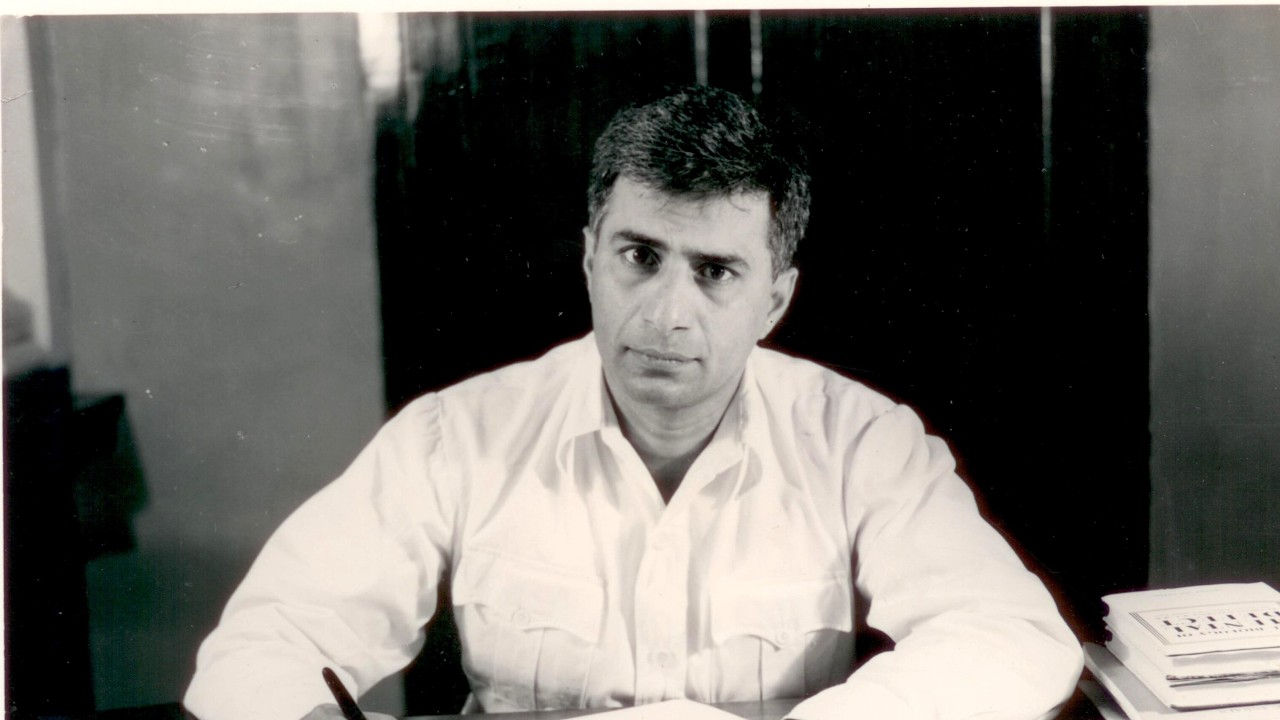
D.D. Kosambi at TIFR, 1945-1962 by Ramakrishna Ramaswamy
Keywords
Summary
209 words
Critical Evaluation
Value of the Information & Strength of the Argument
The value of the information is high: it provides a nuanced, well-researched account of a historically significant figure, highlighting both his mathematical achievements and his broader intellectual contributions. The argumentation is solid, grounded in primary sources such as letters, diaries, and archival documents. The speaker outlines a clear narrative that connects Kosambi’s personal life, academic work, and political evolution, and he effectively conveys the reasons behind Kosambi’s marginalization at TIFR. The talk is persuasive in showing how Kosambi’s neglect in public memory is an unfortunate oversight.
Scientific Rigor, Source Quality, Title Accuracy
The talk is meticulously researched, with references to archives at TIFR, NCBS, the Prime Minister’s Museum and Library, and Harvard University. The speaker mentions specific papers and works by Kosambi, such as his paper on statistics in function space and his work on the Kosambi distance. The title accurately reflects the content, which is exclusively about Kosambi’s time at TIFR. The speaker also acknowledges the assistance of others in obtaining materials. There is no commercial sponsorship within the talk itself, though the video is supported by a company, but that is not part of the content. The overall scientific rigor is high.
203 words
Title / Content Match
The title accurately describes the content: a detailed account of Kosambi's years at TIFR, his contributions, and his departure.
Quality & Reliability
9/10
Speaker is a prominent scientist with deep knowledge of the subject, having authored a biography of Kosambi. The talk is well-documented, referencing archives and primary sources. Content is coherent and historically accurate.
Key Moments
Markers derived by PSI from the transcript: the creator did not define chapters.
- Introduction by host, welcoming the speaker and mentioning Kosambi.
- Speaker introduction by Spenta, discussing Ramaswamy's career and his book on Kosambi.
- Ramaswamy begins his talk, outlining Kosambi's early life and education.
- Discussion of Kosambi's mathematical work, including the Kosambi-Cartan-Chern theory and the Karhunen–Loève theorem.
- Description of Kosambi's contributions to numismatics and genetics.
- Analysis of Kosambi's political and social interests leading to alienation from TIFR colleagues.
- Ramaswamy discusses Kosambi's departure from TIFR and his legacy.
Cited Sources
- Adventures into the Unknown (book by Ramaswamy about Kosambi) — Ramaswamy mentions this biography he authored.
- Parallelism and path spaces (paper by Kosambi) — Mentioned in the talk as a key work in differential geometry.
- Statistics in function space (paper by Kosambi, 1943) — Kosambi's work on principal orthogonal decomposition, later known as Karhunen–Loève theorem.
- Kosambi distance in genetics — A formula for estimating genetic distance, published in Annals of Eugenics.
- On a generalization of the second theorem of Bourbaki (spoof paper) — Kosambi's parody paper credited with introducing the name 'Bourbaki' to the literature.
Contribution & Novelties
The talk provides an original and comprehensive account of Kosambi’s tenure at TIFR, shedding light on a neglected chapter in the history of Indian science. It draws on previously unexplored archival material and personal letters, offering a nuanced portrait of Kosambi’s intellectual evolution and his complex relationship with the institute. The speaker argues that Kosambi’s multidisciplinary approach and his fearless commitment to academic freedom were ahead of his time and remain relevant today.
Pour aller plus loin :
- Karhunen–Loève theorem — A fundamental decomposition technique in statistics and signal processing, independently rediscovered by Kosambi.
- Nicolas Bourbaki — The collective pseudonym under which a group of French mathematicians wrote a rigorous exposition of mathematics; Kosambi’s spoof paper first used this name in print.
- Tata Institute of Fundamental Research — The institute where Kosambi worked from 1945 to 1962, central to this talk.
141 words
Radar Profile
The talk shows strong scores in information quantity and quality, reflecting its detailed and well-researched nature. The technical level is moderate, requiring some background in mathematics and history, but remains accessible. The high reliability score indicates confidence in the speaker's credentials and the scholarly basis of the presentation.