CMB probes of LSS: What is Next? by Gilbert Holder
Keywords
Summary
191 words
Critical Evaluation
Value of the Information & Strength of the Argument
The value of the information is high: it provides an up-to-date snapshot of current CMB surveys, recent results from SPT, and novel ideas for future research. The argumentation is solid: Holder supports his claims with actual maps, spectra, and comparisons to simulations, and he carefully addresses foregrounds and systematic uncertainties. The discussion of the tSZ power spectrum discrepancy with FLAMINGO simulations illustrates a critical current issue, and the proposal for radio CMB measurement is original and well-motivated by the physics of the 21-cm transition.
Scientific Rigor, Source Quality, Title Accuracy
The scientific rigor is high; the talk is based on published or soon-to-be-published data from the SPT collaboration, with transparent methodology. The sources mentioned include the SPT collaboration’s public data releases and the historic Penzias & Wilson detection, but no external references are explicitly cited. The title accurately reflects the focus on LSS probes and future directions. The presentation is well-structured, with clear figures and logical flow, though some parts are speculative (radio CMB idea) and clearly flagged as such.
179 words
Title / Content Match
The title accurately describes the content: an exploration of how CMB observations probe large-scale structure and what future surveys promise.
Quality & Reliability
8/10
Expert talk by a leading cosmologist presenting recent SPT results and future directions, with clear methodology and honest discussion of uncertainties and foregrounds.
Key Moments
Markers derived by PSI from the transcript: the creator did not define chapters.
- Introduction and overview of talk topics: SPT Y map, future of CMB surveys, and radio CMB idea.
- Presentation of CMB survey landscape, plotting beam size vs. sensitivity for various experiments (e.g., WMAP, Planck, SPT, SO).
- Discussion of SPT deep field and Euclid Deep Field South, with public data release.
- Introduction of the SPT thermal SZ map and the Y power spectrum, showing comparison to simulations and discrepancy.
- Details on the Y power spectrum results and implications for sigma_8 and gas fraction.
- Transition to polarization: SPT Stokes Q/U maps, highlighting the cleaner view and E-mode dominance.
- Analysis of CMB lensing: simulation illustrating lensing effects on Q maps and generation of B-modes.
- Presentation of CMB lensing reconstruction from SPT, claiming world's deepest per-pixel lensing map (~50 sigma detection).
- Discussion of patchy screening and scattering effects (remote quadrupole) as additional probes.
- Start of the radio CMB idea: Penzias and Wilson discovery at 4 GHz, and the proposal to use 100 MHz to detect CMB absorption by 21-cm neutral hydrogen.
Cited Sources
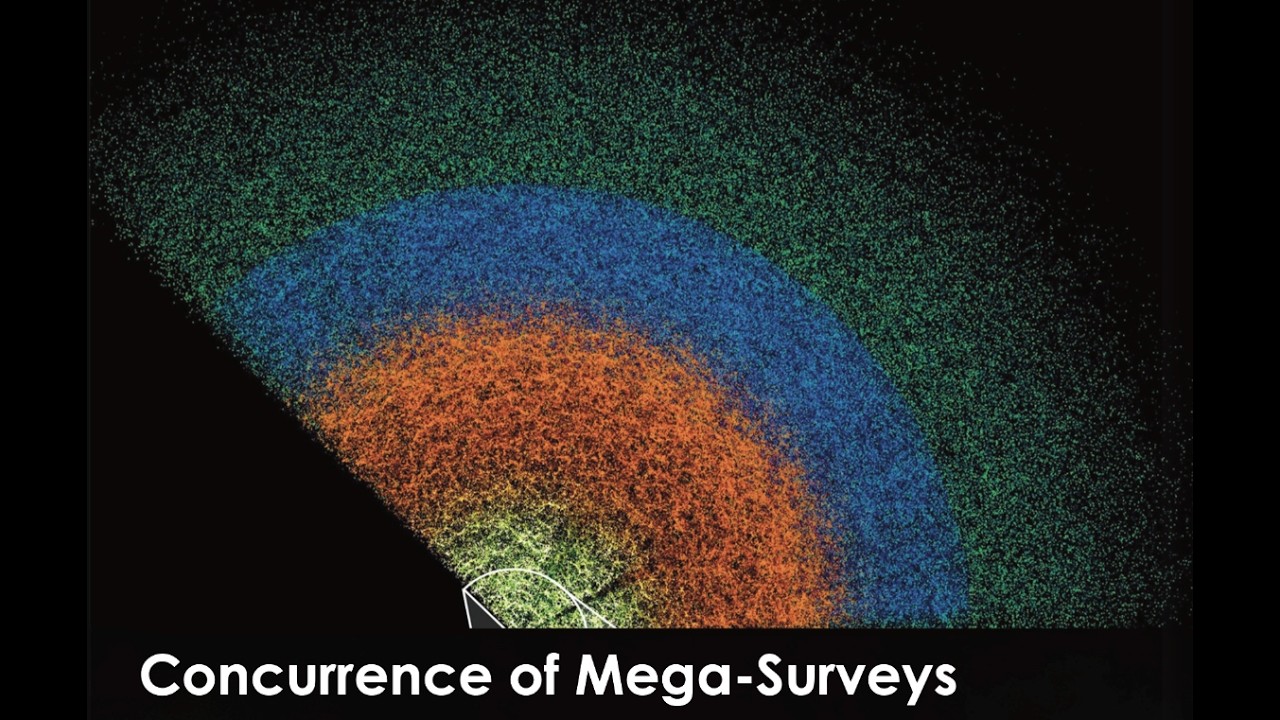
- Program: The Concurrence of Mega-Surveys — Official workshop program page from ICTS, hosting the talk.
Contribution & Novelties
The talk provides an expert synthesis of current CMB-LSS probes, especially highlighting the recent SPT tSZ map and its power spectrum, which shows a significant small-scale suppression compared to simulations—an important open question. It also showcases the first SPT polarization maps and the resulting lensing reconstruction, establishing a new standard for CMB lensing depth. The most novel element is the proposal to detect the CMB at radio frequencies (around 100 MHz) to measure the global 21-cm absorption and infer the spin temperature at high redshift, which would be a complementary probe to traditional 21-cm measurements.
Pour aller plus loin :
- Sunyaev-Zel’dovich effect — Covers the tSZ effect used in the talk.
- Cosmic microwave background — General background on CMB and its probes.
- FLAMINGO simulations — Reference to the simulations used for comparison (if exact URL uncertain, but it’s plausible).
139 words
Radar Profile
The radar chart shows high scores across all dimensions (quantity, quality, technique, reliability), indicating a dense, authoritative, and well-supported talk. The relatively lower 'quantity' score (8) reflects the focused scope, while 'quality' and 'fiabilite' benefit from the expertise and data presented.