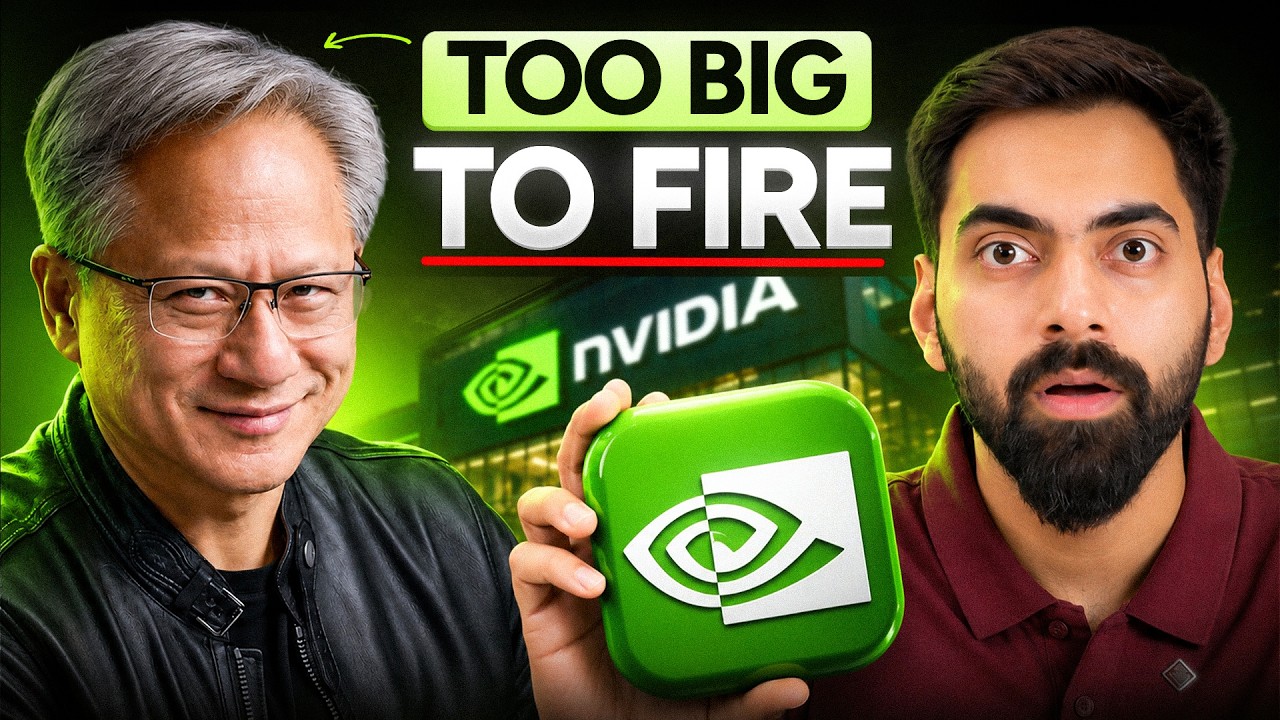
Why Nvidia Had to Bring Jensen Huang Back (AI Bubble Explained)
Keywords
Summary
256 words
Critical Evaluation
Value of the Information & Strength of the Argument
The genuine value here is conceptual rather than factual. The central explanatory device — the co-signer analogy — is well chosen and does real work: it makes legible a financing structure (chip vendors underwriting the credit of their own customers through equity stakes, backstops and rent guarantees) that is genuinely difficult to convey, and it correctly identifies that the risk sits in a web of contingent obligations rather than on the balance sheet in any simple form. The distinction drawn between the promises being Nvidia’s on paper and being Jensen Huang’s in the market’s perception is the sharpest idea in the video, and it is what makes the governance story more than gossip. The dot-com comparison is handled with reasonable care: the narrator explicitly limits the analogy, noting that the customers here are among the richest companies in the world and that the obligations only crystallise on default, which is more epistemic caution than the genre usually displays. The receivables observation — average customer payment time moving from about 45 to 64 days — is the one piece of balance-sheet evidence that would, if accurate, support the thesis independently, and it is unfortunately the least sourced. The argument’s weaknesses are structural. The reasoning is almost entirely counterfactual and causal-by-narrative: we are told the board reversed because of market pressure, but the video concedes nobody outside the room knows, and it resolves the ambiguity by asserting the more dramatic reading. The ’too big to be fired’ line is attributed to an unnamed analyst, and the inference that reinstatement ‘hides’ rather than ‘fixes’ a problem is an interpretive claim presented with the cadence of a finding. The succession argument — that a 63-year-old will eventually leave and that this episode is a ‘preview’ — is sound as far as it goes but is not developed into any assessment of what the actual exposure would be. The deliberately agnostic closing on the bubble question is intellectually honest and is the right call given the evidence presented, though it sits uneasily with a title that promises explanation.
Scientific Rigor, Source Quality, Title Accuracy
Sourcing is the weakest dimension. The description names a NVIDIA Newsroom release and four news organisations plus an explicit date (November 2026), but provides no URLs, no headlines, no authors and no article-level identifiers, so nothing can be traced or read. Within the transcript, specific attributions do appear — a New York Times report in late October, a Financial Times report on 7 November, a second report three days later, a credit rating agency outlook cut, a regulatory accounting review, a congressional appearance scheduled for early December — yet none is given enough specificity to be located. The video deserves credit for naming the counter-evidence: China’s denial of the espionage claim and the Attorney General’s statement that the Justice Department had not concluded the woman was a spy. That is a real, if partial, application of the principle of presenting contrary evidence. It also flags internal inconsistency in the board’s own position — the chairman describing the problem as a lack of honesty five days before the board declared itself satisfied with that honesty — which is a legitimate and well-placed critical observation. The genre framings, however, do a lot of unearned work: the opening montage of anchor voices and ‘breaking news’ style clips signals archival verification that the viewer cannot confirm, and the documentary register invites trust that the underlying sourcing does not support. On title-content fit: the video does address the question posed in the title and does so in a structured way, covering the reversal and the bubble question as promised; the mismatch is one of certainty rather than topic.
621 words
Title / Content Match
The title promises an explanation of why the board reversed itself and what that reveals about an AI bubble; the video does deliver exactly that argument, in that order. Slight mismatch in that the title asserts the comeback as established fact while the body concedes much of the underlying story is unproven.
Quality & Reliability
3/10
The narrative is fluent and internally coherent, but it rests on a chain of events that is not documented anywhere the viewer can check. The description cites a NVIDIA Newsroom press release and reporting by CNBC, Reuters, AP News and CNN dated November 2026, yet supplies no links, article titles, dates or bylines. The transcript itself repeatedly hedges ('a lot of this is still not proven', 'I don't know'), and several figures central to the argument — $118 billion of backstops, a $105 billion rent guarantee for an Ohio campus, CoreWeave's $47 billion of debt, the 45-to-64-day receivables shift — are stated without traceable origin. The video does flag what is contested (China's denial, the Attorney General's position), which is to its credit, but the framing genre (documentary with archival news clips) lends unwarranted facticity to material that could not be independently confirmed from the material provided.
Key Moments
Markers derived by PSI from the transcript: the creator did not define chapters.
- Cold open: news-style clips announcing the CEO's departure, a 13% single-day drop and $500 billion of lost value, ending with the reinstatement announcement.
- Framing of the eleven days: departure on 12 November, the public mea culpa five days later, and the board's stated refusal to bring him back.
- Origin of the scandal: the late-October newspaper report, the $4 billion of chips routed through a Singapore-based company, and the export-control question.
- The structure of AI infrastructure: chips require buildings, power and cooling; data centres cost billions; OpenAI cannot fund them upfront, which creates the 'landlord' intermediary.
- The co-signer analogy explained: up to $105 billion guaranteed for one Ohio campus, $118 billion of total backstops, and CoreWeave's $47 billion of debt losing about a third of its value in eight days.
- Historical parallels: Steve Jobs at Apple, Jack Dorsey at Twitter, Sam Altman at OpenAI — each board losing to bankruptcy, users, or employees respectively.
- The week of pressure: a 200,000-signature petition, more than 60 direct reports with no deputy, a rating outlook cut, an accounting review, and a presidential intervention.
- Reinstatement and the ~30% jump in both Nvidia and CoreWeave; the 'too big to be fired' formulation and the argument that the rescue conceals the fragility.
- The dot-com comparison: vendor financing flattered sales until customers ran out of money, weighed against Nvidia's far stronger customer base and contingent-only liability.
- Closing: open questions around the congressional hearing, the accounting review and the ongoing internal investigation; explicit refusal to declare a bubble.
Cited Sources
- NVIDIA Newsroom — NVIDIA Board Reinstates Jensen Huang as President, CEO and Board Director — Named in the description as the official source for the reinstatement; no link, date or document identifier supplied.
- The New York Times — late-October report on a businesswoman close to Jensen Huang and US intelligence concerns — Cited in the transcript as the report that opened the affair; no headline, byline or date given beyond 'late October'.
- Financial Times — 7 November report that officials believed the relationship was romantic — Presented as the disclosure that triggered the board investigation; not locatable from the material provided.
- CNBC, Reuters, AP News, CNN — November 2026 coverage — Listed collectively in the description as the reporting base for the sequence of events; no individual articles cited.
- US Attorney General statement on the espionage allegation — Invoked in the transcript to note that the Justice Department had not concluded the woman was a spy — presented as counter-evidence to the central allegation.
Contribution & Novelties
The original contribution is not the news itself but the mechanism it isolates: the idea that vendor guarantees and equity stakes in customers have made a handful of AI infrastructure firms implicitly dependent on the continued presence of one executive, and that a governance decision can therefore propagate as a credit event. Framing the value destruction as a repricing of the co-signer rather than of the products is a genuinely useful lens, and it is applied consistently to the CoreWeave example. The parallel drawn with founder removals at Apple, Twitter and OpenAI is familiar but is given a specific twist — that those boards lost to forces internal to their own companies (bankruptcy, users, employees) while Nvidia’s board lost to an external market that had priced a person, not a firm. The tentative treatment of the dot-com comparison, including the explicit caveats about customer quality and contingent liability, is a more disciplined use of historical analogy than the genre typically offers. The succession point — that this episode is a rehearsal for the day the CEO actually leaves — is the most forward-looking observation and is left underdeveloped relative to its importance.
Further reading:
- Jensen Huang — Background on the executive whose personal role in Nvidia’s guarantees is the crux of the argument.
- CoreWeave — The ’landlord’ intermediary used throughout as the case study for debt-financed AI capacity.
- Dot-com bubble — Reference point for the vendor-financing parallel drawn in the final section.
- Removal of Sam Altman from OpenAI — Best-documented of the three founder-removal cases invoked, useful for testing the video’s generalisation.
- Vendor financing — The financial mechanism the video describes without naming; worth studying directly for a rigorous version of the argument.
- Contingent liabilities and guarantees — The accounting concept that determines how much of the claimed $118 billion would actually appear on a balance sheet.
307 words
Radar Profile
The profile is lopsided: a solid conceptual apparatus and a reasonably careful handling of analogy sit alongside very low source traceability and modest technical depth. Information density is respectable for an eleven-minute narrative piece, but the reliability axis collapses because almost every load-bearing figure and event is unverifiable from the material supplied. The result is a video that thinks well about a story the viewer has no means of confirming.