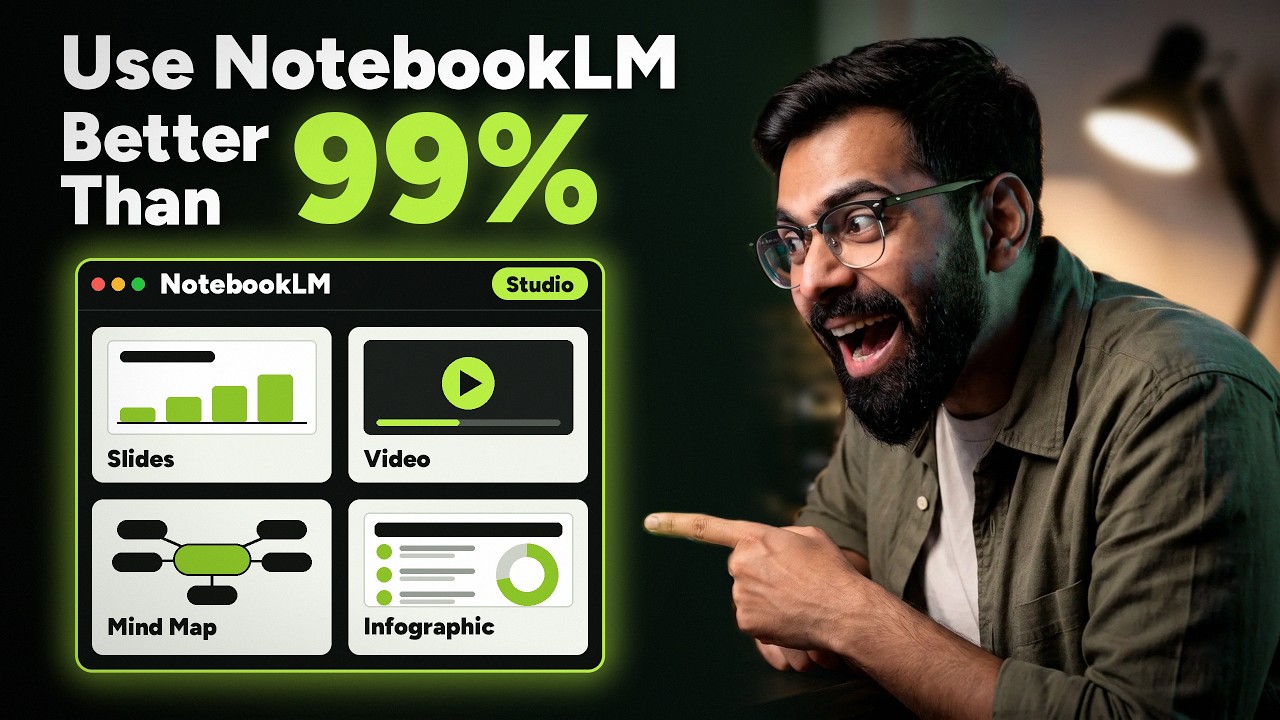
Use Gemini Notebook Better Than 99% of People in 12 Minutes | 2026 Latest
Title history
- Use Gemini Notebook Better Than 99% of People in 12 Minutes | 2026 Latest — observed on 20261115-1739 UTC (YouTube)
Keywords
Summary
140 words
Critical Evaluation
Value of the Information & Strength of the Argument
The video provides high practical value for viewers new to NotebookLM, offering clear, actionable instructions for leveraging the tool in everyday tasks. The argumentation is persuasive, centered around the tool’s ability to ground answers in cited sources, thus reducing hallucination risk. The presenter supports claims with live demos, but the evidence is anecdotal rather than systematic. He makes broad claims (e.g., saving 5-10 hours weekly) without quantitative backing. The argument would be stronger with comparisons to other tools and caveats about edge cases.
Scientific Rigor, Source Quality, Title Accuracy
The video lacks rigorous sourcing; the only external source linked is the tool itself. The presenter mentions websites like The Verge, TechCrunch, and MIT Technology Review as news sources but does not provide direct citations. A Pew Research report is used as an example, but its URL is not shared. The title is somewhat misleading because the actual duration is 23:36, not 12 minutes, though the content matches the promise of learning to use the tool effectively. No comments were provided for analysis.
181 words
Title / Content Match
The title accurately reflects the video's purpose—teaching effective use of Gemini Notebook—though the '12 minutes' claim contradicts the actual 23:36 duration, which is a minor exaggeration.
Quality & Reliability
6/10
The video is a practical tutorial based on the author's personal testing. It clearly explains six use cases with step-by-step instructions, but it contains promotional language and oversimplifications (e.g., claiming the tool 'cannot hallucinate'). No external sources are provided, and the claims are not independently verified. Reliability is moderate: useful for beginners but not authoritative.
Key Moments
Markers derived by PSI from the transcript: the creator did not define chapters.
- Introduction: showcases the tool's ability to summarize podcasts, books, and reports with cited sources.
- Explains how NotebookLM works: sources, chat, studio, and the citation numbers.
- Use case 1: Building a daily AI news brief from trusted websites.
- Use case 2: Summarizing a whole book into a mind map with key ideas.
- Use case 3: Turning a 3-hour podcast into an infographic poster.
- Use case 4: Converting a pile of receipts into a categorized spreadsheet.
- Use case 5: Transforming a 40-page report into a short video for a team.
- Use case 6: Using Deep Research to generate a full presentation from one sentence.
- Conclusion: recap of six use cases and a call to action to join the WhatsApp community.
Cited Sources
- Gemini Notebook (formerly NotebookLM) — The tool demonstrated throughout the video; the presenter directs viewers to this website for access.
Contribution & Novelties
The video compiles six practical workflows for using NotebookLM, saving viewers time by aggregating tips that would otherwise require multiple searches. It highlights the tool’s unique citation feature, which grounds answers in user-provided sources, reducing hallucination risks. The tutorial is accessible and encouraging, but it does not introduce fundamentally new concepts, as the tool’s features are already documented elsewhere.
Pour aller plus loin :
- NotebookLM Wikipedia — Overview of the tool’s history and features.
- Retrieval-augmented generation — The underlying technology that explains how NotebookLM grounds answers in sources.
- Deep Research mode — A feature described in the video that enables autonomous web research and source collection, highlighted as part of Google AI’s broader efforts.
114 words
Radar Profile
The radar profile shows high scores for quantity and quality of information (8 and 7), moderate for technical level (6), and lower for overall reliability (6). This suggests the video is information-dense and practical but lacks authoritative sourcing and deep analysis, making it useful for beginners but not as a primary reference.