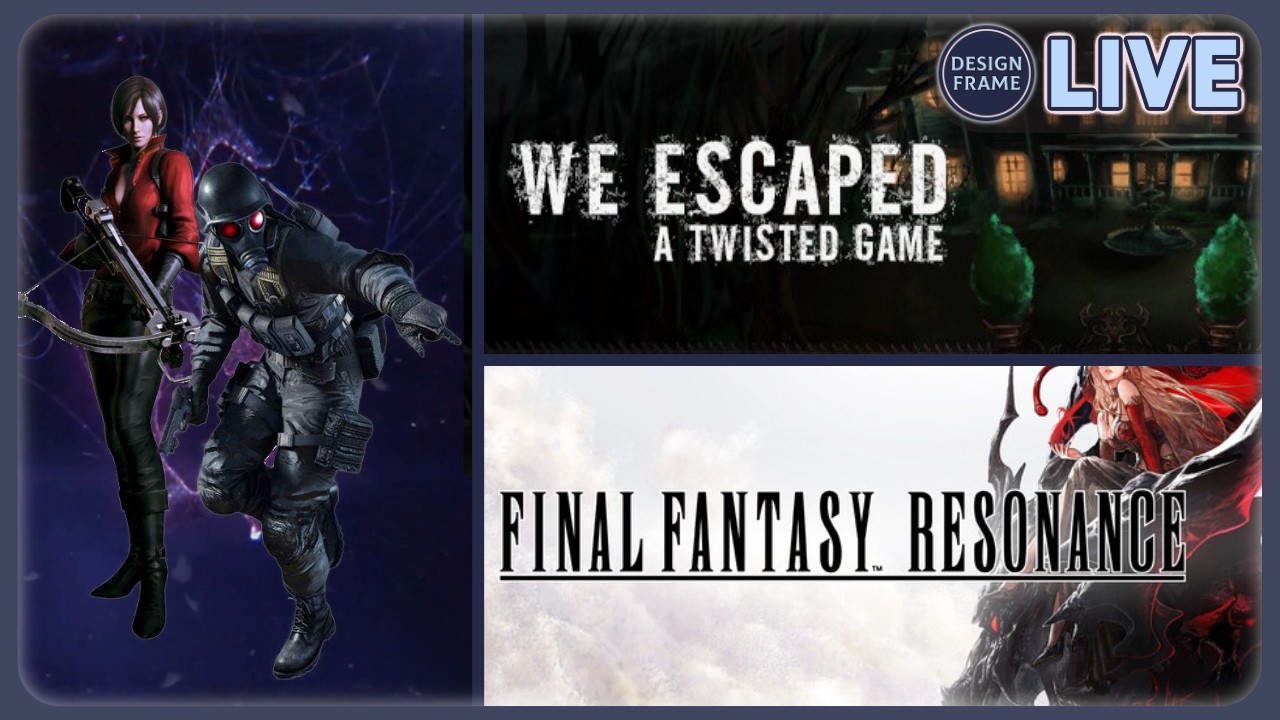
Tried Ada's campaign. Dreadfully Boring. || We Escaped a Twisted Game #2 (End) || FF Resonance Demo
Keywords
Summary
254 words
Critical Evaluation
Value of the Information & Strength of the Argument
The informational value is concentrated in the live, first-hand observation of a shipped product’s cooperative layer. Because the two players are physically playing the build, the claims they make are, for the most part, immediately verifiable by the viewer: the partner character cannot open doors, cannot activate turrets, cannot solve the puzzle and has no unique weapon, and the host contrasts this with the signature tools given to every other co-op partner in the game. These are concrete, checkable design defects rather than tastes, and the repeated demonstration of a character who is functionally a spectator is the strongest evidence the stream produces. The argument is built inductively, from incident to general principle: a mission text instructing the player not to attract attention, combined with the absence of crouching, a camera that fights the player when hugging walls, and enemy waves that cannot be avoided, is used to conclude that the campaign was not designed for stealth despite being structured as a stealth sequence. That reasoning is sound in its own frame, but it stays at the level of personal playthrough experience. There is no reference to developer interviews, patch notes, sales or review data, no comparison with how other co-op titles solve asymmetric partner abilities, and no attempt to test the counter-hypothesis that the Agent character is deliberately minimal to preserve Ada’s solo-authored narrative. The Game Awards discussion illustrates the limits of the format: the hosts dismiss nominees as a ‘joke’ and assert that critics are paid or blackmailed into favourable scores without any supporting evidence, which is assertion rather than argument. Casual banter, food anecdotes and community jokes occupy a large share of the runtime and dilute the analytical thread. The value is therefore real but intermittent: an honest, situated expert-eye walkthrough that surfaces genuine usability defects, wrapped in a format that never systematises or documents them.
Scientific Rigor, Source Quality, Title Accuracy
Scientific rigour is essentially absent in the academic sense: no methodology, no sampling, no external literature, and no distinction between verified fact and recollection. Several factual claims are stated with visible uncertainty — the two hosts hesitate over which character owned which weapon, whether a remake or a newer title displaced Ocarina of Time’s critic score, and repeatedly qualify statements with ‘I may be completely wrong’. This self-awareness is honest but leaves the audience without a reliable factual baseline. The only sources invoked are the game itself, described by the channel as a first-impressions exercise, plus internal channel documents (the live review document and the funding/comparison spreadsheets linked in the description) that are the channel’s own working material rather than independent references. On the title-to-content question, the title announces three distinct items, but the stream delivers only the Resident Evil 6 Ada campaign, so the match is partial and the promised breadth is not honoured.
479 words
Title / Content Match
The title promises the Ada campaign plus two other segments, but only the Resident Evil 6 co-op session is actually delivered; the 'dreadfully boring' verdict is discussed implicitly rather than argued.
Quality & Reliability
2/10
Live co-op stream dominated by casual banter and unscripted first impressions; the game-design observations (bolted-on co-op character, absent stealth mechanics, unreadable camera) are pertinent but purely anecdotal and never backed by cited documentation, measurement or external sources. Industry commentary (Game Awards nominees, review scores) is openly polemical and unsupported.
Key Moments
Markers derived by PSI from the transcript: the creator did not define chapters.
- Opening chat about achievement chasing and the scheduling change that replaced a Silent Hill: Townfall review discussion with this Resident Evil 6 playthrough.
- Discussion of The Game Awards nominees, including the inclusion of an unreleased title and remakes among 'new game' categories.
- Critique of aggregated critic scores and the claim that a long-standing ratings record was displaced, with explicit distrust of review metrics.
- Start of the Ada campaign; the co-host is locked into the 'Agent' character and the two compare their starting loadouts.
- First stealth attempt collapses into an unwinnable firefight with no starting ammo, forcing a full reset — used to argue the mission was meant to be played quietly.
- The absence of any crouch or stealth control is highlighted as a design contradiction in a mission explicitly built around not being spotted.
- Discovery that the Agent character, added after release to enable co-op, cannot interact with doors, objectives or puzzle elements.
- Cooperative puzzle on the rotating painting; the partner cannot manipulate the mechanism, illustrating the asymmetry between the two players.
- Turret sequence: the Agent cannot stand on the activation plate, and the resulting combat exposes the limits of the co-op implementation.
Cited Sources
- Design Frame — indie game design & UX consulting site — The host's professional activity in game design and user-experience consulting, which frames the analytical angle adopted during the playthrough.
- Live Design Plays — Funding List (spreadsheet) — Channel document listing the games scheduled for future design-play streams; referenced as the planning backbone of the format.
- Live Design Plays — Historical Comparison (spreadsheet) — Channel document used to compare design plays over time; the closest thing to a documented method for the critical commentary.
Contribution & Novelties
The stream’s original contribution is a real-time, hands-on diagnosis of what happens when co-op is retrofitted onto a single-protagonist campaign. Rather than reviewing Resident Evil 6 as a whole, it isolates one mechanism — the post-release ‘Agent’ partner — and demonstrates through repeated failure that a second player can exist in the world, carry weapons and take damage while being excluded from every interaction that advances the game. The same session documents a second, complementary defect: a level whose objectives are explicitly stealth-oriented inside a control scheme that offers no crouch, a camera that obstructs the player near geometry, and enemy waves that cannot be avoided, producing a forced combat encounter that ends in a reset. These are small, concrete observations that generalise well to a broader question in game criticism: how the addition of a cooperative mode reshapes level logic, and how players detect incompleteness through interaction rather than through documentation.
Further reading:
- Resident Evil 6 — Background on the title, its multiple interlocking campaigns and its cooperative structure, useful for situating the Ada/Agent asymmetry discussed in the stream.
- Game design — Overview of the discipline whose vocabulary (level design, player agency, feedback loops) underpins the host’s critique.
- Stealth game — Conventions of the genre (line of sight, crouching, alert states) against which the stream measures the campaign’s stealth sequence.
- User experience — The methodological frame behind the channel’s ‘UX’ reading of interface, camera and control friction.
- Asymmetric cooperative design, as discussed in game-development literature on drop-in co-op partners — cited by name only, since no single canonical reference can be attributed with certainty here.
266 words
Radar Profile
The profile is flat and low: a long, loosely structured stream yields limited condensed information and weak sourcing, while the technical level sits at an intermediate level reflecting genuine design vocabulary applied informally. Reliability is the weakest axis, since claims are conversational and occasionally acknowledged as uncertain. The relatively better marks on information quantity and technique reflect the density of concrete, on-screen design defects rather than any documentary apparatus.