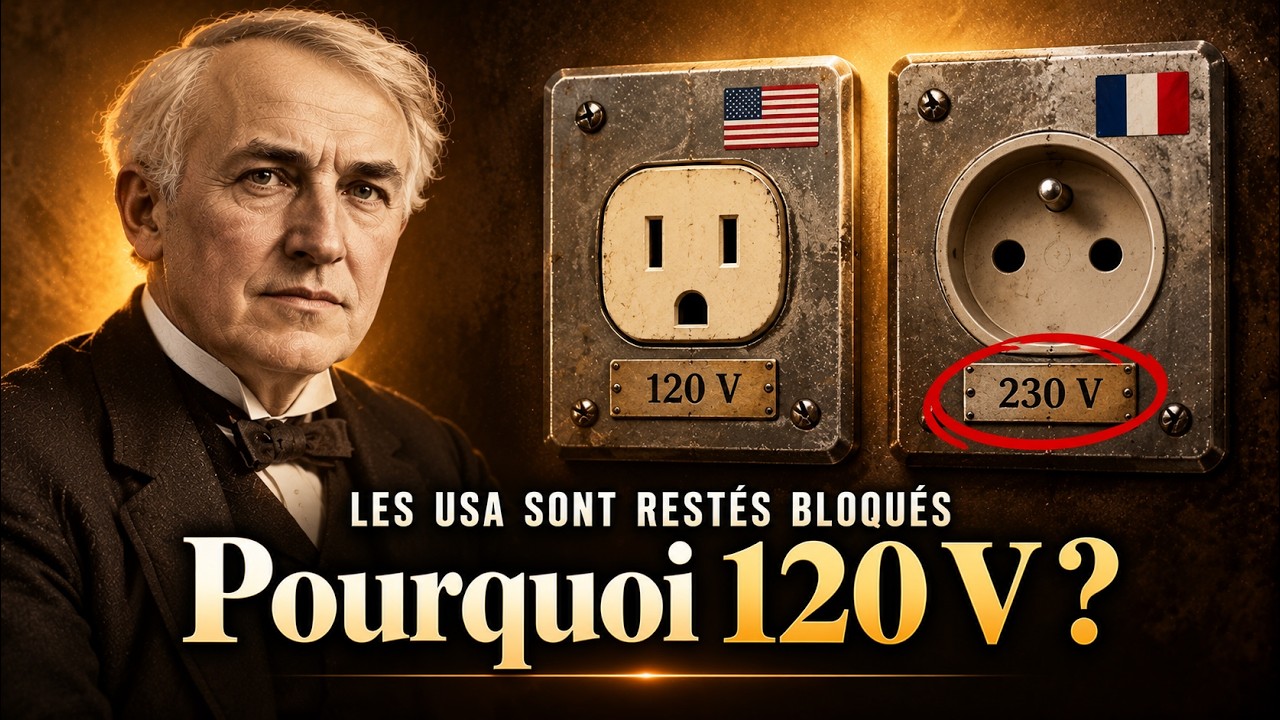
Pourquoi les États-Unis utilisent-ils encore du 120 V alors que la France utilise du 230 V ?
Why do the United States still use 120 V while France uses 230 V?
Title history
- Pourquoi les États-Unis utilisent-ils encore du 120 V alors que la France utilise du 230 V ? — observed on 20261111-2141 UTC (YouTube)
Keywords
Summary
182 words
Critical Evaluation
Value of the Information & Strength of the Argument
The video provides high value by connecting a mundane household question to deep historical and economic forces. It argues convincingly that the voltage difference is not arbitrary but stemmed from a path-dependent process. The argumentation is well-structured: starting from a concrete observation, building historical context, comparing trajectories, and then analyzing consequences. The use of concrete examples (kettle, hair dryer, adapters) makes abstract concepts tangible. However, some claims, such as specific prices and percentages, are stated without sources, and the narrative occasionally simplifies complex economic calculations.
Scientific Rigor, Source Quality, Title Accuracy
The video demonstrates reasonable scientific rigor in its historical account: key events (Edison’s station, Berlin’s switch, French nationalization) are accurately portrayed. The physics explanations (Power = V x I, copper savings) is correct. Yet, no explicit sources are cited, and certain figures (e.g., conversion cost per subscriber) are vague. The title matches the content perfectly. Public comments were not provided, so no trend analysis is possible; the video’s high like ratio (179 likes vs 9,695 views) suggests positive reception, but no detailed comments were analyzed.
185 words
Title / Content Match
The title accurately frames the video's central comparison and explanation of the voltage difference.
Quality & Reliability
7/10
The video presents a coherent historical and technical narrative, but relies on unsourced claims, approximate pricing, and anecdotal examples. It lacks explicit citations, though the factual backbone (historical dates, engineering concepts) is generally accurate.
Chapters
- Pourquoi les prises françaises et américaines n’ont pas la même tension
- La bouilloire révèle la différence de puissance
- Le choix d’Edison et la naissance du réseau américain
- Pourquoi l’Europe a adopté une tension plus élevée
- Pourquoi les États-Unis sont restés à cent vingt volts
- La dépendance au passé des réseaux électriques
- Cuivre, sécurité et recharge des voitures électriques
- Ce que le choix d’Edison a changé jusqu’à aujourd’hui
Contribution & Novelties
The video offers an original synthesis of historical and practical knowledge, packaging well-known facts (Edison’s choice, war of currents) into a compelling narrative about path dependence. It adds practical advice for travelers and highlights the copper inefficiency of 120 V systems.
Pour aller plus loin :
- Path dependence (Wikipedia) — Core concept explaining why historical choices persist despite better alternatives.
- War of the currents (Wikipedia) — Detailed account of the AC/DC rivalry and its resolution.
- Split-phase electric power (Wikipedia) — Technical explanation of the US 120/240 V system.
88 words
Radar Profile
The radar profile shows high scores in information quantity and quality, a moderate technical level, and slightly lower global reliability due to missing citations. This indicates a well-rounded, engaging documentary that would benefit from more rigorous sourcing.