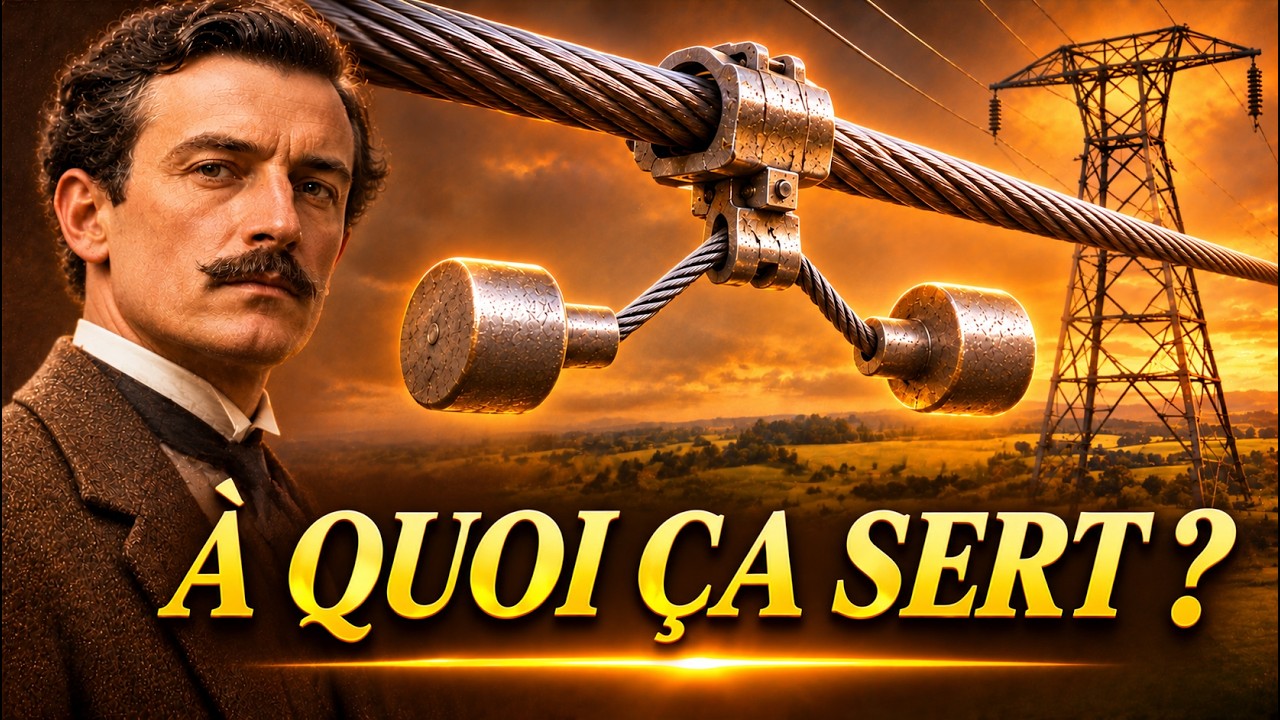
Pourquoi les câbles des pylônes ont-ils ces étranges poids métalliques ?
Why do the cables on utility poles have these strange metal weights?
Title history
- Pourquoi les câbles des pylônes ont-ils ces étranges poids métalliques ? — observed on 20261120-1039 UTC (YouTube)
Keywords
Summary
154 words
Critical Evaluation
Value of the Information & Strength of the Argument
The value of the information is high. It uses a clear pedagogical approach, moving from a simple observation to complex physical principles (vortex shedding, resonance, fatigue) without oversimplifying the core scientific content. It effectively uses metaphors (a swing, a guitar string) to ground abstract concepts. The argumentation is solid, logically progressing from the cause (wind) to the effect (cable fatigue) and then to the solution (the damper). It also integrates practical engineering considerations, such as the trade-off between cable tension and sag, which demonstrates a deep understanding of the subject. The historical narrative adds contextual relevance. The argument that ’tighter cables are more susceptible’ is counterintuitive and well-explained.
Scientific Rigor, Source Quality, Title Accuracy
The scientific rigor is commendable. It correctly references the Kármán vortex street, the Strouhal number, and metal fatigue. It mentions credible bodies like CIGRE and RTE, and mentions a specific international standard homologated in France in 2020. However, no external URLs or documentary sources are provided in the description, relying solely on verbal claims. The title perfectly matches the content, as it directly addresses the question posed. The video includes a brief call-to-action for likes and subscriptions at the end, which is a standard practice but slightly extends beyond pure educational content.
215 words
Title / Content Match
The title perfectly matches the content, which details the purpose, history, physics, and engineering behind the metallic weights on power lines, fully answering the question posed.
Quality & Reliability
8/10
The video provides an accurate and well-structured explanation of the Stockbridge damper. It correctly describes the physics of vortex shedding (Kármán vortex street), the use of the Strouhal number for frequency calculation, the concept of resonance, and the mechanism of metal fatigue. It correctly highlights the counterintuitive relationship between higher tension and increased susceptibility to vibrations. It mentions relevant organizations (CIGRE, RTE) and a recent international standard. No overtly false scientific claims were detected, though some figures (e.g., wind speed ranges) are presented as approximate for accessibility.
Chapters
- Le mystérieux haltère des lignes électriques
- La découverte de la fatigue des câbles
- Comment le vent fait vibrer les câbles
- La répétition qui casse le métal
- L’invention de George H. Stockbridge
- Tension, flèche et emplacement de l’amortisseur
- Coût et surveillance du réseau français
- Une protection invisible contre le vent
Cited Sources
- RTE (Réseau de Transport d'Électricité) — Cited as the French transmission system operator, providing figures for the network length (106,000 km) and the number of pylons (250,000), as well as the monitoring methods.
- CIGRE (International Council on Large Electric Systems) — Mentioned regarding the observation that higher cable tension increases susceptibility to aeolian vibrations.
- International standard homologated in France in 2020 — Mentioned regarding the required laboratory tests (resistance, damping, and pince safety) before installation.
- George H. Stockbridge — Mentioned as the inventor of the damper in the 1920s, working at Southern California Edison (implied).
Contribution & Novelties
The video’s original contribution is its holistic synthesis of the Stockbridge damper. Instead of just naming it, it connects the physical mechanism (vortex shedding and resonance) to the material failure mode (fatigue), to the history of the invention, to modern engineering practice (placement, tension/sag trade-off), and to the operational scale of a national grid. It also clarifies the counterintuitive point about tension increasing vulnerability. The explanation of asymmetry in modern dampers (to broaden frequency response) is a nice technical detail.
Pour aller plus loin :
- Kármán vortex street — Core physical phenomenon causing the alternating forces on the cable.
- Fatigue (material) — The underlying mechanism of cable failure due to cyclic stress.
- Stockbridge damper — Wikipedia article directly about the device discussed, covering its history and variants.
- Strouhal number — The dimensionless number used to calculate the frequency of vortex shedding.
141 words
Radar Profile
The radar profile shows high scores in information quantity, quality, and reliability, with a slightly lower technical level indicative of an accessible explanatory format. The primary limiting factor visible on the profile is the lack of external directly quotable sources in the description, which caps the absolute reliability score, despite the inherent scientific soundness of the content.