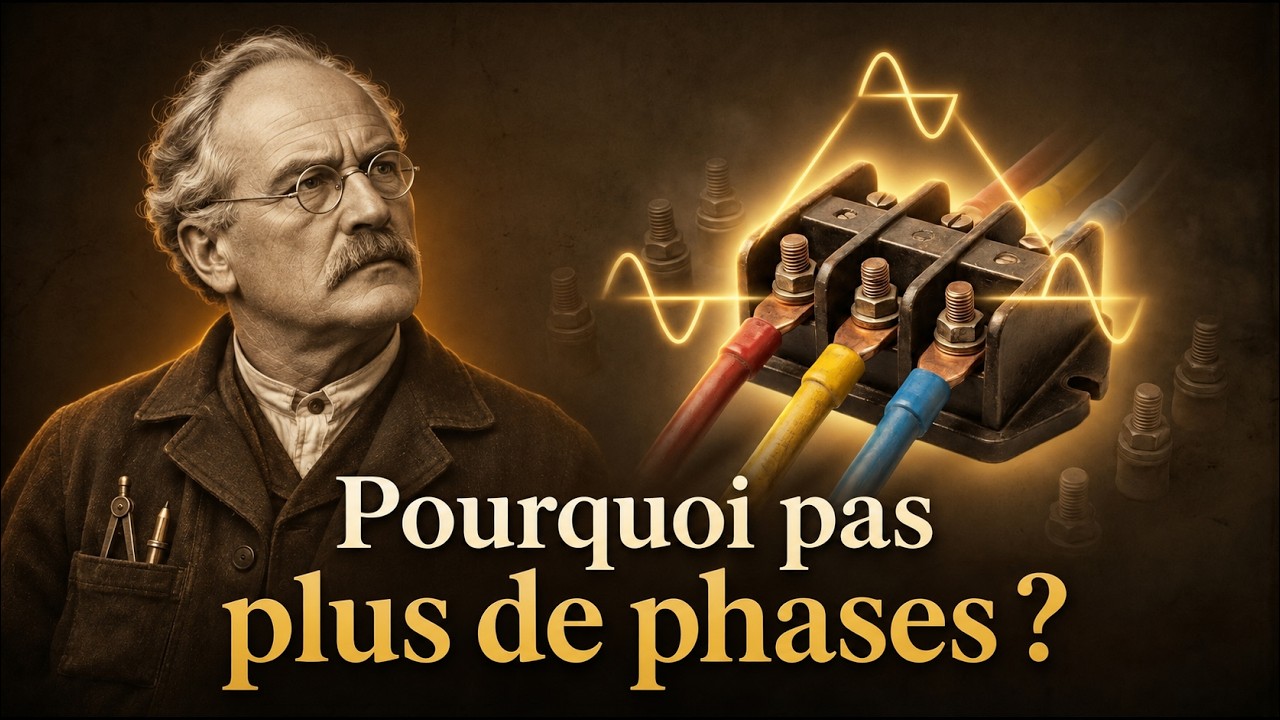
Comment fonctionne le triphasé : pourquoi 3 phases ?
How does three-phase work: why 3 phases?
Title history
- Comment fonctionne le triphasé : pourquoi 3 phases ? — observed on 20261111-2141 UTC (YouTube)
Keywords
Summary
146 words
Critical Evaluation
Value of the Information & Strength of the Argument
The video effectively combines historical storytelling with clear physical reasoning. It argues that three phases represent the optimal trade-off: more than two phases smooth power delivery, and exactly three provides constant power with minimal conductors and symmetric phase-to-phase voltages. The explanation of why power becomes constant, based on balanced vector addition, is accurate and intuitive. The historical narrative is engaging but sometimes simplifies complex events (e.g., Tesla’s involvement and financial details) for narrative clarity. The practical section on home triphasé installation is valuable and addresses common misconceptions, such as breaker tripping due to phase imbalance rather than over-subscription.
Scientific Rigor, Source Quality, Title Accuracy
The video stays scientifically sound, though it relies on well-known historical narratives without citing primary sources. It correctly distinguishes Tesla’s two-phase system from Dolivo-Dobrovolsky’s three-phase innovation and credits Ferraris for early research. The efficiency figure (75%) for the Lauffen-Frankfurt line is plausible and consistent with historical accounts. The title is appropriate and directly answered. No external sources are given in the description, and the video does not name specific journals or papers, limiting provenance but not necessarily accuracy.
191 words
Title / Content Match
Titre accurately reflects content: explains the physical, historical and practical reasons for three-phase power.
Quality & Reliability
7/10
The video is based on widely accepted historical narratives and standard electrical engineering principles. It does not cite specific academic sources but presents no major factual errors. The historical details (e.g., dates, events) align with known records, though specific numbers (like the 75% efficiency) are mentioned without primary reference.
Chapters
- Pourquoi le triphasé s'est imposé
- Edison et les limites du courant continu
- Tesla, le courant alternatif et la guerre des courants
- Dolivo-Dobrovolsky invente le moteur triphasé pratique
- La démonstration de Lauffen à Francfort
- La physique des trois phases
- Le triphasé dans les logements français
- L'héritage oublié de Dolivo-Dobrovolsky
Contribution & Novelties
The video offers a clear, integrated account of the historical and physical reasons for three-phase power, emphasizing the often-overlooked role of Dolivo-Dobrovolsky. It provides a practical angle relevant to consumers, such as the difference between 230 V and 400 V, and the behavior of circuit breakers in three-phase installations.
For deeper exploration:
- Three-phase electric power (Wikipedia) — Comprehensive reference on phase configurations, advantages, and applications.
- Mikhail Dolivo-Dobrovolsky (Wikipedia) — Biographical details and contributions to three-phase systems.
- War of the currents (Wikipedia) — Context for the AC/DC rivalry mentioned in the video.
- Maximum power transfer theorem (Wikipedia) — Relevant to the discussion of transmission efficiency.
104 words
Radar Profile
The radar profile shows high scores in information quantity and moderate technical depth, reflecting a balanced educational video. Reliability is decent but limited by lack of named sources, and technical depth is accessible to lay audiences.