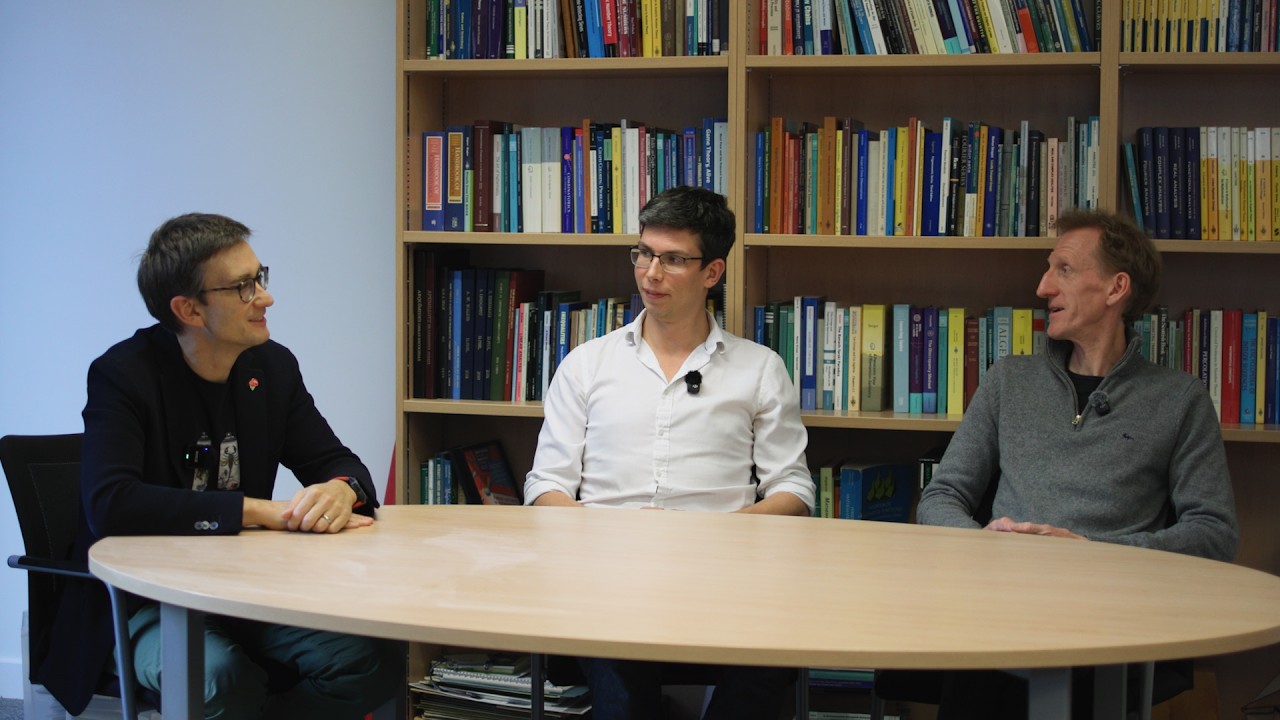
Oxford Mathematics in Conversation on AI - Ben Green and James Maynard with Jan Obloj
Title history
- Oxford Mathematics in Conversation on AI - Ben Green and James Maynard with Jan Obloj — observed on 20261109-1521 UTC (YouTube)
Keywords
Summary
166 words
Critical Evaluation
Value of the Information & Strength of the Argument
The value of this discussion lies in the unique insights from two leading number theorists who have personally engaged with the new AI proofs. They provide a detailed and technical overview of results that have not yet been widely digested, making it an original contribution to the community. Argumentation is robust, as they support each claim with concrete examples and personal experiences, such as conversations with Timothy Gowers and reading the proofs. They carefully distinguish between verified findings and remaining mysteries, and they openly question the philosophical implications of AI-driven mathematics. The conversation is well-structured, moving from specific results to broader questions, and maintains a high intellectual tone throughout.
Scientific Rigor, Source Quality, Title Accuracy
The scientific rigor is high; both mathematicians are experts and discuss the proofs with technical precision, including mechanisms like the polynomial method and metaplectic forms. However, no external sources or citations are provided, and the discussion relies on their expertise and the unpublished OpenAI papers. The title exactly matches the content, and the video is well-aligned with its stated purpose. No comments were analyzed, but the low view count suggests limited public engagement.
197 words
Title / Content Match
The title accurately reflects the content: an Oxford Mathematics interview on AI and mathematics, with the specified participants.
Quality & Reliability
8/10
The conversation features two leading number theorists (Ben Green, James Maynard) discussing recent AI-generated proofs. Their expertise lends high credibility, and they provide concrete technical details. However, no formal citations or links are provided, and opinions are subjective.
Key Moments
Markers derived by PSI from the transcript: the creator did not define chapters.
- Introduction and first question about when the speakers realized AI's impact on mathematics.
- Discussion of the Erdős unit distance problem as the first major shock.
- Ben Green describes shock at August's release of 10 papers, including the Jacobian conjecture disproof.
- Narrative of the October 6 release of 722 papers and reactions, including Timothy Gowers' comments.
- James Maynard explains the quasi-Riemann hypothesis proof and the zero-free region improvements.
- Discussion of Siegel zeros and two independent proofs of their absence.
Contribution & Novelties
This conversation provides an early, expert evaluation of the October 6 AI-generated mathematical results, offering context and technical explanation not yet available in published literature. It also explores the philosophical implications of AI discovering ‘unnatural’ proofs, a novel angle in public discourse.
Pour aller plus loin :
- Riemann hypothesis — Background on the central problem addressed by the quasi-Riemann proof.
- Polynomial method — The technique central to several AI proofs, with historical examples like Dvir’s solution.
- Siegel zero — Explanation of the infamous gap that was closed by the new proofs.
91 words
Radar Profile
The radar profile shows very high scores across quantitative and technical dimensions, reflecting the dense, expert-level content. Fiabilité is strong but slightly lower due to the lack of external citations. The balance suggests a technically outstanding but narrowly focused discussion.