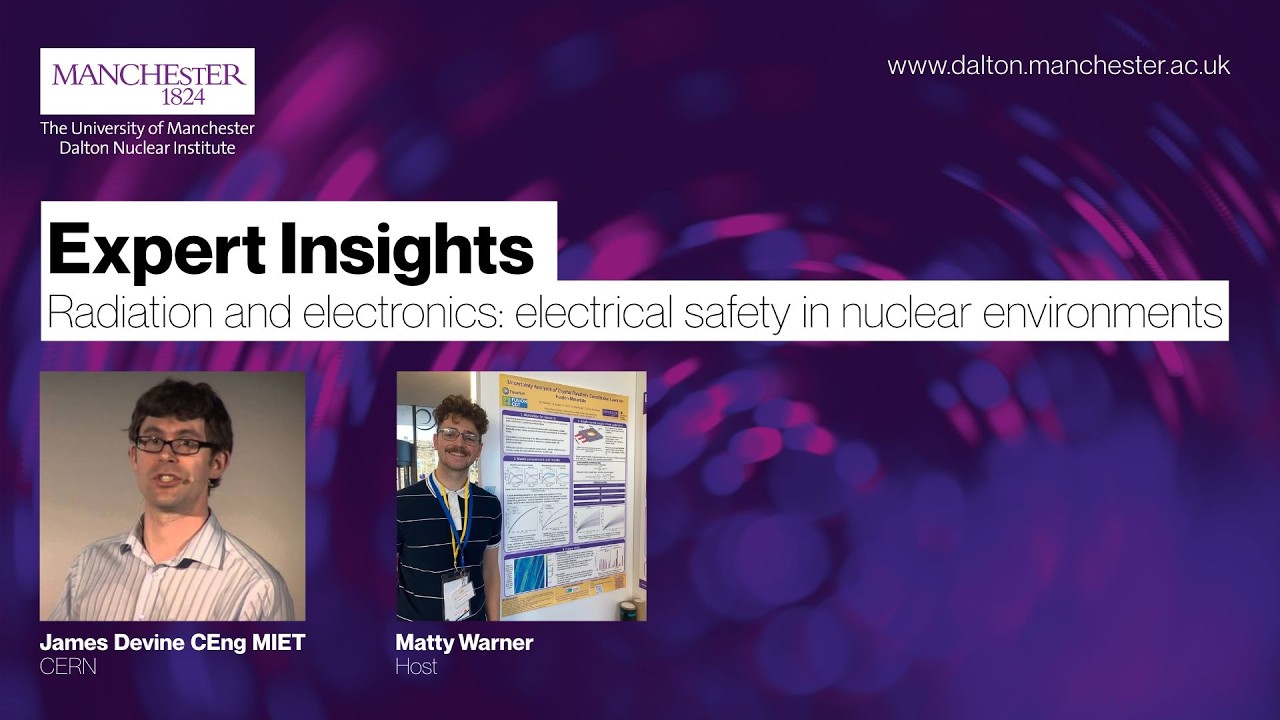
Radiation and electronics: electrical safety in nuclear environments | Expert Insights Series
Title history
- Radiation and electronics: electrical safety in nuclear environments | Expert Insights Series — observed on 20261119-1100 UTC (YouTube)
Keywords
Summary
163 words
Critical Evaluation
Value of the Information & Strength of the Argument
The value of the information lies in its practical, experiential nature, offering concrete examples of failure modes and design solutions based on real-world testing at CERN. The argumentation is coherent, progressing from the context to specific challenges and solutions. Devine supports his claims with empirical data from the radiation tests, such as the survival of a particular luminaire design and the identification of single event burnout as the primary failure mode. He also explains fundamental semiconductor physics to justify design choices, strengthening the technical credibility. The talk effectively bridges theory and application, making it valuable for engineers working in harsh radiation environments.
Scientific Rigor, Source Quality, Title Accuracy
The scientific rigour is high: the speaker is a chartered engineer with direct involvement in the projects described, and the talk is hosted by the Dalton Nuclear Institute, a reputable academic body. Sources mentioned include French standards (NFC 18-510, NFC 15-100) and IEC standards, as well as internal CERN tests. However, no external publications or formal citations are provided, limiting verifiability. The title accurately reflects the content, and the presentation is well-structured, with clear explanations suitable for a technical audience. The lack of a Q&A transcript may omit some clarifications, but the core content is solid.
213 words
Title / Content Match
The title accurately reflects the content, which covers radiation effects on electronics and electrical safety in nuclear environments such as CERN.
Quality & Reliability
8/10
The talk is given by a chartered electrical engineer with direct experience at CERN, providing practical, first-hand insights into radiation-hard electronics design. The content is grounded in engineering standards (NFC, IEC) and includes empirical testing results, contributing to high reliability. Some limitations include the lack of external citations and the informal nature of a seminar.
Key Moments
Markers derived by PSI from the transcript: the creator did not define chapters.
- Introduction and housekeeping by the host, mentioning previous seminars.
- Speaker introduction: James Devine's background and role at CERN.
- Overview of CERN's electrical infrastructure, including 400 kV connections and substations.
- Electrical safety framework: adaptation of French and Swiss standards (NFC 18-510, NFC 15-100) and use of IEC standards.
- Radiation environments: dose rates and the need for radiation-hard equipment in accelerators.
- Emergency lighting challenge: requirements, constraints, and the need for physical luminaires.
- Radiation hardness scales (TID, HEH, 1-MeV equivalent) and the target dose for LHC.
- Evolutionary approach: testing off-the-shelf lights, identifying the one that survived, and analyzing its design.
- Failure mechanisms: total ionizing dose and single event burnout in silicon power supplies.
- Solution: simple circuit with overrated components, using wide bandgap semiconductors and achieving 1 kGy tolerance.
Cited Sources
- NFC 18-510 (French standard for electrical work) — Mentioned as the standard defining electrical safety rules for work, used at CERN.
- NFC 15-100 (French standard for low voltage installations) — Used to define low voltage infrastructure at CERN.
- IEC standards — Reference for equipment not covered by French standards, ensuring compatibility.
- GBU-8K diode — Qualified by LHCb experiment for radiation hardness, used in the emergency luminaire design.
- CERN — The organization where the speaker works and where the experiments and tests were conducted.
Contribution & Novelties
The talk provides a rare insight into the practical engineering of radiation-hard electronics at CERN, specifically the design of emergency lighting that can withstand high radiation doses. The evolutionary testing approach and the emphasis on simple, overrated components offer a pragmatic alternative to complex custom design. The use of wide bandgap semiconductors like gallium nitride in commercial LEDs is highlighted as a key factor for radiation resilience. This adds practical knowledge to the field of radiation-tolerant electronics, particularly for accelerator environments.
Pour aller plus loin :
- Radiation hardening — Overview of techniques to make electronics resistant to radiation, relevant to the design principles discussed.
- Single event upset — Explanation of transient and destructive effects from high-energy particles, central to understanding failure modes.
- Wide-bandgap semiconductor — Details on materials like GaN and SiC that offer superior radiation tolerance.
137 words
Radar Profile
The radar profile shows high scores in information quality and technical level, reflecting the speaker's expertise and the depth of the content. The quantity of information is also strong, covering multiple aspects of the topic. Reliability is high due to the source's credibility, though the lack of external citations leaves a slight gap.