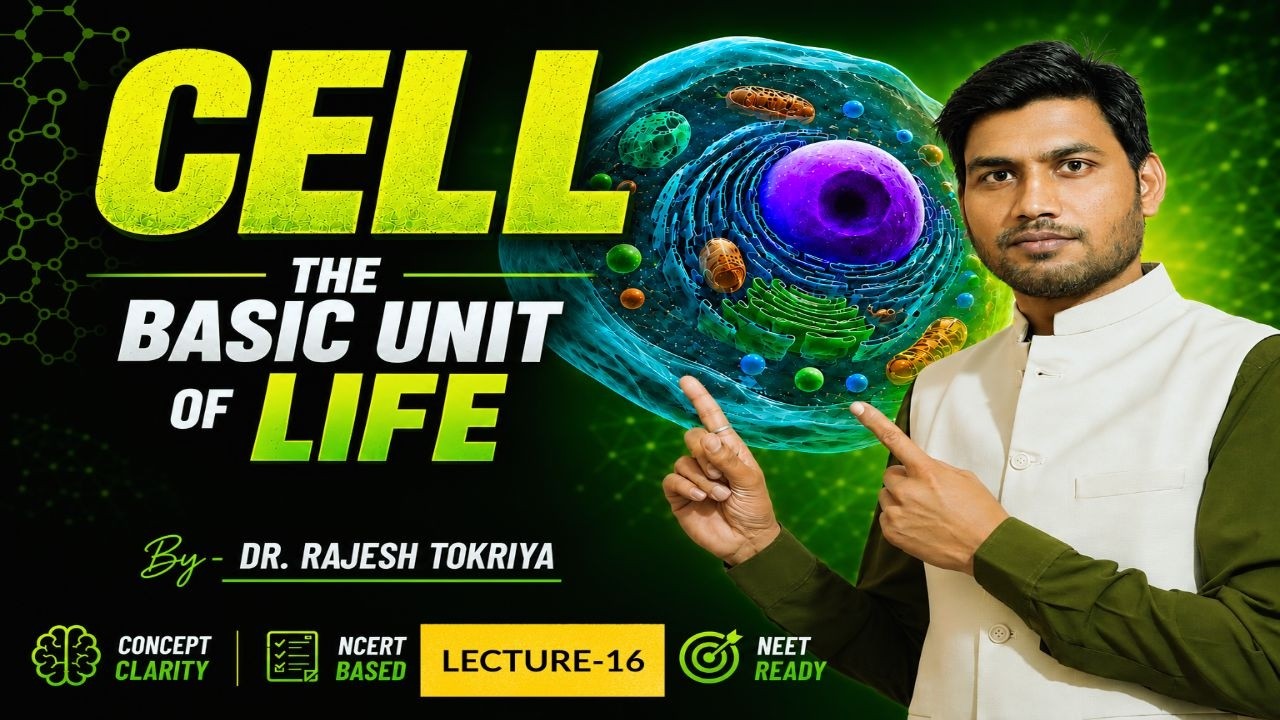
L-16 (Part-2) Active Transport | Primary & Secondary Active Transport
Keywords
Summary
168 words
Critical Evaluation
Value of the Information & Strength of the Argument
The video provides clear, step-by-step explanations of active transport mechanisms, reinforced by visual diagrams and memory aids. The use of analogies (cycling uphill, boats towing) effectively clarifies the energy dependence and the coupling of primary and secondary transport. The argumentation is straightforward and consistent with standard biology textbooks, making it accessible for beginners. However, it does not offer critical evaluation of alternative views or evolutionary significance, limiting its depth for advanced learners.
Scientific Rigor, Source Quality, Title Accuracy
The video is scientifically accurate but does not cite specific external sources; it aligns with NCERT guidelines, which is appropriate for the target audience. The presentation includes minor repetitions and a few imprecise statements (e.g., ‘iron gradient’ instead of ‘ion gradient’), but these do not undermine the core content. The title precisely matches the content, covering both primary and secondary active transport as advertised.
151 words
Title / Content Match
The title accurately reflects the video's scope: active transport, specifically primary and secondary mechanisms. The content stays on topic and aligns well with the title.
Quality & Reliability
7/10
The content is based on standard biology curriculum (NCERT) and is accurate for the intended audience. However, it lacks original citations and references to primary literature, and the presentation is somewhat repetitive. It is suitable for exam preparation but not for advanced research.
Key Moments
Markers derived by PSI from the transcript: the creator did not define chapters.
- Introduction: welcoming and recap of passive transport.
- Definition of active transport: movement against concentration gradient using proteins and ATP.
- Explanation of primary active transport, with the sodium-potassium pump as the classic example.
- Detailed mechanism of the Na+/K+ pump: binding of 3 Na+, ATP hydrolysis, conformational change, release of Na+, binding of 2 K+, and release inside.
- Secondary active transport: uses the gradient created by primary transport; examples of symport and antiport.
- Summary and conclusion, emphasizing exam-relevant points and differences between active and passive transport.
Contribution & Novelties
The video offers a pedagogically structured explanation of active transport, using analogies and visual diagrams to build intuitive understanding. Its main contribution is the detailed, step-by-step treatment of the sodium-potassium pump and the coupling concept in secondary active transport, tailored for NEET and board exam preparation.
Pour aller plus loin :
- Sodium–potassium pump — Provides a comprehensive overview of the pump’s structure, function, and clinical significance.
- Secondary active transport — Detailed explanation of symport, antiport, and the role of electrochemical gradients.
- Active transport — General principles and types of active transport, including primary and secondary mechanisms.
- Electrochemical gradient — Explains the driving force behind secondary transport.
106 words
Radar Profile
The radar profile shows a strong emphasis on information quantity (8) and decent quality (7) and reliability (7), with a lower technical level (6). This indicates a well-filled but not deeply specialized educational resource, suited for foundational understanding rather than advanced research.