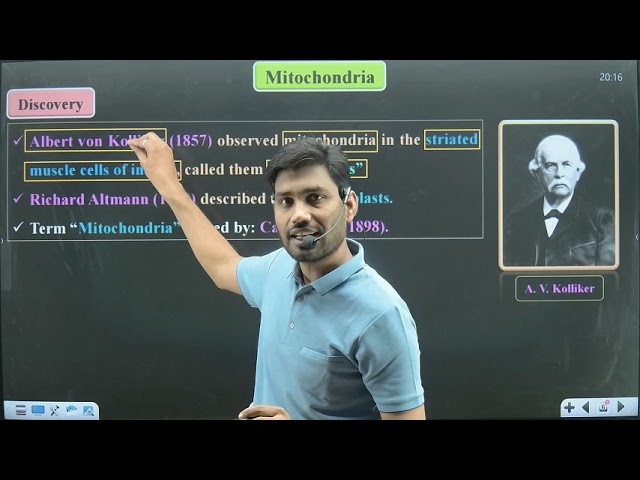
Mitochondria, Structure and functions
Title history
- Mitochondria, Structure and functions — observed on 20261108-1452 UTC (YouTube)
Keywords
Summary
155 words
Critical Evaluation
Value of the Information & Strength of the Argument
The video offers a clear and well-structured explanation of mitochondrial biology, focusing on essential concepts for students. The argumentation is logical, starting from the basic need for energy and progressing through the steps of cellular respiration and organelle structure. The instructor uses simplified language and diagrams to reinforce understanding. However, the presentation is largely descriptive with minimal critical analysis or experimental evidence, making it more of a tutorial than an in-depth scientific discussion. The emphasis on rote memorization of alternative names and numbers may be overly focused on exam performance rather than fostering conceptual depth.
Scientific Rigor, Source Quality, Title Accuracy
The scientific content is fundamentally accurate, aligned with established cell biology knowledge. The instructor correctly identifies key facts such as the double membrane, presence of mtDNA, and semi-autonomous nature. However, the lack of citations or references to scientific literature reduces the verifiable rigor; the information appears drawn from standard textbooks like NCERT, which are reliable for basic education. The title matches the content precisely, and the video stays on topic. There are no explicit references to primary sources, but the accuracy of the information is not compromised. The presentation is methodical and likely appropriate for the target audience of class 11 and NEET students.
214 words
Title / Content Match
The title accurately reflects the content, which covers both the structure and functions of mitochondria comprehensively.
Quality & Reliability
8/10
The lecture accurately presents the basic structure and function of mitochondria based on NCERT and standard cell biology knowledge. While it lacks explicit citations, the information is factually correct and well-suited for introductory biology students.
Key Moments
Markers derived by PSI from the transcript: the creator did not define chapters.
- Introduction to the channel and overview of the lecture.
- Basic concept of mitochondria's role in cellular respiration and ATP production.
- History and discovery: Kölliker, Altmann, Benda; alternative names (sarcomere, bioblast).
- Presence and absence of mitochondria in different cells; factors affecting number.
- Explanation of semi-autonomous nature: mtDNA, ribosomes, dependence on nucleus.
- Detailed ultrastructure: outer membrane, inner membrane, cristae, matrix, intermembrane space.
- Functions: ATP synthesis, role in metabolism, and comparison with other organelles.
Contribution & Novelties
The video provides a concise, exam-oriented synthesis of mitochondrial structure and function, primarily for NEET and high school biology students. It compiles commonly tested points into a single lecture, making it a convenient revision resource. The information is standard, with no novel scientific contributions, but the pedagogical presentation is well organized.
Pour aller plus loin :
- Mitochondrion - Wikipedia — Provides a comprehensive overview of mitochondrial structure, function, and evolution.
- Mitochondrial DNA - National Library of Medicine — Discusses the genetic features and inheritance of mitochondrial DNA.
- Krebs Cycle - Khan Academy — Explains the biochemical steps of the citric acid cycle relevant to mitochondrial respiration.
106 words
Radar Profile
The radar profile shows moderate to high scores in information quantity and quality, a lower technical level, and high reliability. This indicates an accessible, accurate educational resource suitable for introductory learners, with room for more advanced depth.