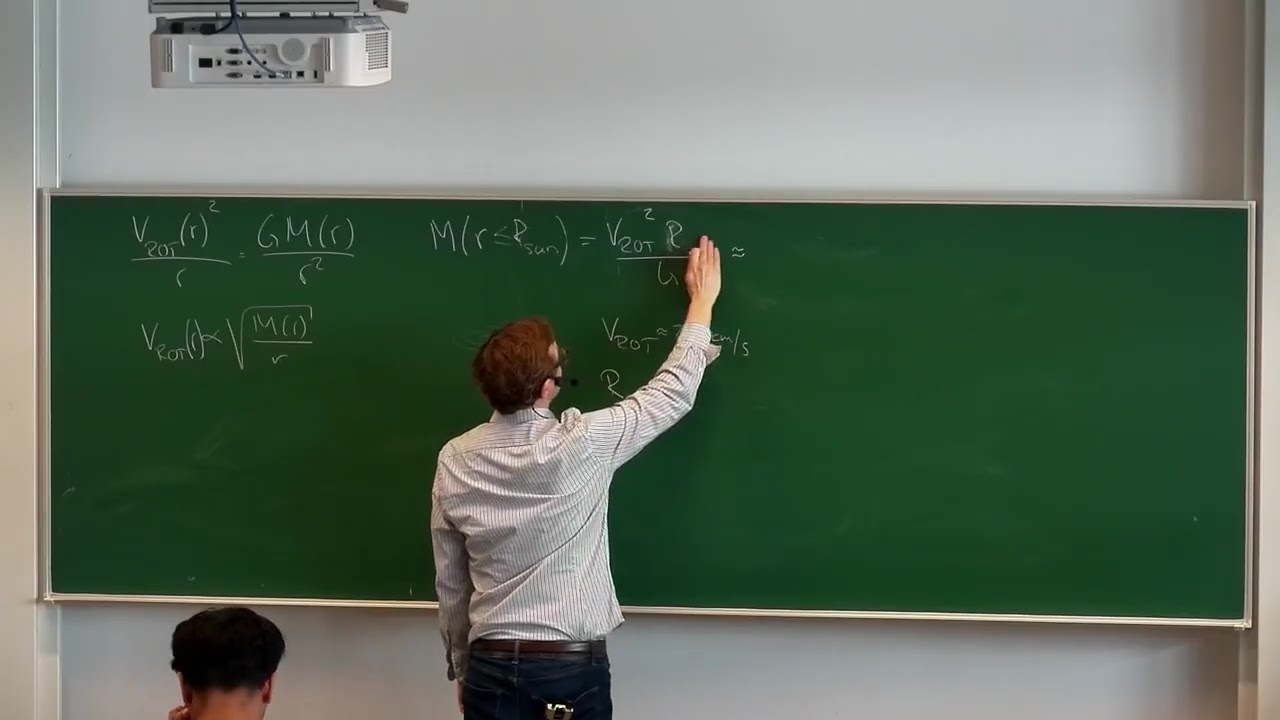
Galaxies and Cosmology: L3a - Exercises on galaxy dynamics
Keywords
Summary
280 words
Critical Evaluation
Value of the Information & Strength of the Argument
The information density is moderate but well targeted: each result is a single clean scaling derived in a few lines, and the value lies in the explicit handling of assumptions rather than in any new findings. The centrifugal-balance relation v² = G M(<r)/r is stated as the single tool, and the three density profiles are then treated as a controlled sweep of the same formula, which makes the contrast between Keplerian, solid-body and flat rotation curves pedagogically very clear. Assumptions are verbalised repeatedly: spherical symmetry for the mass integrals, circular orbits, a scale length held constant for the luminosity integral (with the explicit caveat that an r-dependent scale length would force a numerical solution), and a strict proportionality treatment in which constants are deliberately carried only when they matter. The Milky Way numbers are handled with the correct sense of precision — 220 km/s and 8.5 kpc give ~9.6×10^10 solar masses, rounded honestly to ‘order 10^11’ — and the derived 240 Myr orbital time is then used to build a ratio against the Hubble time. That ratio is immediately subjected to a sanity check, and the lecturer invites the audience to judge whether 58 laps is an over- or underestimate; the answer (an overestimate, because the Earth is only 4.6 Gyr old and the comparison should not use a Hubble time) is drawn out from the students rather than asserted, and the reasoning is explicitly bounded as an order-of-magnitude exercise. The integration-by-parts step is performed from first principles via d(ab), which reinforces the method rather than hiding it in software; the lecturer notes that numerical tools exist but defends doing the integral by hand. The weakest link in argumentation is the leap from the isothermal-sphere result to the observed flatness of real rotation curves: the claim that real galaxies are ‘roughly flat’ is stated on the strength of the previous week’s class rather than supported here with data, and the implication of unseen mass is left implicit at this stage of the module. The point-mass argument used to justify why an outer neutral-hydrogen cloud should see a falling curve is qualitatively sound but compressed. Overall the reasoning is careful, self-correcting and honest about the schematic nature of the figures drawn at the board.
Scientific Rigor, Source Quality, Title Accuracy
Scientific rigour is high for a live recording: the derivations are standard and reproduce textbook results without shortcuts, the lecturer flags when a drawing is schematic, corrects a misstated quantity mid-sentence (the mass formula briefly called a square root, immediately rectified), and repeatedly refers to material established in previous sessions rather than re-deriving it. The single bibliographic anchor is Peter Schneider’s ‘Extragalactic Astronomy and Cosmology: An Introduction’ (2015), chapters 2–3, named in the description as background reading; beyond that the only institutional source is the KU Leuven Institute of Astronomy website, and the description links back to the course playlists and to an edited version of the same lecture on a second channel. No primary research papers, survey catalogues or data tables are cited on screen or in speech, and the empirical claim that rotation curves are flat rests on the preceding class rather than on a presented measurement — so source quality is credible but thin, appropriate to a teaching context rather than to a research claim. The provenance is unusually transparent: the video is explicitly labelled an unedited classroom recording, the lecturer invites error reports in the comments, and the exercise set is framed as such. On adequacy of title to content, there is no discrepancy at all — the title announces exercises on galaxy dynamics and the whole session is exactly that, at the board, with a clearly delimited scope. The presence of an edited companion version on another channel is disclosed, which is good practice for a recording of this kind.
643 words
Title / Content Match
The title matches the content precisely: a board-based exercise session on galaxy dynamics (rotation curves, Milky Way numbers, disk photometry), explicitly labelled as part I of the module.
Quality & Reliability
8/10
Graduate-level classroom session from a recognised university institute (KU Leuven Institute of Astronomy) that derives standard, textbook-consistent results — rotation curves for Keplerian, constant-density and isothermal density profiles, the Milky Way mass interior to the Sun, and the integrated luminosity of an exponential disk — while stating the assumptions behind each estimate and while correcting a slip of the tongue live. The physics is conventional and internally consistent; no primary literature is discussed beyond a recommended textbook, and results are order-of-magnitude only.
Key Moments
Markers derived by PSI from the transcript: the creator did not define chapters.
- Framing of the session: recap of the rotation-curve scaling exercises and preview of Milky Way numbers and luminosity/surface-brightness relations.
- Centrifugal balance stated: circular speed proportional to sqrt(M(<r)/r), the single formula driving all three cases.
- Point-mass case: v ∝ r^-1/2, identified with Keplerian motion and the solar system, where almost all mass sits in the centre.
- Constant-density case: M(<r) ∝ r^3 gives solid-body rotation v ∝ r.
- Density ∝ 1/r^2 gives M(<r) ∝ r and therefore a flat rotation curve — the isothermal self-gravitating sphere.
- Observation that real spiral galaxies show roughly flat curves far beyond the luminous disk, contrary to the pure-disk expectation.
- Solar values inserted: 220 km/s at 8.5 kpc yields ~9.6×10^10, i.e. order 10^11, solar masses interior to the Sun.
- Orbital period of about 240 Myr derived, giving roughly 58 laps over a Hubble time of ~14 Gyr.
- Student exchange establishing that 58 laps is an overestimate, since the Earth is only ~4.6 Gyr old.
- Switch to disk photometry: exponential surface-brightness profile integrated in annuli, dL = 2πr I(r) dr.
- Integration by parts worked out from d(ab), change of variables x = r/h_R, resulting in L = 2π I0 h_R^2.
- Why empirical surface-brightness laws matter: instrument sensitivity truncates the profile, so extrapolating the fit recovers the undetected outer light.
Cited Sources
- Peter Schneider, Extragalactic Astronomy and Cosmology: An Introduction (2015), Chapters 2–3 — The only bibliographic reference given, in the description, as further reading; the lecturer notes that figure and example references appear on the lecture slides.
- Institute of Astronomy, KU Leuven — Institutional home of the course and of the lecturer, cited in the description.
- Edited version of this class (StarlightWinds channel) — Disclosed companion recording of the same lecture, offered as an alternative to the raw classroom version.
- Raw classroom course playlist — Playlist collecting the unedited recordings of the full course, from which this module is taken.
- Full edited course playlist — Playlist of the edited course, referenced for viewers wanting the polished version of the same material.
Concurring Sources
- Galaxy rotation curve — Wikipedia — Confirms the three theoretical cases derived in the lecture and the empirical flatness of observed spiral rotation curves.
- Isothermal sphere — Wikipedia — Supports the claim that a 1/r² density profile yields a constant circular velocity.
- Milky Way — Wikipedia — Corroborates the order-of-magnitude values used: ~220–230 km/s circular speed at ~8 kpc and an orbital period of a few hundred million years.
- Surface brightness — Wikipedia — Background for the exponential surface-brightness profile and its use in deriving total disk luminosity.
Dissenting Sources
- Modified Newtonian dynamics — Wikipedia — Offers an alternative to the unseen-mass reading of flat rotation curves; the lecture presents flatness as an observed fact pointing toward missing mass without discussing modified-gravity alternatives, so the framing is incomplete rather than wrong.
Contribution & Novelties
Nothing here is a new result: every derivation reproduces well-established textbook outcomes, and the session’s value is pedagogical rather than scientific. Its distinctive contribution is the discipline with which assumptions are carried through order-of-magnitude estimates — spherical symmetry, circular orbits, constant scale length — and the explicit invitation to students to test a derived number (58 laps around the Galaxy) against an independent fact (the Earth’s 4.6 Gyr age), which turns a formula into a check on its own validity. The treatment of the exponential-disk integral and the motivation for extrapolating empirical surface-brightness fits beyond the detection limit is a compact illustration of why empirical fitting laws remain indispensable in observational photometry.
Further reading:
- Galaxy rotation curve — Overview of the observed flatness of spiral rotation curves and the inference of unseen mass, the observational fact the lecture invokes from the previous week.
- Dark matter — Context for the missing-mass interpretation that the flat-curve result motivates but that this segment does not yet develop.
- Isothermal sphere — Background on the density profile ∝ 1/r² that produces the flat rotation curve derived at the board.
- Surface brightness — Photometric quantity underlying the exponential profile and its integration to a total luminosity.
- Milky Way — Reference values for the solar galactocentric distance and circular speed used in the numerical exercise.
- Modified Newtonian dynamics (MOND) — Alternative to unseen mass for explaining flat rotation curves; not discussed in the lecture but the standard competing interpretation.
242 words
Radar Profile
The profile is dominated by technical level and reliability, both high: the material is graduate-level, derived from first principles and internally consistent. Information quantity sits lower, because the session covers a small number of short derivations rather than a broad survey. Quality tracks reliability closely, reflecting careful assumption-tracking with only light empirical grounding.