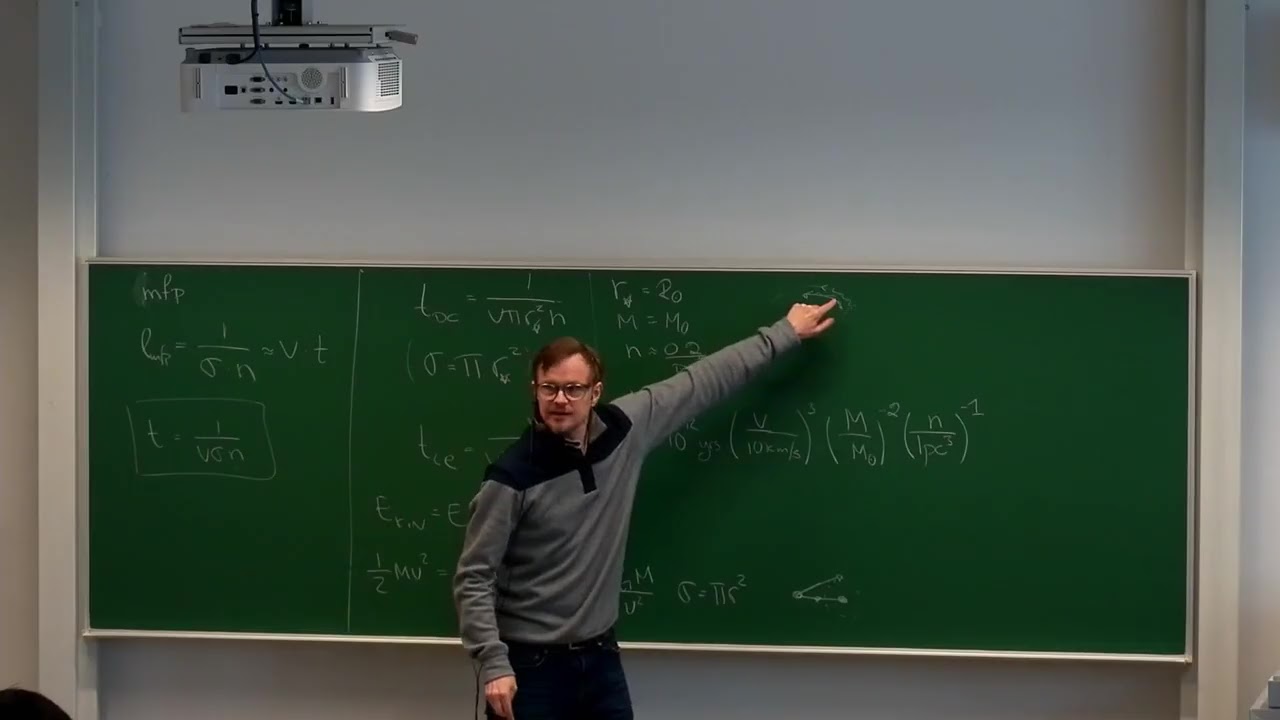
Galaxies and Cosmology: L2a - An estimate of stellar collision rates
Keywords
Summary
248 words
Critical Evaluation
Value of the Information & Strength of the Argument
The main value lies in the transparent construction of a quantitative answer to a qualitative question: why galaxies can be treated as collisionless despite containing many stars. The lecture does not merely state the result; it builds the estimate from the mean free path, separates direct collisions from gravitational close encounters, and shows how each choice of cross-section changes the scaling. The solar-neighbourhood calculation is especially useful because it makes the numerical hierarchy explicit: direct collisions are extraordinarily rare, close encounters are still far beyond a Hubble time, and the crossing time is much shorter. The extension to spherical systems gives a reusable scaling relation between collision time and crossing time, and the application to an elliptical galaxy shows how the same logic adapts to different N, radius and velocity dispersion. The argument is solid for order-of-magnitude purposes. Assumptions are stated: equal masses, a single characteristic velocity, a sharp collision radius, and simplified spherical geometry. The lecturer repeatedly warns that factors of order unity do not matter and invites a check of one arithmetic result, which strengthens credibility rather than weakening it. The contrast with gas atoms is a well-chosen control case because it changes the collision time by many orders of magnitude and explains why the physical modelling must switch from collisional kinetics to smooth gravitational potentials. The only substantive limitation is that the treatment is deliberately schematic: it does not derive distribution functions, relaxation theory, or the conditions under which close encounters become dynamically important in dense clusters.
Scientific Rigor, Source Quality, Title Accuracy
Rigour is that of a university lecture rather than a peer-reviewed paper. The derivations are standard mean-free-path and gravitational-encounter arguments, and the numerical inputs are conventional astrophysical values. The description points to Peter Schneider’s Extragalactic Astronomy and Cosmology for further reading on dynamics, and to the KU Leuven Institute of Astronomy and the associated course playlists for context. The recording itself does not provide inline citations for the adopted density or velocity dispersion, so those values are presented as accepted order-of-magnitude inputs rather than traced to a specific table or survey. The title is accurate and appropriately narrow: it promises an estimate of stellar collision rates within a galaxies and cosmology course, and the lecture delivers exactly that, extending it to close encounters, spherical systems and a gas comparison. No significant mismatch between title and content is apparent.
403 words
Title / Content Match
The title accurately signals a lecture-level estimate of stellar collision rates within a galaxies and cosmology course; the content delivers that estimate and extends it to spherical systems and gas collisions.
Quality & Reliability
8/10
Academic lecture by a university astronomer, built from standard mean-free-path and gravitational-encounter arguments; calculations are explicitly order-of-magnitude, assumptions and caveats are stated, and one arithmetic check is invited.
Key Moments
Markers derived by PSI from the transcript: the creator did not define chapters.
- Lecture opens with the exercise: derive mean time between close encounters and direct collisions for equal-mass stars and estimate it for the solar neighbourhood.
- Reintroduces mean free path and converts it to a characteristic collision time tau approximately 1/(sigma n v).
- Direct-collision cross-section taken as pi R_star squared, giving tau_direct approximately 1/(v pi R_star squared n).
- Close-encounter radius derived from kinetic energy equalling gravitational potential energy, r_close approximately 2GM/v squared, and inserted into the cross-section.
- Solar-neighbourhood values: solar mass and radius, n approximately 0.2 per cubic parsec, random velocity approximately 25 km/s; direct-collision time approximately 1.3 times 10 to the 20 years.
- Close-encounter time estimated around 10 to the 14 years and compared with the Hubble time and the age of the Sun.
- General spherical system: N equals nV, leading to collision time versus crossing time scaling; application to a giant elliptical galaxy.
- Elliptical-galaxy numbers give crossing time approximately 10 to the 8 years and far longer collision and close-encounter times; globular clusters and galaxy clusters are flagged as denser exceptions.
- Contrast with atoms in air: mean free path gives collisions about every 10 to the minus 9 seconds, motivating collisionless dynamics, smooth potentials and N-body simulations.
Cited Sources
- KU Leuven Institute of Astronomy — Institutional host and course context given in the description.
- Galaxies and Cosmology — raw classroom course playlist — Playlist for the live classroom recordings, including this lecture.
- Edited version of this class on StarlightWinds — Edited version of the same class referenced in the description.
- Edited Galaxies and Cosmology course playlist — Full edited course playlist referenced in the description.
- Peter Schneider, Extragalactic Astronomy and Cosmology: An Introduction (2015) — Further reading cited in the description for dynamics; no direct link supplied.
Concurring Sources
- Mean free path — Wikipedia — Defines the same mean-free-path relation used to set up the collision-time estimate.
- Stellar collision — Wikipedia — General background concordant with the lecture's conclusion that direct stellar collisions are rare in ordinary galactic environments.
- Vlasov equation — Wikipedia — Formal framework for the collisionless stellar dynamics discussed at the end.
- N-body simulation — Wikipedia — Concordant with the lecture's mention of N-body methods for smooth potentials.
Contribution & Novelties
The lecture’s originality is pedagogical and methodological rather than research-level. It makes explicit the chain from mean free path to stellar collision rates, then uses the same scaling to contrast direct collisions, gravitational close encounters, and gas collisions. A useful move is the comparison of local solar-neighbourhood times with global crossing-time scalings, which turns a simple exercise into a general argument for collisionless stellar dynamics. The lecture also flags where the conclusion weakens: dense globular clusters and cluster cores.
Further reading:
- Mean free path — Wikipedia: https://en.wikipedia.org/wiki/Mean_free_path — Background for the tau approximately 1/(sigma n v) estimate used throughout.
- Stellar collision — Wikipedia: https://en.wikipedia.org/wiki/Stellar_collision — Context on direct stellar collisions and their rarity.
- Vlasov equation — Wikipedia: https://en.wikipedia.org/wiki/Vlasov_equation — Formal basis for collisionless dynamics and smooth potentials.
- N-body simulation — Wikipedia: https://en.wikipedia.org/wiki/N-body_simulation — Numerical approach mentioned at the end.
- Globular cluster — Wikipedia: https://en.wikipedia.org/wiki/Globular_cluster — Dense stellar systems where close encounters can matter.
153 words
Radar Profile
The profile is consistently strong: information density, technical level, quality and reliability all sit in the upper range. The lecture is technically dense but explicitly framed as order-of-magnitude reasoning, so the high technical score does not come at the expense of transparency.