Galaxies and Cosmology: L5a - Active galaxies and quasars
Keywords
Summary
342 words
Critical Evaluation
Value of the Information & Strength of the Argument
The informational value lies less in novelty than in the coherence of the reconstruction: the lecture assembles a complete observational-to-physical chain for active galactic nuclei in under an hour, and each step is motivated rather than asserted. The strongest passage is the line-broadening argument, which is built as a genuine inference: measure widths of thousands of km/s, test the thermal hypothesis using a known scaling (10 km/s at 10^4 K, scaling as the square root of temperature), compute the required ~10^8 K, then reject it because the observed ionization stages (triple-ionized carbon, singly ionized magnesium) could not survive in such a gas. The rejection is not rhetorical but anchored in an independent observable, which is exactly what makes the subsequent bulk-motion interpretation credible. The second strong chain links the unresolved point-like appearance to a size upper limit of order 100 pc, then couples that radius with the virial/kinetic-energy argument to obtain ~10^10 solar masses inside 100 pc, and concludes that a cluster of stars cannot supply that luminosity, so a single compact object is required. The lecturer is explicit that these are order-of-magnitude estimates and repeats that caveat, which is appropriate and protects the argument from overreach. Elsewhere the treatment is more descriptive: the taxonomy of Seyferts, radio galaxies, quasars and blazars is presented as historically accreted nomenclature rather than derived, and the lecturer says so openly, which is honest but limits the argumentative density of that section. The unified model is sketched with the standard caveat that the torus is probably not the neat geometric structure drawn in textbooks. The discussion of demographics is careful in a way that is often missing from popular treatments: the redshift peak in quasar counts near z ~ 2 is immediately qualified by detection bias, with an explicit analogy to dwarf galaxies being locally abundant but invisible at high redshift, and the claim that quasars were roughly a thousand times more common at z ~ 3 is presented as surviving that correction. The closing Eddington-limit argument is well posed as an open problem rather than a solved one, with the growth-from-stellar-seed scenario shown to fail and alternatives deferred to a seminar. The main weakness is that several quantitative statements (radio luminosity thresholds, luminosity classes, the peak redshift) are delivered as remembered numbers without in-video derivation, and the blackboard accretion-disc derivation announced for the second part falls outside this recording, so the energetics are referenced rather than demonstrated.
Scientific Rigor, Source Quality, Title Accuracy
The scientific content is orthodox graduate-level astrophysics and matches the standard reference the lecturer names, Peter Schneider’s ‘Extragalactic Astronomy and Cosmology’ (2015), chapters 5 and 2, which he identifies as the backbone of the module; that is an appropriate and current textbook anchor for this material. Beyond that, sourcing is light: the spoken lecture cites no individual research papers, and the figures and examples are attributed in a generic way to lecture slides whose original references are not visible in the recording. Observational claims therefore rest on the lecturer’s authority and on the internal consistency of the derivations rather than on traceable citations, and quantities such as the radio luminosity threshold, the relative space densities of Seyferts and ellipticals, and the quasar space-density enhancement at z ~ 3 are given as order-of-magnitude figures without a stated provenance in the audio. To his credit, the lecturer repeatedly labels these as order-of-magnitude numbers, distinguishes empirical classification from physical explanation, and explicitly flags terminology drift in the literature (quasar as ‘quasi-stellar radio source’ versus modern usage, QSO versus quasar, radio-loud versus radio-quiet). He also volunteers that high-redshift quasar records are updated frequently and invites students to check the current holder during the break rather than asserting a value, which is a sound way to handle a fast-moving figure. Where the argument is quantitative, the arithmetic is shown and checkable; where it is not, the framing is descriptive and not overstated. On title/content adequacy: the title announces active galaxies and quasars for Module 5 part I, and the recording delivers precisely that scope, with no digression or inflated promise; the stated division between an introductory part and a blackboard accretion part is likewise honoured within the hour.
702 words
Title / Content Match
The title promises an introduction to active galaxies and quasars, and the lecture delivers exactly that: taxonomy, spectroscopic signatures, the unified model, demographics and the accretion/Eddington physics behind quasar luminosities. Very good match, with no overselling.
Quality & Reliability
8/10
Lecture delivered by a university professor of astronomy from established textbook material (Schneider, 'Extragalactic Astronomy and Cosmology', ch. 5), with explicit order-of-magnitude derivations that the lecturer flags as such. The physics presented (SED shapes, line-broadening arguments, black-hole mass estimate, unified model, Eddington limit, redshift demographics) is standard and internally consistent. No primary research papers are cited in the spoken content, and figures are attributed only to lecture slides that are not shown in the recording, so the traceability of specific numbers remains partial.
Key Moments
Markers derived by PSI from the transcript: the creator did not define chapters.
- Comparison of broadband spectral energy distributions: quiescent ellipticals peak in the infrared and are star-dominated, whereas quasars show a much wider SED with a UV 'blue bump' from accretion and a high-energy X-ray/gamma-ray tail, plus the radio-quiet/radio-loud split.
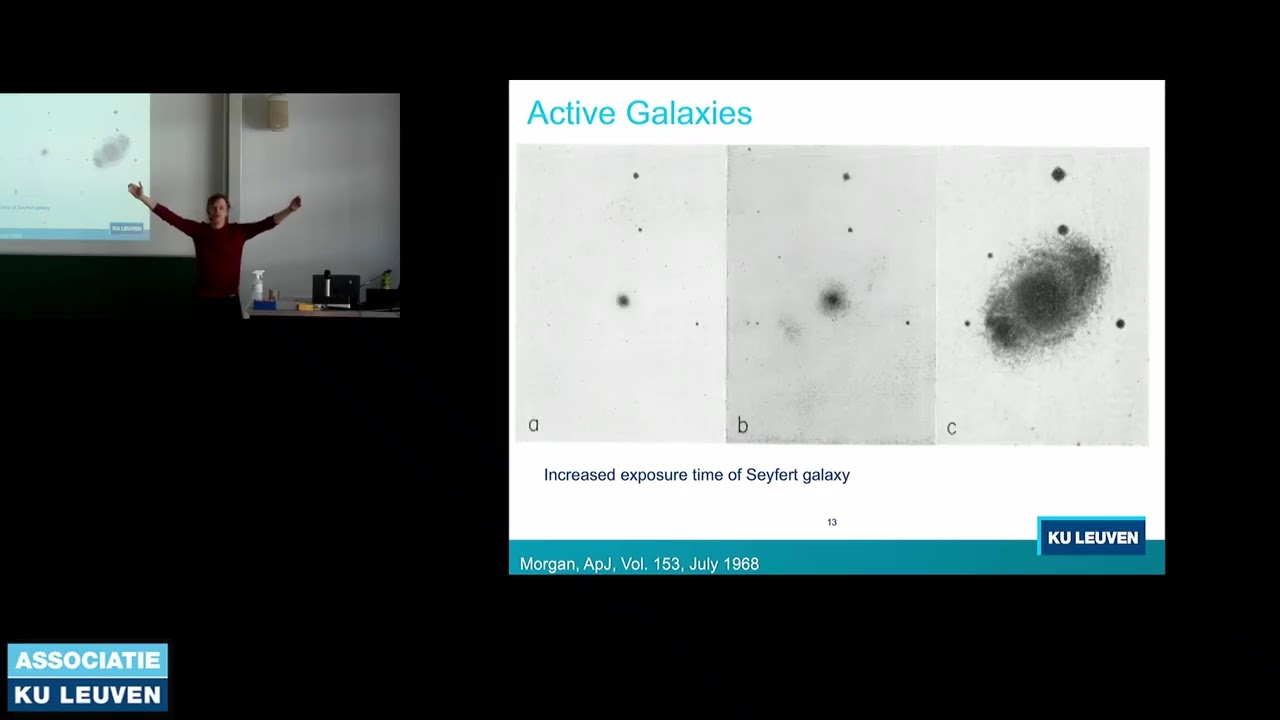
- Classic exposure-time sequence of a Seyfert galaxy: the nucleus looks point-like at short exposure while the spiral host emerges at longer exposure; distant quasars stay unresolved, which explains the historical name 'quasi-stellar object'.
- Broad emission lines as the key spectroscopic signature, with widths corresponding to velocities of thousands of km/s, far exceeding those measured in normal galaxies.
- Order-of-magnitude test of the thermal-broadening hypothesis: 10 km/s at 10^4 K scaling as the square root of temperature implies ~10^8 K, incompatible with the observed C IV and Mg II ionization states, so bulk motions are required.
- Combining an unresolved size limit of ~100 pc with velocities of a few thousand km/s yields ~10^10 solar masses inside 100 pc — too much for a star cluster and the historical argument for a single supermassive black hole.
- Observational taxonomy and its historical logic: Seyfert 1 (broad lines) versus Seyfert 2 (narrower, optically fainter), radio galaxies, quasars and blazars, with the warning that 'narrow' still means hundreds of km/s.
- Radio galaxies and their jets and lobes (Cygnus A), with radio emission from electrons accelerated to near light speed and extending on galaxy scales, distinct from the nuclear source itself.
- Anatomy of the unified model: supermassive black hole, efficient accretion disc, broad-line region, narrow-line region at larger radii, dusty obscuring torus and variable jets — the same physics seen at different viewing angles.
- Demographics and redshift evolution: active galaxies are rare locally, quasar counts peak near z ~ 2, and detection bias (only the most luminous systems remain visible at high redshift) must be removed before concluding that activity was far more common in the past.
- Eddington-limit argument applied to accretion: luminous quasars at z ~ 10 imply 10^9-10^10 solar mass black holes less than a billion years after the Big Bang, and growth from stellar-mass seeds at the Eddington rate is insufficient — the open seeding problem.
Cited Sources
- Institute of Astronomy, KU Leuven — Host institution of the course and of the lecturer; listed in the description as the institutional reference.
- Galaxies and Cosmology — raw classroom course playlist — Full unedited lecture series from which this Module 5, part I recording is taken.
- Galaxies and Cosmology — full edited course playlist — Edited counterpart of the course on the StarlightWinds channel, offered as an alternative viewing format.
- Edited version of this class (StarlightWinds) — Edited version of the same lecture, referenced in the description for a condensed presentation.
- Peter Schneider, Extragalactic Astronomy and Cosmology: An Introduction (2015), ch. 5 and selected material in ch. 2 — Textbook explicitly named as the further-reading anchor for the module; the lecturer states that figure and example references are given in the lecture slides.
Concurring Sources
- Active galactic nucleus — Wikipedia — Corroborates the unified-model anatomy (accretion disc, broad- and narrow-line regions, obscuring torus, jets) and the observational classes presented.
- Quasar — Wikipedia — Confirms the historical 'quasi-stellar radio source' terminology, the radio-loud/radio-quiet distinction and the current high-redshift detections.
- Eddington luminosity — Wikipedia — Supports the accretion-rate and black-hole-mass estimates used to argue that early supermassive black holes are difficult to grow from stellar-mass seeds.
- Cygnus A — Wikipedia — Consistent with the description of radio galaxies as jet/lobe systems whose radio emission arises from relativistic electrons on galaxy scales.
Contribution & Novelties
The added value is pedagogical rather than scientific: this is a live classroom reconstruction of the standard AGN picture, and its originality lies in the visible reasoning steps. Two chains in particular are built end to end rather than asserted — first the elimination of thermal broadening via an independent ionization-state argument, then the radius-plus-velocity route to a compact ~10^10 solar mass object. The lecture also keeps an explicit thread running from start to finish: why the Milky Way’s central black hole does not make us an active galaxy, with accretion efficiency as the answer. The treatment of redshift demographics is unusually careful for a lecture format, pairing every claim about past quasar abundance with the detection bias that inflates it, and the closing Eddington-limit discussion frames high-redshift supermassive black holes as an open problem in black-hole seeding rather than a settled result.
Pour aller plus loin (further reading):
- Active galactic nucleus — Overview of the taxonomy, unified model and emission components discussed in the lecture.
- Quasar — Historical definition (quasi-stellar radio source), radio-loud versus radio-quiet classes, and redshift record holders referred to in the closing section.
- Eddington luminosity — The radiative limit used here to bound accretion rates and infer black-hole masses for high-redshift quasars.
- Messier 87 — The nearby radio galaxy cited as a canonical example, with its resolved jet.
- Cygnus A — The textbook radio galaxy used to illustrate jets and lobes extending far beyond the nucleus.
- Supermassive black hole seeding (light seeds from stellar remnants versus heavy seeds from direct collapse) — the open problem raised at the end of the lecture and deferred to a seminar; no single canonical reference cited in the video.
279 words
Radar Profile
The profile is broad and high: strong on information quantity, technical level and reliability, reflecting a dense graduate lecture that moves from observation to physical inference with explicit ordre-of-magnitude checks. Quality is held slightly below the maximum by the reliance on remembered figures and by descriptive, citation-light passages on taxonomy and demographics.