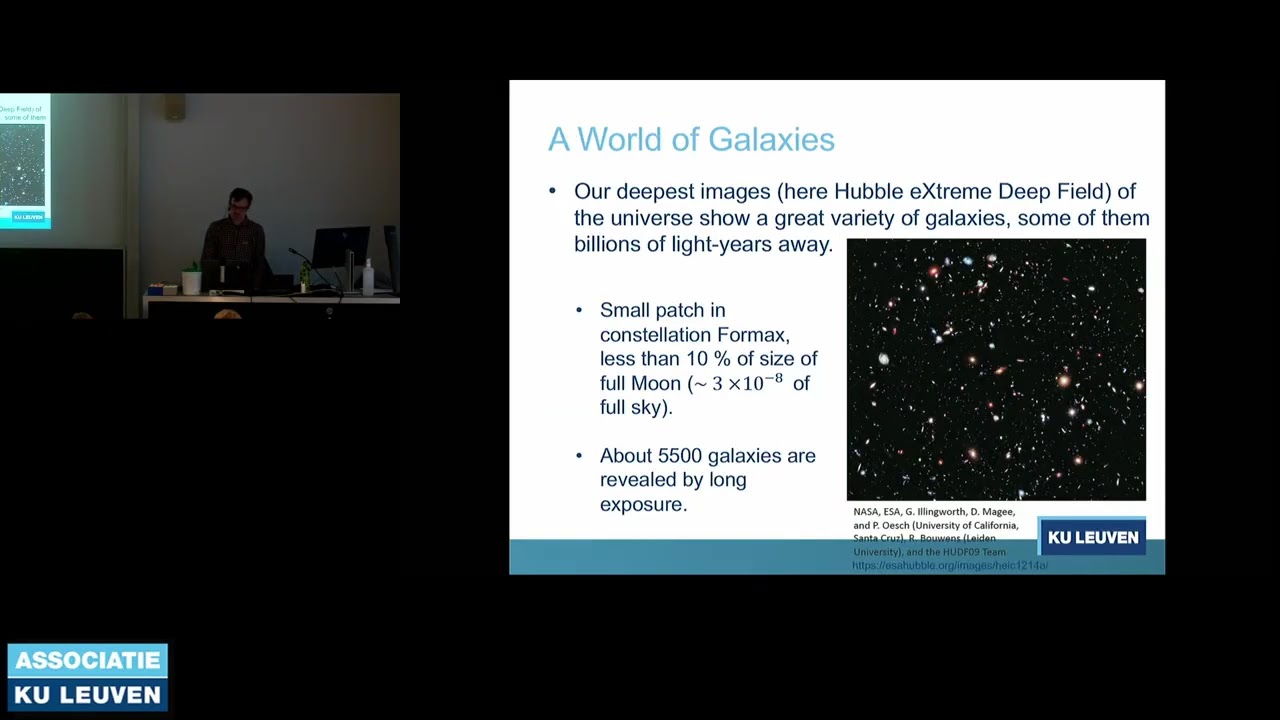
Galaxies and Cosmology: L1a - A world of galaxies
Keywords
Summary
337 words
Critical Evaluation
Value of the Information & Strength of the Argument
The informational value is high for an opening lecture: rather than a list of objects, the talk builds a working conceptual toolkit. Each definition is immediately stress-tested — the ‘many stars’ criterion is qualified by active galaxies whose luminosity is not stellar, and the ’luminous’ criterion is qualified by the dark halos that dominate the mass budget — which teaches the listener how astrophysical definitions are negotiated rather than simply asserted. The pedagogical scaffolding is effective: the classroom analogy for inside-out versus outside-in observation of the Milky Way makes the methodological handicap of our embedded vantage point immediately concrete, and the enclosed-mass numbers at 8 kpc versus 100 kpc turn that analogy into a quantitative statement about dark matter. The colour argument is the strongest chain in the lecture: blue spiral arms imply ongoing star formation, ongoing star formation implies short-lived massive stars, the steep mass-luminosity scaling (roughly L ∝ M^3) implies those stars dominate the light out of proportion to their numbers, and their rapid death explains the red, old populations of gas-poor ellipticals. This is a causal sequence, not a catalogue, and it is what makes the subsequent morphological classification meaningful. The argumentation is honest about its own limits: the precise definition of a galaxy is called non-trivial and flagged as something to keep in mind throughout the course; the Hubble sequence is explicitly declared not to be an evolutionary sequence, with the caveat that the true relation may be closer to the reverse; the claim that most galaxies are dwarfs is marked as an inference from the local neighbourhood rather than a direct census, because distant dwarfs are lost in the glare of giants. The interaction-driven scenario for ellipticals is offered as a plausible leading explanation with appropriate modal language rather than as settled fact. Quantitative content is deliberately approximate — order-of-magnitude star counts, a 20 kpc disc scale, a rough cubic mass-luminosity law — which is appropriate at the orientation stage but means the lecture is not a source of precise values. The weakest passages are the most topical ones: the reference to a newly announced very high-redshift quasar is given without the actual number and with visible hesitation, and the description of AGN unification is sketched at a level that will need substantial later development. The lecture also deliberately defers most of its content (‘we will come back to this many times’), so its standalone argumentative completeness is low even though its orienting value is high.
Scientific Rigor, Source Quality, Title Accuracy
Sourcing is explicit and institutional rather than journalistic: the description names Peter Schneider’s Extragalactic Astronomy and Cosmology: An Introduction (2015), Chapter 1, as the accompanying reading, and states that references for the figures and examples are carried in the lecture slides where used. That is a coherent and standard pairing of a master’s lecture with a recognised textbook, and the lecturer’s institution (KU Leuven Institute of Astronomy) is linked. The weakness is that the slides themselves are not part of the published material, so several figures — the Extreme Deep Field annotation, the multi-wavelength Milky Way composite, the modified tuning fork with boxy/discy ellipticals, the guest astrophotography — are shown but their provenance is only asserted, not traceable from what is published. Measurements are generally attributed to named objects (M87, the Sagittarius stream, the Virgo cluster) rather than to specific papers, which is normal for a lecture but limits verifiability. The lecturer’s own framing invites correction from viewers, and he explicitly declines to quote a figure he is unsure of (the recent high-redshift quasar), which is a good sign of calibration. No source is misrepresented and no claim is overstated as consensus when it is not. Regarding title and content: the title announces a first lecture (‘L1a’) on ‘a world of galaxies’ within a galaxies-and-cosmology course, and the recording is exactly that — an orientation pass through galaxy definitions, classes and components, with cosmology flagged as the companion subject to be developed later. The mismatch is nil, and the title does not promise anything the lecture fails to deliver.
685 words
Title / Content Match
The title announces an introductory overview of galaxies, and the content delivers exactly that: definitions, morphological classes, multi-wavelength caveats and a first pass at AGN and dark halos. Perfect match.
Quality & Reliability
8/10
University lecture by a specialist in the field, delivered within a structured master's programme and explicitly anchored in a standard textbook chapter (Schneider 2015, Ch. 1). The physics invoked (mass-luminosity relation, stellar populations, interstellar extinction, accretion luminosity) is textbook-consolidated and presented with appropriate hedging. A few figures and quantitative claims are given from memory and flagged as approximate by the lecturer himself; one recent quasar record is mentioned without quoting the value. No commercial bias, no sensationalism.
Key Moments
Markers derived by PSI from the transcript: the creator did not define chapters.
- Attempting a definition of a galaxy: gravitationally bound system, many stars, visible in radiation — and why the definition is not trivial.
- Scales: typical stellar content, luminous disc extent (~20 kpc) versus mean intergalactic distance, and the analogy with stellar radii versus nearest-star distances.
- Anatomy of the Milky Way: disc and spiral arms, bulge and central supermassive black hole, stellar halo and globular clusters, and the larger dark halo.
- Enclosed mass at 8 kpc (~10^11 solar masses) versus 100 kpc: most of the mass lies outside the Sun's orbit.
- Hubble Extreme Deep Field: about 5,500 galaxies in a patch roughly a tenth of the full Moon, and the link between galaxy observation and cosmology.
- Why spirals are blue: ongoing star formation, hot massive short-lived stars, steep mass-luminosity scaling, and the reddening once gas is exhausted.
- Interacting galaxies: colliding spirals and irregular morphologies, the Sagittarius dwarf being accreted, and the future Milky Way–Andromeda encounter.
- Active galaxies: central accretion luminosity, AGN unified model with torus and jets, quasars as unresolved point sources, and why the Milky Way is not active.
- In-lecture multiple-choice question on why strong ongoing star formation produces a blue-white appearance, with the answer discussed.
- The Hubble tuning fork and what actually varies along it: bulge-to-disc ratio, bars, stellar mass, angular momentum, age, mass-to-light ratio and colour.
Cited Sources
- Peter Schneider, Extragalactic Astronomy and Cosmology: An Introduction (2015), Chapter 1 — Textbook designated as the further reading for this lecture; figure and example references are given in the lecture slides where used.
- Institute of Astronomy, KU Leuven — Host institute of the course and the lecturer, linked in the description.
- Raw classroom course playlist (Galaxies and Cosmology) — Full unedited lecture series this recording belongs to.
- Edited version of this class (StarlightWinds channel) — Cut version of the same lecture, offered as an alternative to the raw recording.
- Full edited course playlist — Complete edited lecture series from the same lecturer.
Concurring Sources
- Galaxy — Wikipedia — Confirms the standard characterisation of galaxies as gravitationally bound systems of stars, gas, dust and dark matter, and the difficulty of a sharp definition.
- Hubble sequence — Wikipedia — Supports the description of the tuning fork, the ordering by bulge-to-disc ratio and the explicit point that it is not an evolutionary sequence.
- Active galactic nucleus — Wikipedia — Corroborates the unification-by-viewing-angle picture, accretion onto a central black hole, jets and the quasar/blazar/radio-galaxy family.
- Dark matter halo — Wikipedia — Matches the claim that galaxies are embedded in extended non-luminous halos inferred from gravitational dynamics, and that dwarf galaxies show high inferred dark-matter fractions.
- Andromeda Galaxy — Wikipedia — Consistent with the statement that the Milky Way and Andromeda are approaching each other and will merge, contrary to the local Hubble flow.
Contribution & Novelties
No new empirical result is presented — this is an orientation lecture, and its contribution is structural rather than novel. Its distinctive value lies in the ordering of the argument: definition first, then scale, then colour as a physical tracer of star-formation history, then morphology as a consequence rather than a taxonomy, and only afterwards classification. That sequence makes the Hubble tuning fork arrive as an interpretation of correlated physical parameters (bulge-to-disc ratio, angular momentum, stellar mass, age, mass-to-light ratio, colour) rather than as a memorised diagram, and it explicitly warns against the persistent misreading of the fork as an evolutionary path. The lecture also integrates two themes that are often kept in separate introductory treatments: the inside-out observational handicap of studying the Milky Way from within, made concrete by a classroom analogy and then quantified through enclosed mass, and the ubiquity of non-luminous halos inferred gravitationally. The closing multi-wavelength Milky Way image, used to demonstrate interstellar extinction hiding the bulge in optical light, ties extragalactic classification back to radiative processes in a way that makes the wavelength-dependence of morphology explicit.
Further reading:
- Galaxy — Overview of definitions, classes and the observational basis discussed in the opening minutes.
- Hubble sequence — The tuning fork and its physical correlates, including the caveat that it is not an evolutionary sequence.
- Active galactic nucleus — Unified model, accretion luminosity, obscuring torus and jets, sketched here at orientation level.
- Dark matter halo — The non-luminous component inferred from gravitational motions of stars and dwarfs.
- Hubble Ultra-Deep Field — Context for the deep-field image and its ~5,500 galaxies per small patch.
- Globular clusters versus dwarf galaxies — mass can be comparable while spatial extent and inferred dark-matter content differ sharply; a distinction the lecture flags and promises to revisit quantitatively.
295 words
Radar Profile
The profile is broad and balanced: high on information quantity and technical level, driven by a dense but well-organised sweep through definitions, scales, stellar populations and AGN physics. Quality and reliability sit close behind, kept slightly below the maximum by the reliance on approximate numbers and by figures whose provenance is only asserted in unpublished slides. The shape is that of a strong orienting lecture rather than a specialised deep dive.