Galaxies and Cosmology: L8d - Cosmological parameters and evidence for Lambda
Keywords
Summary
312 words
Critical Evaluation
Value of the Information & Strength of the Argument
The informational value lies in synthesis rather than novelty. Within a single session the lecturer assembles a coherent causal chain: decoupling lowers the Jeans mass, Hubble drag keeps linear growth slow, cold dark matter supplies early potential wells, and the resulting acoustic imprints are then read off the microwave background as a measuring stick for geometry. That chain is the real content, and it is presented with the right ordering of magnitude-versus-precision: order-of-magnitude estimates were done at the board, while the precise parameter extraction is delegated to Planck’s fitting and to data-analysis courses. The argumentative structure is cumulative and explicit. Each probe is shown to constrain a different direction in parameter space (microwave background peaks pin curvature towards flatness, cluster masses give a total matter density around 0.3, supernovae constrain the acceleration), and the concordance region is presented as their intersection rather than as the result of any single data set. The lecturer also states the physical reasoning behind the supernova result instead of merely quoting it: objects appear dimmer than a decelerating model predicts, hence further away, hence the expansion must have accelerated. Notable is the explicit epistemic hygiene. Inflation is labelled a working hypothesis whose details belong to another course; the supernova Hubble diagram is admitted to look unconvincing by eye and defended on statistical grounds; the repeated re-testing over roughly 25 years is offered as the reason for confidence, not the elegance of the model. Equally notable is the meta-argument distinguishing ‘modify Lambda-CDM’ (varying the equation-of-state parameter, allowing time dependence) from ‘replace the framework’, a distinction the lecturer presents openly as his own opinion and explicitly leaves room to contest. The weaknesses are those of the oral classroom format. Several derivations are referenced rather than performed, a few sentences are garbled or self-corrected mid-flow, the numerical values quoted are approximate (‘on the order of 0.3’, ‘of order one degree’), and the audience is asked to accept slide figures that the recording does not show. The small-scale problems are listed without quantification. The reasoning overall is sound and internally consistent, but it functions as a guided tour of established results rather than as an independent demonstration.
Scientific Rigor, Source Quality, Title Accuracy
The sources invoked are the standard observational pillars of the field: WMAP and Planck maps of the microwave background, the Supernova Cosmology Project Hubble diagram, cluster mass measurements, and the Aquarius and Millennium dark-matter simulations, with the Vera Rubin Observatory anticipated for future transient detection. The course anchors these in a named textbook, Peter Schneider’s Extragalactic Astronomy and Cosmology (2015), with chapters 7 and 8 indicated as further reading, and the lecturer states that figure references are carried on the lecture slides. No primary research papers are cited in the audio, so the chain from claim to publication is implicit and rests on the textbook and on the audience’s trust in the standard literature; this is normal for a lecture but it limits verifiability from the recording alone. Two caveats are handled with care rather than glossed over: the calibration transfer from local to distant supernovae is described as an assumption (‘we need to hope that they are the same’), and the extinction correction is named as an obstacle that must be solved before any distance can be trusted. The claim that the acceleration result has survived repeated scrutiny for roughly 25 years is accurate at the level of the field, but it is asserted globally without itemising which surveys or tensions. The treatment of the open problems is balanced: Hubble tension, cusp-core, too-big-to-fail and missing satellites are named, and the lecturer resists presenting them as refutations, explicitly separating parameter adjustment from framework replacement and flagging that separation as a personal judgement. On title-content fit, the session matches its announced subject closely, delivering both the parameter description and the observational case for Lambda, with the recap of growth physics and simulations serving as necessary context rather than digression.
661 words
Title / Content Match
The segment delivers what the title announces: how observations constrain cosmological parameters and why a cosmological constant was reintroduced. It also spends time recapping earlier material on structure formation and simulations, which is contextual rather than off-topic.
Quality & Reliability
8/10
University lecture delivered by a specialist in an accredited master's programme, based on a standard textbook (Schneider 2015) and on mainstream observational results (Planck, WMAP, Type Ia supernovae, cluster masses). The physics presented is the consensus Lambda-CDM framework, the lecturer explicitly flags what is hypothesis (inflation) versus what is measured, and open problems are stated rather than hidden. Points are deducted because the argument is delivered orally over slides that are not visible in the recording, no primary references are cited in the audio, and several quantitative steps are delegated ('look that up', 'do some numerical work') rather than shown.
Key Moments
Markers derived by PSI from the transcript: the creator did not define chapters.
- Recap of the structure-formation module: gravitational collapse, when growth started, and which components are needed to match observed structures.
- Nonlinear regime requires numerical simulations; dark-matter-only runs from the Aquarius and Millennium programmes are introduced.
- Where the primordial fluctuations came from: inflation presented as a working hypothesis, deferred to a more specialised course.
- Summary argument: radiation pressure before decoupling suppresses growth by raising the Jeans mass; afterwards baryons collapse bottom-up.
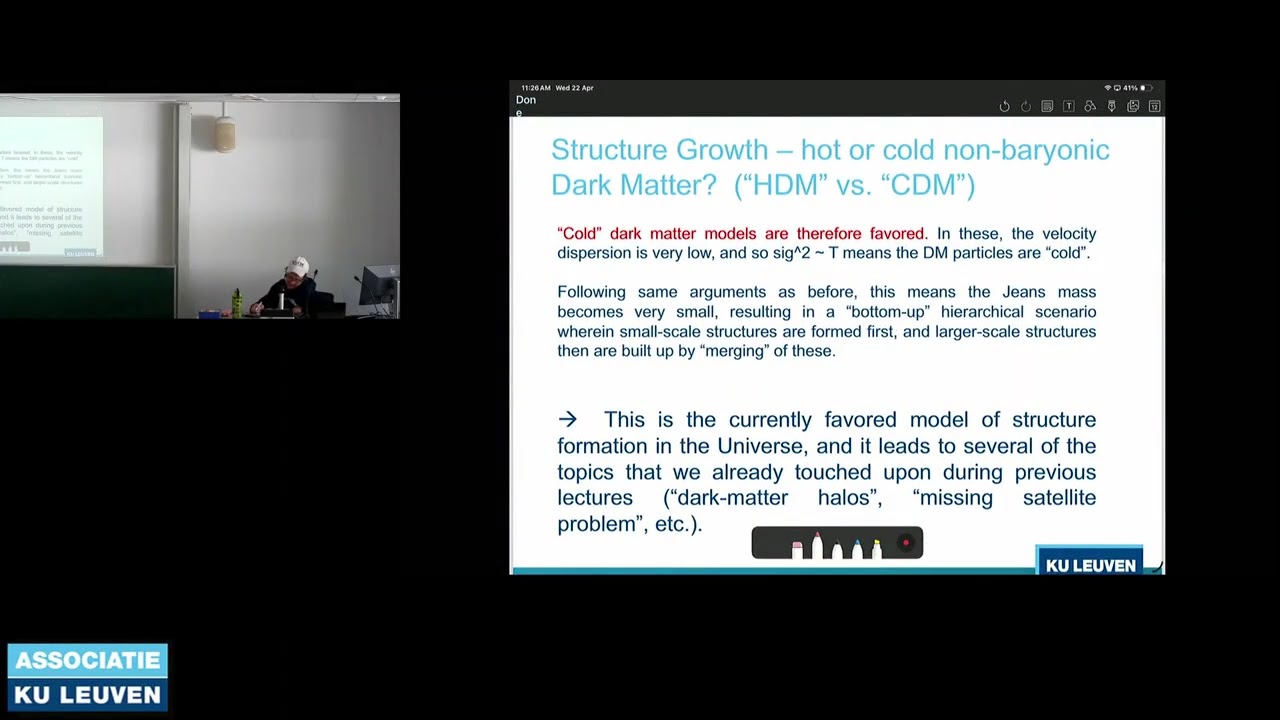
- Growth is only linear in the scale factor because of Hubble drag; cold dark matter builds the potential wells into which baryons fall, whereas hot dark matter fails.
- Planck anisotropies: the first acoustic peak near one degree and its sensitivity to H0, matter density and curvature; mention of the Hubble tension.
- Type Ia supernovae as standard candles: Chandrasekhar-limit progenitors, luminosity distance in a cosmological model, and the obstacles of extinction and transient detection.
- The supernova Hubble diagram: high-redshift events are dimmer than a decelerating model predicts, implying accelerated expansion and Lambda.
- Combining microwave background, cluster masses and supernovae converges on Omega_m about 0.3 with roughly 0.7 in Lambda in a flat universe.
- Open problems: time-dependent or non-standard dark energy, Hubble tension, and small-scale issues (cusp-core, too-big-to-fail, missing satellites).
Cited Sources
- Institute of Astronomy, KU Leuven — Institutional page of the hosting institute, given in the description as the lecturer's affiliation.
- Galaxies and Cosmology - raw classroom course (playlist) — Full unedited lecture series to which this recording belongs.
- Galaxies and Cosmology - edited course (playlist) — Edited version of the same course, referenced in the description.
- Edited version of this class (StarlightWinds) — Polished recording of the same lecture, provided by the lecturer as an alternative.
- Peter Schneider, Extragalactic Astronomy and Cosmology: An Introduction (2015), chapters 7-8 — Textbook named in the description as the reference for the lecture material and figures; no URL given by the lecturer.
Concurring Sources
- Lambda-CDM model (Wikipedia) — Standard concordance framework; matches the roughly 0.3 matter and 0.7 dark-energy budget and the flat geometry discussed.
- Type Ia supernova (Wikipedia) — Covers the Chandrasekhar-limit progenitor scenario and the standard-candle use presented in the lecture.
- Cosmic microwave background (Wikipedia) — Acoustic peak structure and the Planck/WMAP anisotropy measurements used to constrain curvature and parameters.
- Baryon acoustic oscillations (Wikipedia) — The sound-wave imprint before decoupling, which the lecturer derives qualitatively and then reads off the microwave background.
- Vera C. Rubin Observatory (Wikipedia) — Facility the lecturer expects to deliver large numbers of transient detections, including distant Type Ia supernovae.
Contribution & Novelties
The session contains no new measurement or original result; its contribution is pedagogical and methodological. It reconstructs the full evidential logic by which a cosmological constant returned to the standard model, and it does so by keeping three independent probes separate before combining them: acoustic peaks fixing geometry, cluster masses fixing the total matter density, supernovae fixing the acceleration. The most transferable element is the explicit distinction between adjusting the free parameters of Lambda-CDM (allowing a different equation-of-state parameter, or time dependence) and abandoning the framework altogether, a distinction the lecturer presents as his own reading and explicitly opens to disagreement. Also useful is the honest accounting of the practical obstacles on the supernova route, in particular the calibration transfer from local to distant events, which is where most of the systematic uncertainty actually sits.
For further reading / Pour aller plus loin :
- Lambda-CDM model — reference frame for the Omega_m about 0.3 / Omega_Lambda about 0.7 concordance discussed.
- Type Ia supernova — progenitor physics, Chandrasekhar limit and the standard-candle assumption.
- Cosmic microwave background — acoustic peak structure and the Planck constraints on curvature.
- Baryon acoustic oscillations — the sound horizon imprinted before decoupling.
- Vera C. Rubin Observatory — the transient survey expected to enlarge the supernova samples.
- Peter Schneider, Extragalactic Astronomy and Cosmology: An Introduction (2015), chapters 7-8 — the textbook the lecturer designates as the written counterpart of these slides, cited here by name only.
238 words
Radar Profile
The profile is that of an advanced lecture: technical level and information quantity are high, supported by a mature observational framework, while quality and reliability sit slightly below because the derivations are partly deferred and no primary literature is cited in the audio. The weak axis is verifiability from the recording itself, since key figures live on slides that are not shown.