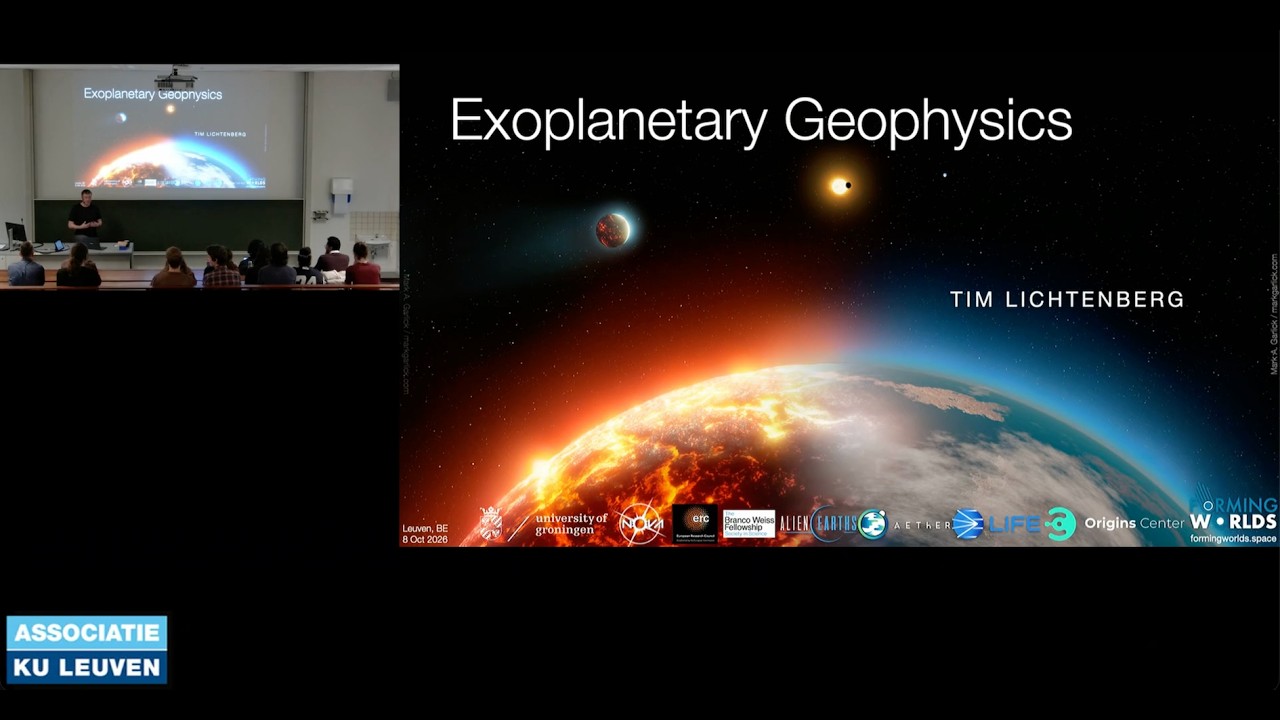
IvS Seminar: Tim Lichtenberg (08/10/2026)
Keywords
Summary
140 words
Critical Evaluation
Value of the Information & Strength of the Argument
The talk provides valuable insight into the emerging field of exoplanetary geophysics, presenting new observational trends and theoretical interpretations. The argumentation is solid, using quantitative comparisons and clearly explaining the logical chain from observations to conclusions. The speaker effectively demonstrates how internal processes can alter atmospheric detectability, challenging conventional wisdom. The discussion is rigorous, with appropriate caveats about degeneracies and biases.
Scientific Rigor, Source Quality, Title Accuracy
The scientific rigor is high, with clear reasoning and consistency with current literature. However, specific citations are not provided in the video description, limiting direct verification. The title accurately reflects the content.
108 words
Title / Content Match
The title accurately reflects the content, which is an academic seminar on exoplanetary geophysics.
Quality & Reliability
8/10
Seminar by an expert in exoplanetary geophysics, presenting recent results and methods with clear scientific reasoning. However, as it is a single source, claims are not independently peer-reviewed here.
Key Moments
Markers derived by PSI from the transcript: the creator did not define chapters.
Contribution & Novelties
The presentation offers a novel perspective on how interior geochemistry and geophysics determine atmospheric composition and evolution, particularly for ultra-short period super-Earths. It integrates recent JWST observations with theoretical models of magma oceans and volatile outgassing, providing a framework to interpret observed trends. The talk also highlights the importance of considering phase states beyond simple solid/atmosphere dichotomy, such as supercritical regimes.
Pour aller plus loin :
- Magma ocean — Relevant to the molten phase state of early exoplanets and its role in atmospheric outgassing.
- Sub-Neptune — Class of exoplanets discussed, with distinct interior and atmospheric compositions.
- James Webb Space Telescope — Instrument enabling high-resolution transit and eclipse spectroscopy of exoplanets.
110 words
Radar Profile
The high level of technical detail and information quantity indicate a dense, expert-level presentation. The balance between new observational data and theoretical modeling is reflected in the scores, suggesting a reliable but not fully cross-verified source.