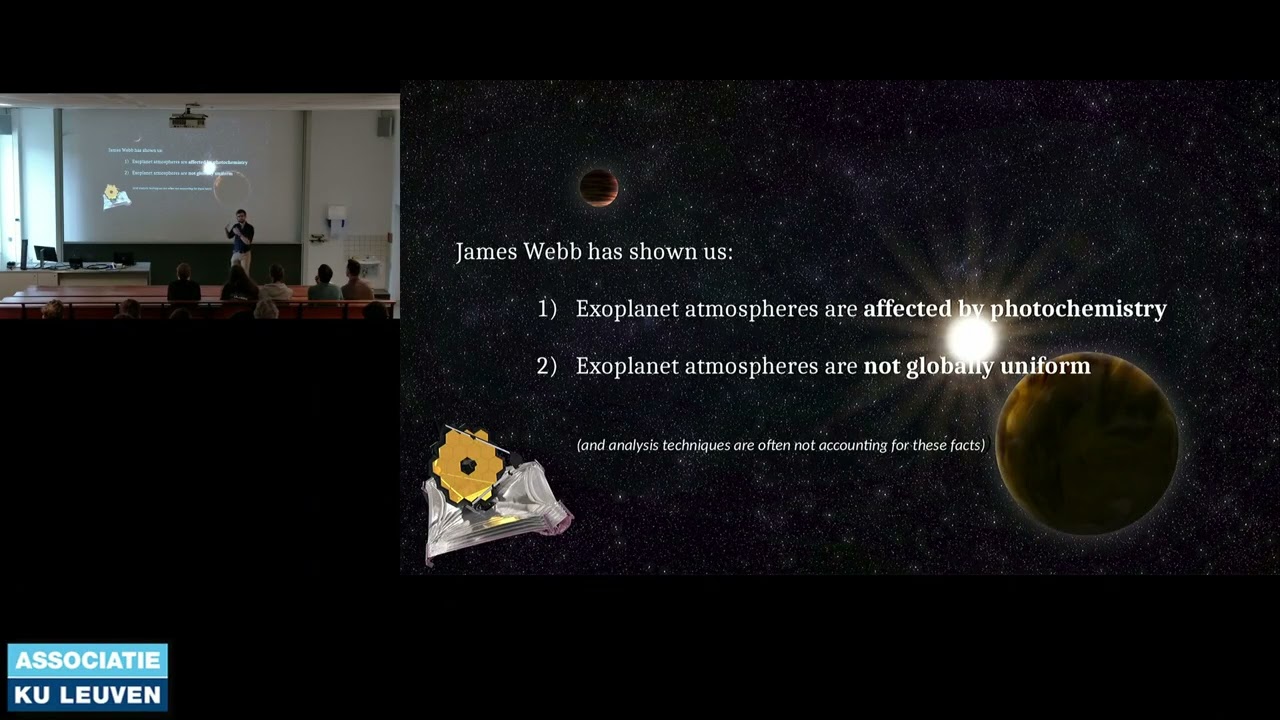
IvS Seminar: Robin Baeyens (23/09/2025)
Keywords
Summary
183 words
Critical Evaluation
Value of the Information & Strength of the Argument
The talk provides valuable insights into the role of photochemistry in shaping exoplanet atmospheres, synthesizing recent observations and modeling efforts. The argumentation is solid: Baeyens systematically builds from basic principles to a specific case study, demonstrating that photochemical processes, when coupled with atmospheric circulation, can explain observed asymmetries. He clearly presents his modeling approach and verifies that photochemistry is a necessary condition for HCN formation on the night side, thereby strengthening his claims. The discussion of uncertainties (e.g., upper atmosphere temperature, 3D effects) shows scientific honesty. However, the talk is a seminar presentation rather than a peer-reviewed article, and some claims rely on preliminary or aggregated data with large error bars, which he acknowledges. Overall, the value is high for researchers and students interested in exoplanet atmospheric science.
Scientific Rigor, Source Quality, Title Accuracy
The scientific rigor is commendable: Baeyens refers to established concepts (core accretion, condensation sequences) and recent JWST findings, and he contrasts his models with observations. He cites multiple papers, though not with full bibliographic details, and the lack of URLs in the description limits direct verification. The adequacy between title and content is direct: the title is a standard seminar label, and the content matches exactly. The speaker clearly distinguishes between his own work and literature, and he acknowledges limitations such as the absence of temperature feedback in his models. The talk would benefit from explicit source citations, but the internal consistency of the argument and reliance on well-known studies contribute to its reliability.
257 words
Title / Content Match
The title is a generic seminar announcement; the content matches as it is indeed a seminar talk on exoplanet atmospheres.
Quality & Reliability
8/10
Talk by a researcher presenting his own modeling work, with references to recent literature (e.g., JWST observations). The content is scientifically plausible and well-argued, but not peer-reviewed in this format.
Key Moments
Markers derived by PSI from the transcript: the creator did not define chapters.
- Introduction: importance of photochemistry in exoplanet atmospheres.
- Mass–metallicity relationship and carbon-to-oxygen ratio as formation tracers.
- JWST observations: SO2, HCN, and other photochemical species; 3D asymmetries.
- Grid of photochemical models; trends with temperature and UV.
- Case study: WASP-76b – 3D GCM and chemical kinetics; HCN formation on nightside.
- Future directions: ion-neutral chemistry, thermal feedback, and observational implications.
Cited Sources
- Study on exoplanet mass–metallicity relationship (2017) — Mentioned as an early plot of exoplanet metallicity measurements vs. mass.
- Classic paper on C/O ratio in protoplanetary discs (2011) — Cited as the idea linking carbon-to-oxygen ratio to planet formation location.
- WASP-39b JWST detection and photochemical model — Referenced as the first JWST evidence of photochemistry producing SO2.
- R. Baeyens' earlier grid of photochemical models — His own study on trends of photochemical species with temperature and UV.
Contribution & Novelties
The original contribution is the integrated 3D modeling of WASP-76b, showing that photochemistry on the dayside, combined with atmospheric circulation, generates HCN on the nightside, explaining observed asymmetries. This challenges the assumption that photochemistry only operates on illuminated hemispheres and highlights the need for 3D and chemical kinetics coupling in exoplanet studies. The talk also emphasizes that such effects can bias derived atmospheric properties like metallicity.
Pour aller plus loin :
- Exoplanet atmosphere - Wikipedia — Overview of composition, observations, and modeling.
- Photochemistry - Wikipedia — Basic principles of photochemical reactions relevant to atmospheres.
- Hot Jupiter - Wikipedia — General characteristics of hot Jupiters, including ultra-hot variants.
- WASP-39b - Wikipedia — Specific planet with JWST SO2 detection, illustrating photochemistry.
119 words
Radar Profile
The radar profile shows high scores across all dimensions, particularly in technical level and information quality, indicating a dense and scientifically robust presentation. The slightly lower reliability score reflects the seminar format and lack of direct source links, but overall the talk is well-founded.