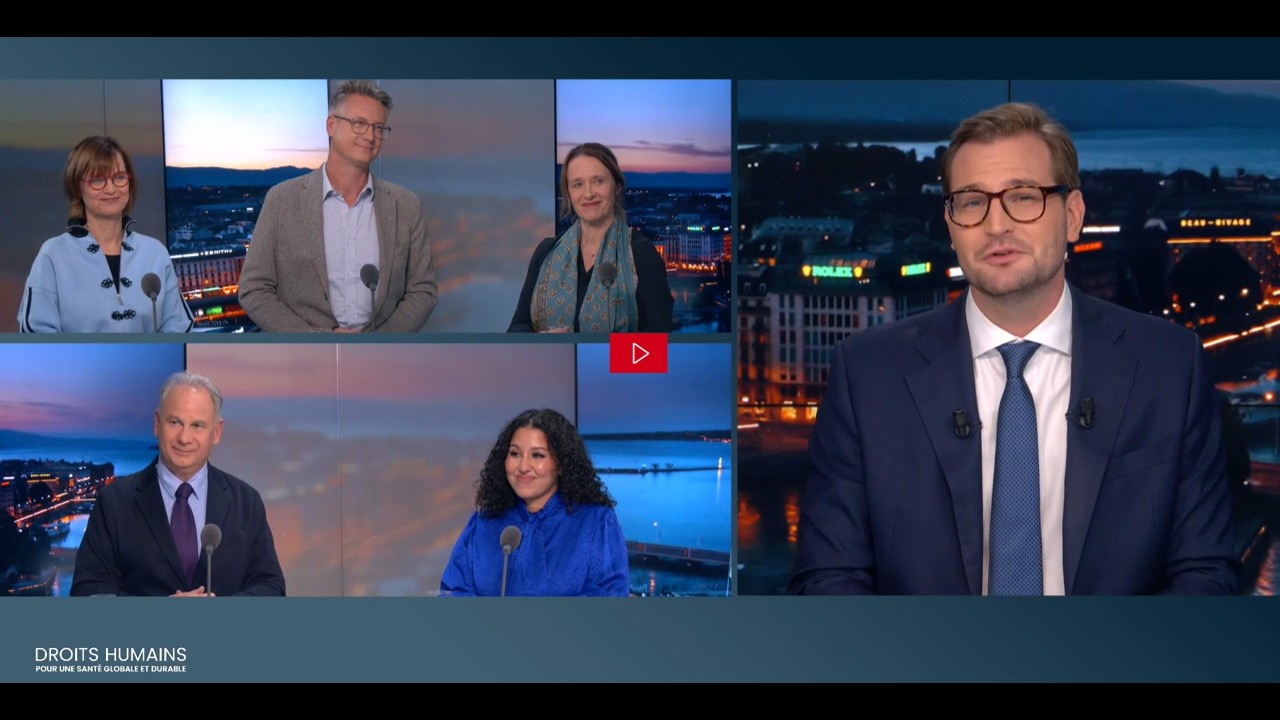
Émission spéciale "Droits humains : pour une santé globale et durable"
Special Broadcast: "Human Rights: Toward Global and Sustainable Health"
Title history
- Émission spéciale "Droits humains : pour une santé globale et durable" — observed on 20261108-0954 UTC (YouTube)
Keywords
Summary
204 words
Critical Evaluation
Value of the Information & Strength of the Argument
The value of this exchange lies in the diversity and complementarity of the speakers’ perspectives: a clinician, a legal scholar, a public health officer, a political scientist, and a student. This structure provides a rich, multi-dimensional look at health policy. The arguments put forth are anchored in concrete examples—the historical HIV response, the rapid Covid-19 timeline, and the current Swiss healthcare system’s financial access barriers—which strengthens their persuasiveness. The criticism of the Swiss system is well-founded, referencing the gap between the legal obligation to care and the financial burden that prevents access. Furthermore, the discussion on information as a determinant of health is highly relevant, connecting the past tactics of the tobacco industry to current online misinformation. However, the format remains a televised debate, so arguments are presented logically but not deeply evidenced; the claims made by the experts, while credible, are illustrative rather than backed by specific statistical data or cited studies on air.
Scientific Rigor, Source Quality, Title Accuracy
Scientific rigor is moderate and largely based on the speakers’ professional opinions and anecdotal references to well-known institutions (WHO, UNAIDS, the Global Fund). No specific academic articles or reports are directly cited during the conversation, which limits the verifiability of certain statements. The mention of the tobacco industry’s historical influence on science is a valid reference but is not detailed. The title, ‘Special programme Human rights for a global and sustainable health’, is perfectly aligned with the content, clearly indicating the broadcast context and the thematic focus. The adequacy of the title is a strong plus, as it transparently sets expectations for a specialized discussion rather than a news summary, without misleading the viewer about the nature of the content.
290 words
Title / Content Match
The title accurately reflects the content: a special episode of Léman Bleu broadcast ahead of UNIGE's Human Rights Week, focusing on the link between human rights and global health.
Quality & Reliability
7/10
The discussion relies on the recognized expertise of professionals (infectiologist, legal scholar, cantonal physician, political scientist) and references key institutions (WHO, UNAIDS, Global Fund), but does not present unpublished data or verifiable scientific citations within the video itself, limiting strict independent verification.
Key Moments
Markers derived by PSI from the transcript: the creator did not define chapters.
- Frédéric Esposito introduces the goals of Human Rights Week and its focus on health, linking it to Geneva's role in human rights.
- Alexandra Calmy explains how the HIV response created the modern framework of global health governance, and discusses its current fragility.
- Alessandro Cassini addresses the lack of a fundamental right to health in the Swiss federal constitution, contrasting it with Geneva's more progressive legal framework.
- Ibat Allah Habli highlights the medical gaslighting and diagnostic delays concerning endometriosis, calling for legal recognition and protection for affected women.
- The panel discusses the high costs of Swiss health insurance, the limits of the current system, and the essential role of reliable scientific information as a determinant of health.
Cited Sources
- World Health Organization (WHO) — Referred to as the main international institution for health, whose leadership and role in global governance are discussed.
- UNAIDS — Cited as a key organization in the global HIV response, illustrating the evolution of health governance.
- The Global Fund — Mentioned as a major funding mechanism for global health, particularly in the context of HIV and pandemic preparedness.
Concurring Sources
- World Health Organization - The right to health — Corroborates the idea that health is a fundamental human right, which is the central premise of the panel.
Contribution & Novelties
The unique contribution of this program lies in bridging the legal-theoretical framework of human rights with the concrete medical and social realities in Switzerland, particularly through the intergenerational dialogue between established experts and a law student. It sheds light on the often-overlooked legal dimension of health, such as the absence of a federal right to health in Switzerland, and brings up-to-date discussions on medical gaslighting and endometriosis, which are rarely addressed in mainstream health policy discourse.
For further exploration:
- Right to health — Essential background on the legal foundations of the right to health as a human right.
- Universal health coverage — Relevant to the discussion on access to care and the Swiss insurance system.
- HIV/AIDS pandemic — Contextualizes the historical development of the global HIV response discussed by Professor Calmy.
131 words
Radar Profile
The radar profile shows a well-balanced exchange with high scores in information quality (8) and reliability (7), but a moderate technical level (5), reflecting the accessible nature of a TV special rather than a highly specialized academic lecture. The quantity of information is solid, covering multiple dimensions of global health within the 27-minute limit.