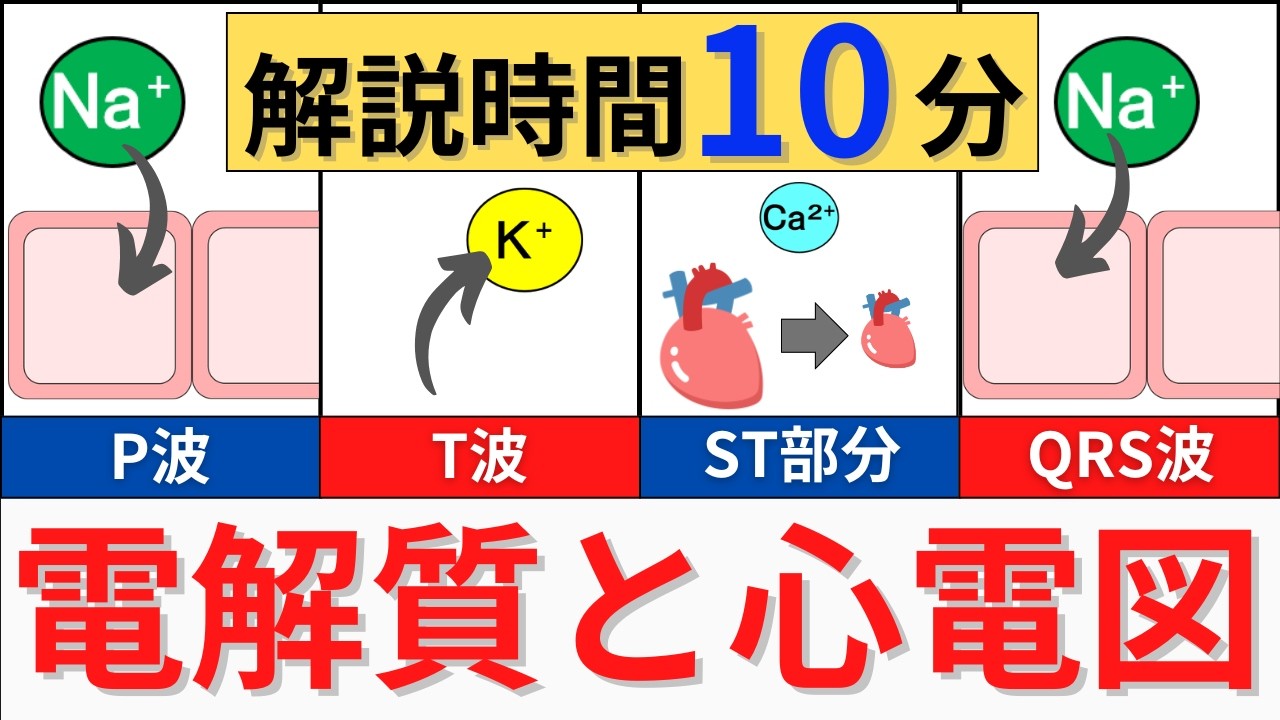
【10分で解説】電解質と心電図波形について解説
[10-Minute Guide] Electrolytes and ECG Waveforms Explained
Keywords
Summary
229 words
Critical Evaluation
Value of the Information & Strength of the Argument
The informational value lies in a clear causal chain that links ionic movements to excitation, contraction, relaxation, and then to each ECG waveform. The argumentation is stepwise and cumulative: stimulation and sodium influx are used to explain depolarization and propagation; neurotransmitter release and calcium release are used to explain muscle contraction; potassium efflux and the Na+/K+ pump are used to explain repolarization and restoration of gradients. This makes the later mapping onto P, QRS, T, and ST segments easy to follow. The review questions and exam-style items add retrieval practice and help consolidate the material. The main weakness is oversimplification: several statements compress complex physiology into single-cause explanations, and the video does not discuss exceptions, quantitative details, or clinical correlations. The reasoning is pedagogically effective but not exhaustive or nuanced.
Scientific Rigor, Source Quality, Title Accuracy
Scientific rigor is moderate: the content follows standard physiology, but the video provides no citations, no references to textbooks or guidelines, and no provenance for the national-exam questions it uses. The links in the description point to the creator’s own related videos and to MedicMedia pages, not to independent primary literature, so source quality is limited for verification. The title/content fit is reasonable except for the stated 10-minute duration, which does not match the roughly 19-minute runtime; otherwise the promised topics are addressed.
228 words
Title / Content Match
The title announces a 10-minute explanation, while the video lasts about 19 minutes; apart from that duration mismatch, the content does cover electrolytes and ECG waveforms as promised.
Quality & Reliability
6/10
The physiology presented is broadly consistent with standard textbook explanations and is internally coherent, but the video provides no external references, no quantitative data, and relies on simplified statements. Reliability is therefore moderate for study purposes rather than high for independent verification.
Chapters
Cited Sources
- Sodium explained (related video) — Linked in the description as a companion explanation of sodium.
- Potassium explained (related video) — Linked in the description as a companion explanation of potassium.
- Calcium explained (related video) — Linked in the description as a companion explanation of calcium.
- MedicMedia nursing article page (March 2025) — Linked in the description as an external page where the channel was featured.
- MedicMedia nursing article page (October 2025) — Linked in the description as an external page where the channel was featured.
External References
Contribution & Novelties
The video does not report new scientific findings. Its originality is pedagogical: it connects the electrolyte roles in nerve and muscle physiology to ECG waveform components in a single explanatory sequence, then reinforces that sequence with review questions and national-exam-style items.
Further reading:
- Electrocardiography — Background on ECG waves, intervals, and segments.
- Action potential — Ionic basis of depolarization and repolarization.
- Electrolyte — General physiology of electrolyte distribution and function.
- Sarcoplasmic reticulum — Calcium storage and release in muscle contraction.
80 words
Radar Profile
The radar is fairly balanced: information quantity is the highest dimension, while technical depth and reliability sit at a moderate level. This matches a dense but simplified exam-review format rather than a research-level presentation.