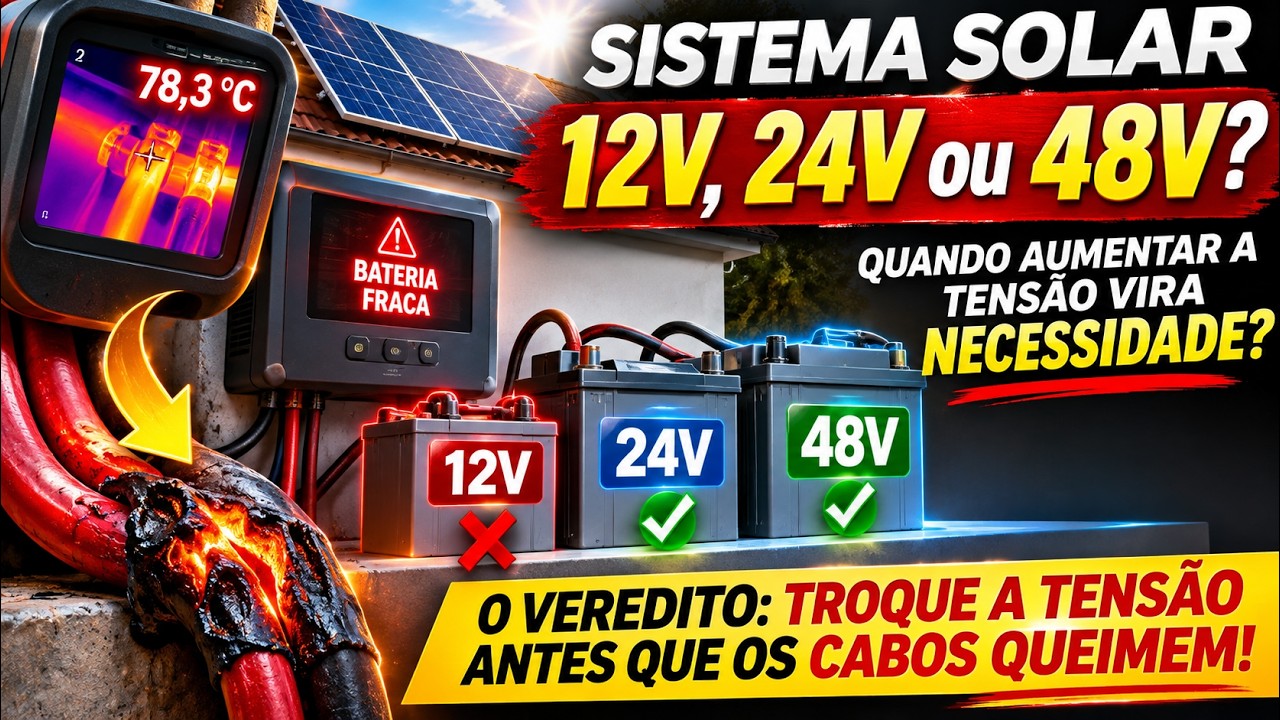
SISTEMA SOLAR 12 V, 24 V OU 48 V: QUANDO VOCÊ É OBRIGADO A MUDAR A TENSÃO
12V, 24V, OR 48V SOLAR SYSTEM: WHEN YOU’RE FORCED TO CHANGE THE VOLTAGE
Keywords
Summary
166 words
Critical Evaluation
Value of the Information & Strength of the Argument
The video provides substantial value by translating a fundamental electrical formula into actionable engineering guidance for solar system design. It presents clear numerical examples and systematically compares 12V, 24V, and 48V architectures, making the trade-offs tangible. The argumentation is solid: it builds on Ohm’s law and Joule’s law, logically explaining why higher voltage is beneficial for high-power systems. It also addresses common misconceptions, such as the belief that 48V requires more batteries, by using a concrete battery configuration example. The inclusion of five practical warning signs enhances the video’s utility for installers and hobbyists. The reasoning is coherent and accessible, though it could be strengthened by referencing specific standards or manufacturer recommendations.
Scientific Rigor, Source Quality, Title Accuracy
The scientific rigor is acceptable for an educational video: it correctly uses P=VI and P=RI², and the calculations are accurate (e.g., 2400W at 12V yields 200A, at 48V 50A). The video is self-contained and does not cite external sources, which is a limitation but not fatal for a practical tutorial. The description offers no references, and the video mentions no specific studies or standards. The title is faithful to the content: it explicitly asks when you are forced to change voltage, and the video answers that question with technical justifications. No public comments were provided, so no analysis of audience reception is possible.
230 words
Title / Content Match
The title accurately reflects the content: the video explains when a 12V system becomes insufficient and when changing to 24V or 48V is necessary.
Quality & Reliability
8/10
The video presents correct engineering principles (P=V*I, Joule's law) with clear numerical examples, but lacks external citations and simplifies some practical aspects, such as component compatibility and safety standards.
Key Moments
Markers derived by PSI from the transcript: the creator did not define chapters.
- Introduction to common problems with 12V solar systems.
- Explanation of power equation P=V*I with 2400W example.
- Joule effect and loss calculations showing 16× reduction from 12V to 48V.
- Analysis of 12V systems: typical uses, current limits, and voltage drop sensitivity.
- Discussion of 24V systems with series battery connections.
- Benefits of 48V systems for high-power residential applications.
- Debunking the myth that 48V requires more batteries; energy storage comparison.
- Five signs your system should switch to a higher voltage.
- Final comparison and summary of voltage choice guidelines.
Contribution & Novelties
The video’s original contribution is its practical, example-driven approach to voltage selection in off-grid solar systems, bridging fundamental physics with real-world engineering decisions. It clearly quantifies the impact of voltage on current and losses, and provides a checklist of warning signs. The myth-busting about battery count is particularly useful.
Pour aller plus loin :
- Joule heating — Understanding the physical basis of power losses in conductors.
- Electric power — The P=V*I relationship and its applications.
- Series and parallel circuits — How battery configurations affect voltage and capacity.
- Solar inverter — Types of inverters and their voltage compatibility.
97 words
Radar Profile
The radar profile shows strong scores in information quantity and reliability, with slightly lower technical depth. This reflects the video's balance between theoretical explanation and practical guidance, making it accessible to a broad audience while maintaining accuracy.