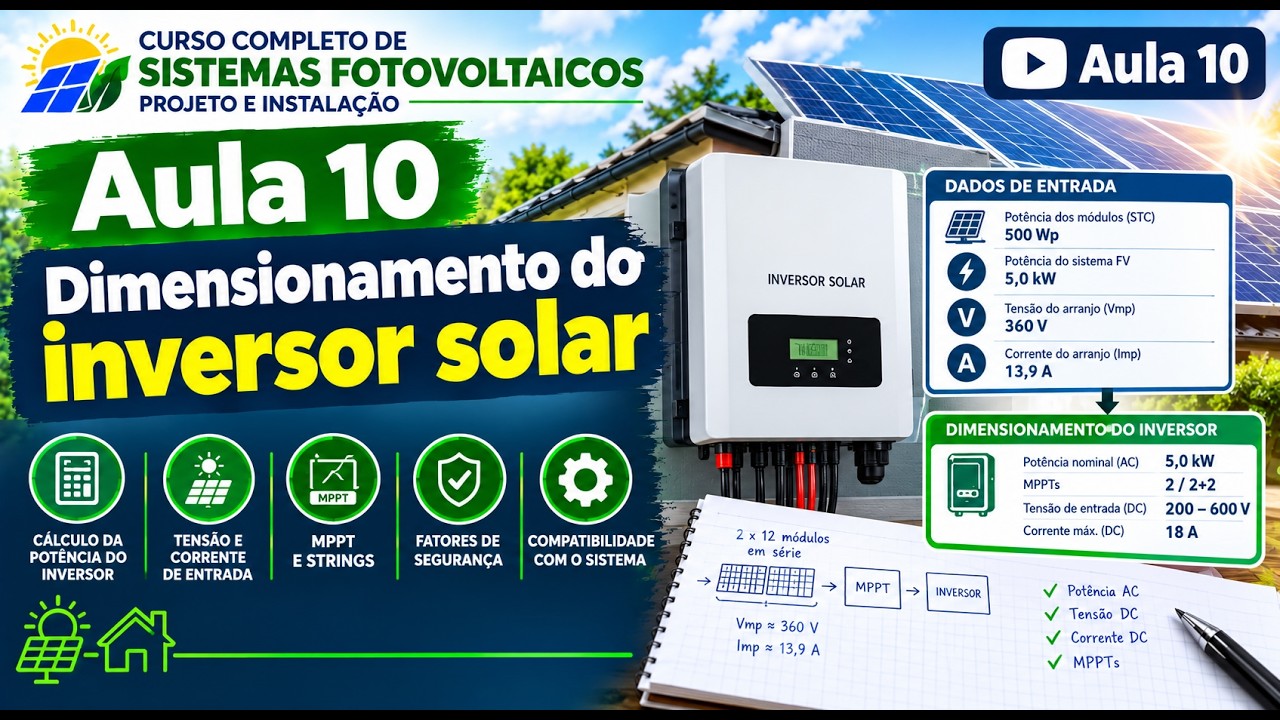
Aula 10_Dimensionamento do inversor solar
Class 10_Sizing of the solar inverter
Keywords
Summary
197 words
Critical Evaluation
Value of the Information & Strength of the Argument
The video delivers practical, actionable knowledge for sizing solar inverters in residential systems. The argumentation is clear and logical, building from fundamental principles (DC/AC conversion) to specific design checks. The instructor uses diagrams and real product datasheets to illustrate how to match inverter specifications with the PV array. The main value lies in the real-world perspective: the instructor shares industry experience, such as avoiding non-INMETRO-certified inverters which cannot be grid-connected, and the cost-benefit of different brands. The explanation of MPPT is particularly thorough, showing how multiple MPPTs help isolate strings under different conditions. The argumentation is coherent, though it relies heavily on the instructor’s anecdotal preferences (e.g., praising Growatt) without supporting data, and the lack of formal engineering calculations (e.g., voltage drop, power derating) is a minor limitation.
Scientific Rigor, Source Quality, Title Accuracy
The video maintains scientific rigour by referencing technical standards (NBR 1690) and manufacturer datasheets, which are authoritative sources. However, direct sources are not explicitly cited with URLs or documents; the presenter mentions the standard and shows datasheet excerpts but does not provide verifiable references. The title is fully aligned with the content: ‘Dimensionamento do inversor solar’ accurately describes the tutorial. The content is technically sound, with correct definitions of MPPT, VOC, STC, and appropriate safety margins. The instructor’s personal brand recommendation (Growatt) is presented as opinion, but it is not based on comparative testing, slightly reducing the perceived objectivity. Overall, the methodology (checking datasheet limits against calculated array values) is exemplary and replicable.
256 words
Title / Content Match
The title accurately reflects the content: the video focuses on solar inverter sizing, covering definitions, MPPT, voltage and current limits, and a practical example.
Quality & Reliability
7/10
The video provides a detailed tutorial on solar inverter sizing, explaining key concepts such as MPPT, string sizing, and datasheet verification. The information is technically accurate and practical, but the presenter's brand preferences and lack of formal citations reduce the score.
Key Moments
Markers derived by PSI from the transcript: the creator did not define chapters.
- Introduction to the role of the inverter in converting DC to AC.
- Explanation of the inverter also named as 'unidade de condicionamento de potência' (UCP) per NBR 1690.
- Discussion of popular inverter brands in Brazil, with emphasis on Growatt's cost-benefit.
- Importance of checking INMETRO certification for inverter homologation.
- Definition of MPPT and its physical representation as input terminals.
- Strategic use of multiple MPPTs to handle multiple roof orientations.
- Dealing with partial shading using separate MPPTs.
- Practical example: selecting a Growatt inverter for a 6-module system.
- Checking maximum PV power and DC voltage limits against datasheet values.
- Final summary on inverter selection criteria and MPPT count.
Cited Sources
- NBR 1690 - Photovoltaic systems standard (mentioned) — The instructor refers to this standard for terminology and inverter requirements.
- Growatt inverter datasheet (mentioned, not linked) — The datasheet for the Growatt MIC 3000 TL-X2 is used to illustrate specification checking.
Concurring Sources
- PV Education - Photovoltaic Systems — General reference for PV system sizing and inverter parameters.
Dissenting Sources
- No discordant sources found — The content is consistent with standard engineering practices for inverter sizing.
Contribution & Novelties
The video stands out for its practical, step-by-step approach to inverter sizing, bridging the gap between theoretical knowledge and real-world installation. It uniquely highlights the strategic use of multiple MPPTs to manage roof orientations, shading, and module mismatches, a topic often treated superficially in other tutorials.
Pour aller plus loin :
- Maximum Power Point Tracking - Wikipedia — Concepts of maximum power point tracking algorithms.
- String inverter - Wikipedia — Overview of inverter topologies in solar photovoltaic systems.
- ABNT NBR 1690-1 (in Portuguese) — The Brazilian standard for PV systems, source of UCP terminology.
94 words
Radar Profile
The profile shows high scores in information quantity and fiabilite, reflecting the detailed technical content and reliable methods. The lower niveau_technique score indicates the content is accessible to beginners, while qualite_information is solid. The radar suggests a well-rounded educational resource.