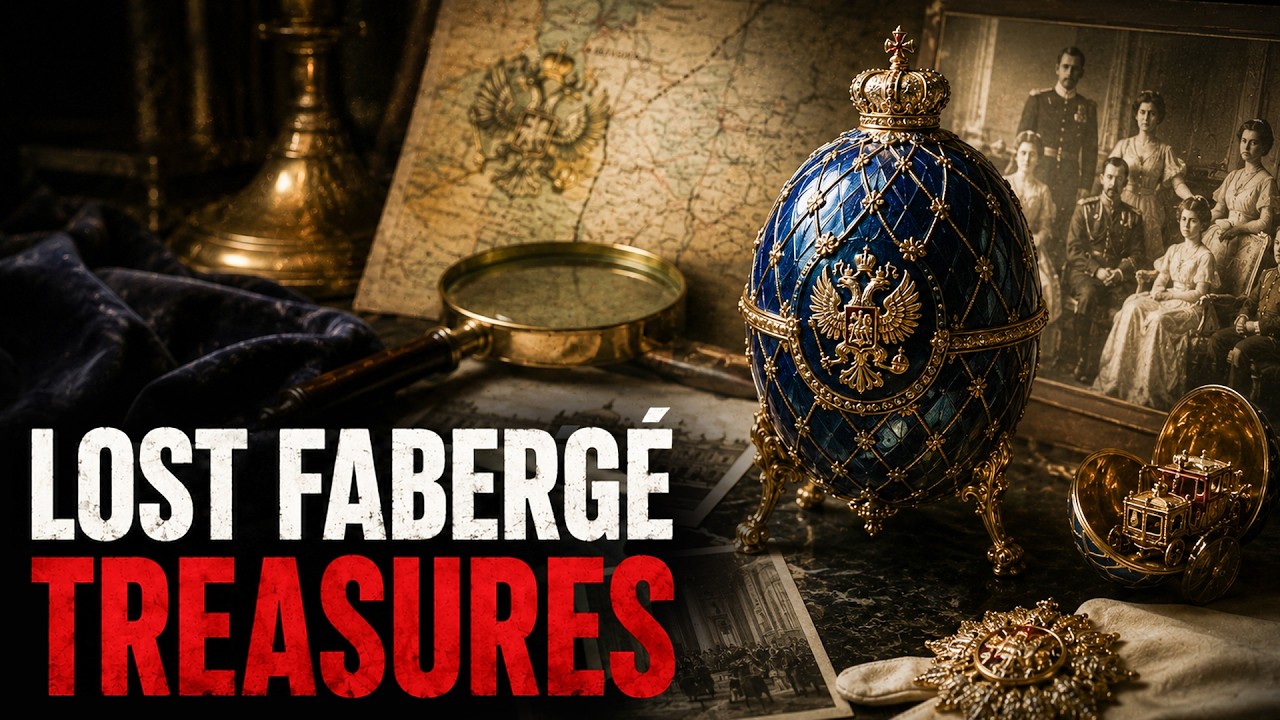
Lost Fabergé Treasures: The Imperial Eggs Hunt Now | Fabergé Eggs | Art History | Lost Treasures
Keywords
Summary
189 words
Critical Evaluation
Value of the Information & Strength of the Argument
The documentary offers substantial historical value by synthesizing the well-documented story of Fabergé’s imperial eggs with newly highlighted rediscoveries and survivor accounts. The argumentation is built through a chronological narrative supported by expert interviews (antique dealers, historians, and specialists) that give a human and material dimension to the objects. However, the narrative often relies on dramatized scenes and rhetorical flourishes, and the causal links between events (e.g., the exact decisions leading to the eggs’ survival) are presented without deep critical analysis. The strength of the argumentation rests on the emotional resonance and the richness of visual and anecdotal details rather than on rigorous historical debate, making it engaging but less analytically robust.
Scientific Rigor, Source Quality, Title Accuracy
The documentary does not provide explicit citations, URLs, or a bibliography in the description, and the only named sources are institutional (e.g., Wartski, the Hermitage) mentioned verbally. The production quality suggests access to expert testimony, but the lack of verifiable references undermines its scholarly credibility. The title is appropriate and descriptive, accurately signaling the focus on lost Fabergé treasures and the hunt for them. The video’s obscurity (single view, no comments) offers no external validation of its accuracy, and the absence of a comments section means no community feedback is available to assess reception or corrections.
223 words
Title / Content Match
The title accurately reflects the content: a documentary on lost Fabergé imperial eggs, their historical journey, and the hunt for missing pieces.
Quality & Reliability
6/10
The documentary presents a coherent historical narrative with interviews and dramatic reconstructions, but it lacks explicit citations or a bibliography in the description. The channel is obscure and the video has almost no engagement, making it difficult to assess the production's editorial standards. The content is plausible and generally consistent with known history, but the absence of verifiable sources and the reliance on atmospheric storytelling lower the reliability score.
Key Moments
Markers derived by PSI from the transcript: the creator did not define chapters.
- Discovery of photographs at Wartski in London, hinting at a lost Fabergé egg.
- Introduction of Carl Fabergé's background and rise to imperial favor.
- The first imperial hen egg presented to Empress Maria Feodorovna in 1885.
- Expansion of the Fabergé firm and commissions from other European aristocrats.
- Impact of World War I and the Russian Revolution on Fabergé and the royal family.
- Execution of the Romanovs and nationalization of Fabergé's holdings.
- Fabergé's escape to Switzerland and the smuggling of treasures, including the Cross of St. George egg.
- Rediscovery of the unfinished Constellation egg in a Moscow museum and the ongoing search for missing eggs.
Contribution & Novelties
The video’s original contribution lies in its accessible narrative that weaves together the well-known history of the Fabergé eggs with recent rediscovery anecdotes, notably the London antique store episode and the unfinished Constellation egg. It humanizes the tragedy of the Romanovs through the lens of these objects, emphasizing their role as tangible witnesses of a lost world. However, it does not present new research or unpublished findings, serving more as a synthesis for a general audience.
Pour aller plus loin :
- Fabergé egg — Wikipedia — Overview of the 50 imperial eggs and their fates.
- Carl Fabergé — Wikipedia — Biography of the jeweler and his company.
- Russian Revolution — Wikipedia — Context of the historical upheaval that scattered the treasures.
121 words
Radar Profile
The profile shows a high quantity of information (8) but moderate quality and reliability scores (6 and 5), indicating a content-rich yet not critically sourced documentary. The technical level is average (5), suitable for a broad audience, while the overall fiabilite score (5) reflects the lack of verifiable references.