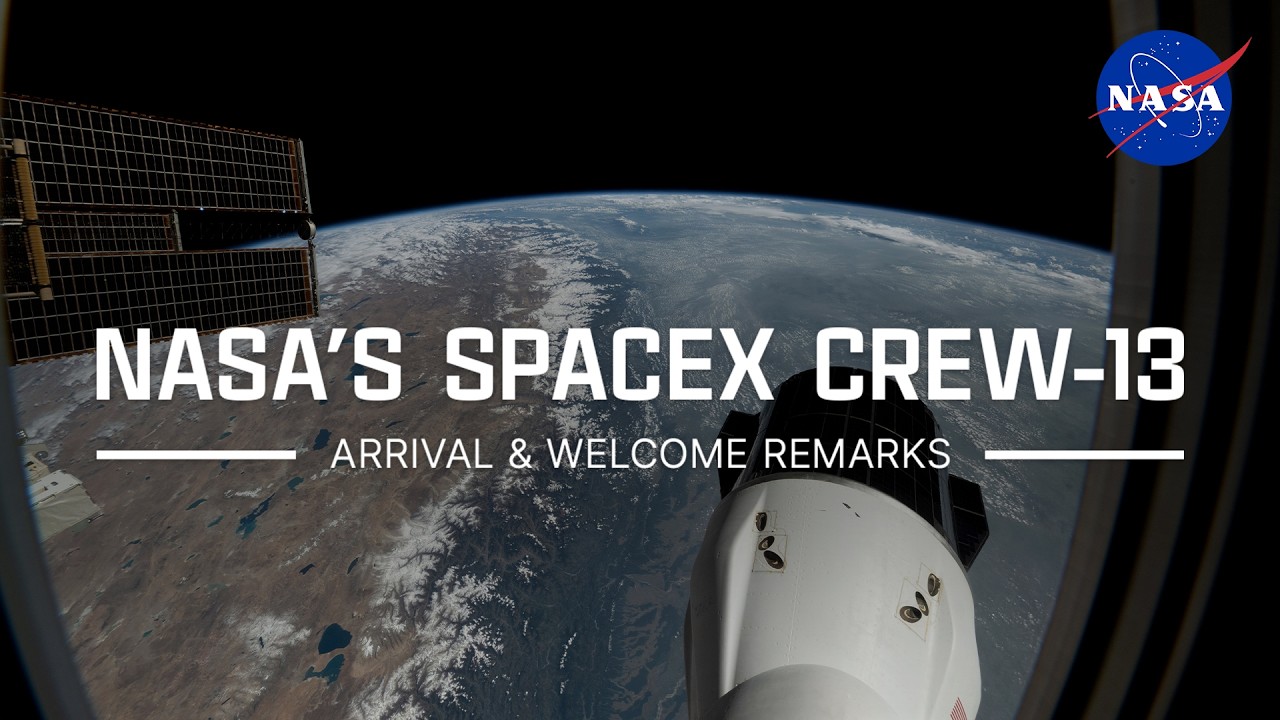
NASA's SpaceX Crew-13 Arrival & Welcome Remarks
Keywords
Summary
186 words
Critical Evaluation
Value of the Information & Strength of the Argument
The video provides exceptional real-time insight into the complexities of spacecraft docking. The hosts articulate the sequence of burns, orbital mechanics, and safety protocols with clarity, supported by live telemetry and visuals. The argumentation is logically structured, progressing from launch to approach, docking, and post-docking activities. The explanations are grounded in physical principles and engineering systems, with precise references to times, distances, and thruster firings. The inclusion of crew bios and research objectives adds depth, while the commentary from NASA and SpaceX personnel underscores the credibility of the information. The presentation demonstrates a solid understanding of spaceflight operations, making it highly persuasive and informative.
Scientific Rigor, Source Quality, Title Accuracy
The scientific rigor is exemplary, as the content is delivered by official agencies (NASA and SpaceX) and based on actual mission data. The two references provided in the description (NASA blog and mission page) serve as primary sources for further verification. The title accurately reflects the video’s scope: it covers the arrival (docking) and includes welcome remarks, as promised. There are no discrepancies between the title and content. The production quality and factual consistency further enhance its reliability. No comments were provided for analysis.
203 words
Title / Content Match
The title accurately reflects the content: it covers the arrival (docking) of the Crew-13 mission and includes welcome remarks from the crew.
Quality & Reliability
9/10
The video is produced by NASA, an authoritative space agency, and features live coverage with expert commentary from NASA and SpaceX officials. The information is accurate and corroborated by official sources.
Key Moments
Markers derived by PSI from the transcript: the creator did not define chapters.
- Introduction and mission overview with hosts Jesse Anderson and Leah Cheshier.
- Approach initiation burn and detailed explanation of orbital maneuvers.
- Docking and soft/hard capture at the International Space Station.
- Hatch opening and crew ingress into the ISS.
- Welcome remarks and crew introductions from the station.
Cited Sources
- NASA Space Station Blog — Daily updates from the International Space Station, providing ongoing mission information.
- NASA's SpaceX Crew-13 Mission Page — Official mission overview, crew details, and objectives.
Concurring Sources
- NASA Space Station Blog — Provides ongoing updates and corroborates mission events.
- NASA's SpaceX Crew-13 Mission Page — Confirms crew details and mission objectives.
Contribution & Novelties
This video offers a unique, real-time view of a crewed orbital rendezvous, demystifying the technical steps involved in docking a spacecraft to the ISS. It combines live telemetry with expert narration, providing an educational experience rarely captured in such detail. The coverage highlights the precision of spaceflight operations and the collaborative effort between NASA and SpaceX. For viewers, it translates complex orbital mechanics into accessible concepts, enhancing public understanding of human spaceflight.
Pour aller plus loin :
- International Docking Adapter — Understanding the hardware that enables docking and its role in spacecraft compatibility.
- SpaceX Dragon 2 — The spacecraft used in this mission, its design, and capabilities.
- Orbital mechanics — The physics behind the maneuvers described, including Hohmann transfers and phasing.
121 words
Radar Profile
The radar profile shows uniformly high scores across all dimensions—quantity, quality, technical depth, and reliability—indicating a well-rounded, authoritative presentation. The slight dip in quantity relative to reliability suggests that while the video is exceptionally accurate, its length may limit exhaustive depth in certain areas, but overall it is a top-tier educational resource.