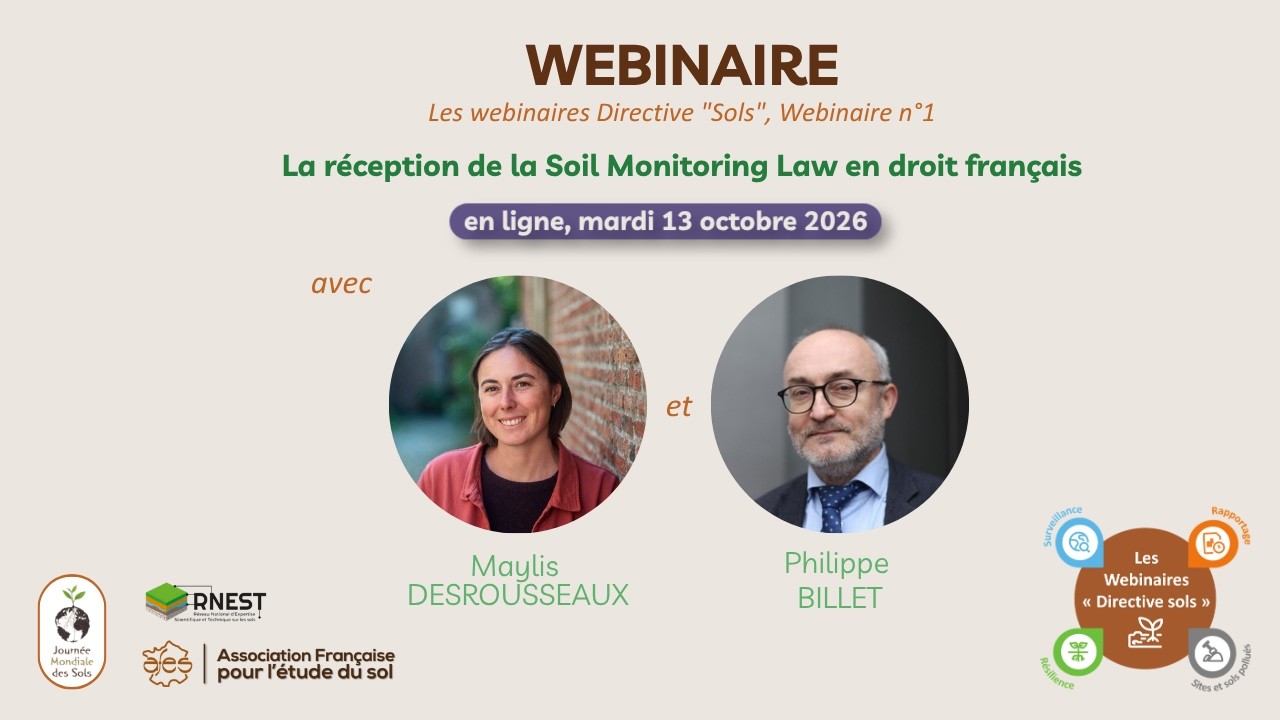
JMS 2026 | Webinaire "Directive Sols" 1
WSD 2026 | "Soil Directive" Webinar 1
Keywords
Summary
179 words
Critical Evaluation
Value of the Information & Strength of the Argument
The webinar provides valuable expert insight into the legal dimensions of the Soil Monitoring Directive. The speakers demonstrate a strong command of European and national legal contexts, systematically linking the directive to existing frameworks such as the Aarhus Convention, the INSPIRE directive, and French environmental law. Their argumentation is solid, based on reading of the directive’s text and preparatory documents, and they openly acknowledge ambiguities—particularly around the classification of land managers and users. The discussion is not merely descriptive but critically examines potential implementation pitfalls, adding depth to the analysis. The main value lies in clarifying the directive’s integration into French administrative and legal systems, and in identifying concrete legal questions that need resolution. The speakers’ reasoning is logical and well-structured, though some points remain speculative due to incomplete transposition guidance.
Scientific Rigor, Source Quality, Title Accuracy
The scientific rigor is high: the speakers are legal academics specialising in environmental law and urban planning, and they ground their commentary in the directive’s legal text and related EU instruments. They cite the directive (EU) 2025/2360, the Aarhus Convention, and other legislative references, though no direct references to published studies are given. The webinar is part of a series organised by respected French soil science institutions (AFES, RNEST), which lends credibility. The title ‘Directive Sols’ accurately conveys the subject matter. The source of this video is the official AFES channel, and the description provides a link to the 2026 Journée Mondiale des Sols programme. However, as a webinar, it does not undergo peer review, and the perspectives are those of the experts rather than a consensus. The title is appropriate and does not overstate the content.
283 words
Title / Content Match
The title accurately reflects the content: a webinar in the JMS 2026 series focused on the Soil Directive, specifically its reception in French law.
Quality & Reliability
8/10
The webinar features two legal experts (a professor of public law and a lecturer in urban planning) who provide a thorough, nuanced analysis of the EU Soil Monitoring Directive and its implications for French law. The discussion is structured, references legal texts and existing frameworks, and acknowledges uncertainties in interpretation. The content is specialised and current, though it represents the presenters' perspectives rather than a formal academic review.
Key Moments
Markers derived by PSI from the transcript: the creator did not define chapters.
- Introduction by Flavien Poinsot on the webinar series and context of the Soil Directive
- Sophie Raous presents the Journée Mondiale des Sols 2026 programme and related events
- Maylis Desrousseaux begins legal analysis: adoption, objectives, and scope of the directive
- Discussion on soil districts and units, and the integration into existing territorial frameworks
- Analysis of the right to environmental information, land manager/user categories, and property rights
- Questions and answers on planning implications and transposition challenges
Cited Sources
- Journée Mondiale des Sols 2026 — Official page for the 2026 World Soil Day events, mentioned in the webinar as part of the related programme.
Contribution & Novelties
This webinar provides a timely legal analysis of the Soil Monitoring Directive from a French perspective, filling a gap in understanding how the directive will interact with existing national law. It highlights the unprecedented definition of ‘soil health’ and the innovations in information rights, while raising critical questions about the classification of stakeholders. The ‘pour aller plus loin’ section offers resources for further exploration.
Pour aller plus loin :
- Directive (EU) 2025/2360 — The legal text of the Soil Monitoring Directive, essential for verifying specific provisions.
- Aarhus Convention — The international treaty underpinning environmental information rights, central to the webinar’s discussion.
- INSPIRE Directive — EU framework for spatial information, relevant to the directive’s data-sharing requirements.
115 words
Radar Profile
The radar profile shows high scores in information quantity, quality, and reliability, with a slightly lower technical level due to the legal focus. This indicates a well-structured, expert-led webinar that offers substantial legal detail but may require familiarity with EU law for full comprehension.