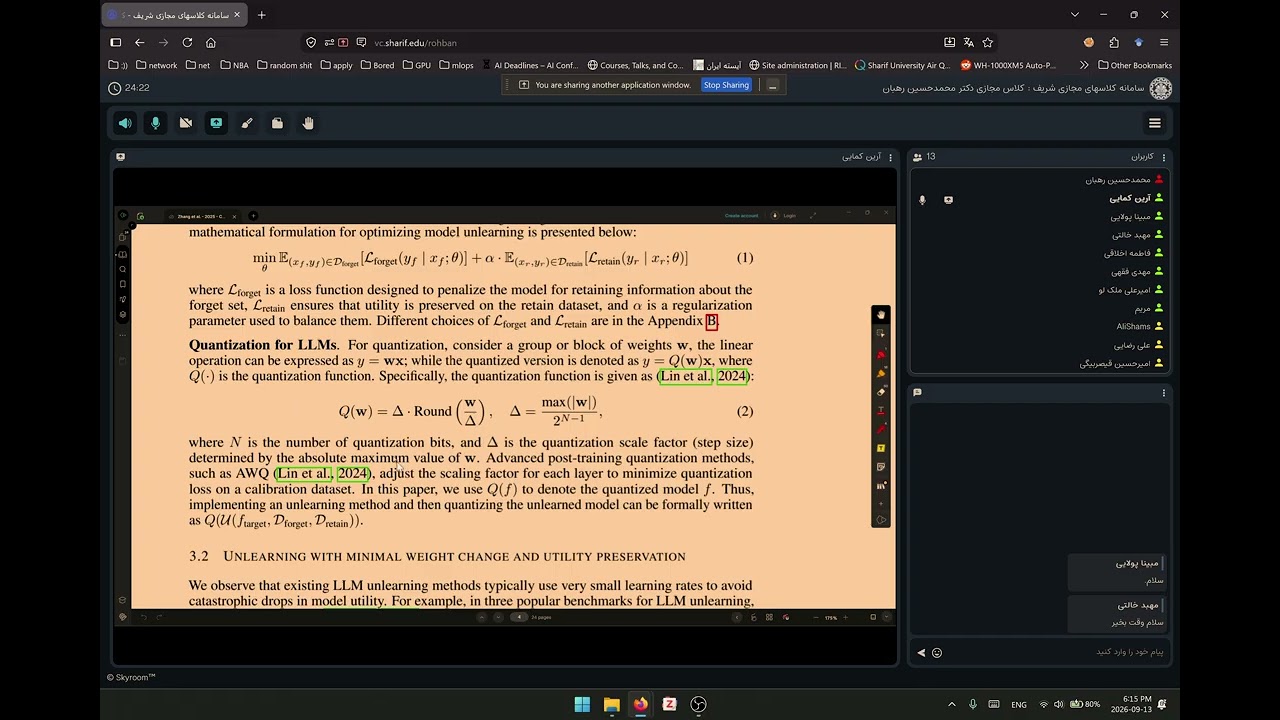
mlsec journal club: Catastrophic Failure of LLM Unlearning via Quantization
Keywords
Summary
182 words
Critical Evaluation
Value of the Information & Strength of the Argument
The video provides strong added value by clearly articulating a non-obvious technical phenomenon: the interaction between low-learning-rate unlearning updates and the discrete grid of quantized weights. The argumentation is solid; the hosts systematically map the paper’s methodology, metrics, and results, and they tie the hypothesis to observed outcomes, such as the increased failure when preservation terms are added. They also demonstrate high scientific rigor by hypothesizing a trade-off between forgetting and utility, and by questioning the validity of the benchmark’s ideal model setup, which they suspect might be a fine-tuned model rather than a fully retrained one, thereby weakening the paper’s comparative claims.
Scientific Rigor, Source Quality, Title Accuracy
The scientific rigor is good for a journal club format, as the hosts delve deeply into the technical details of quantization schemes (asymmetric vs. symmetric, block-wise etc.) and the overhead of bits per weight. However, the reliance is solely on the single presented paper, without any external source verification or supplementary materials cited in the description. The title of the video accurately reflects the core subject and clearly sets the expectation for a deep journal club walkthrough, which is exactly what the content delivers.
202 words
Title / Content Match
The title is perfectly accurate; the video is dedicated to presenting and dissecting the paper on the catastrophic failure of unlearning through quantization.
Quality & Reliability
7/10
The discussion presents a rigorous technical critique. It thoroughly explains the mechanism by which quantization disrupts unlearning, evaluates the MUSE benchmark metrics, and critically questions the validity of the 'ideal' target model. The skepticism is sound, but the video relies solely on the single paper without cross-referencing external studies or providing links in the description, limiting broader verification.
Key Moments
Markers derived by PSI from the transcript: the creator did not define chapters.
- Introduction to the paper and the core hypothesis about quantization nullifying unlearning.
- Detailed explanation of weight mapping and quantization effects on unlearning.
- Review of the MUSE benchmark, metrics M1, M2, M3, M4 and the datasets used.
- Analysis of the results table, showing failures particularly with 4-bit quantization and preservation terms.
- Critical questioning of the 'ideal' model used as target in the benchmark, speculating on fine-tuning vs retraining.
- Brief look at the paper's proposed solution and overall concluding assessments.
Cited Sources
- Catastrophic Failure of LLM Unlearning via Quantization — The central research paper discussed and analyzed throughout this journal club session.
Contribution & Novelties
The video explains the mechanism by which quantization restores forgotten knowledge, showing that minimal weight perturbations from unlearning are lost in the integer mapping. This insight is crucial for AI safety and model deployment, as it reveals that standard unlearning pipelines can be completely bypassed by a simple conversion step. The discussion goes beyond the paper by intuitively linking the trade-off between forgetting and utility preservation to the quantization behavior.
Pour aller plus loin :
- Direct Preference Optimization (DPO) - A supervised fine-tuning technique referenced in the paper for unlearning optimization.
- ROUGE metric - The text similarity metric used to evaluate performance in the MUSE benchmark.
- Machine unlearning - The broader field of research that this paper seeks to contribute to.
- LLaMA model - The base large language model used for the experiments in the paper.
136 words
Radar Profile
The radar profile shows a high level of technical depth and information quality, balanced by a slightly lower score for breadth of sources. This indicates a focused, expert-level discussion where the intellectual rigor of the analysis is the main asset, rather than a wide-ranging literature review.