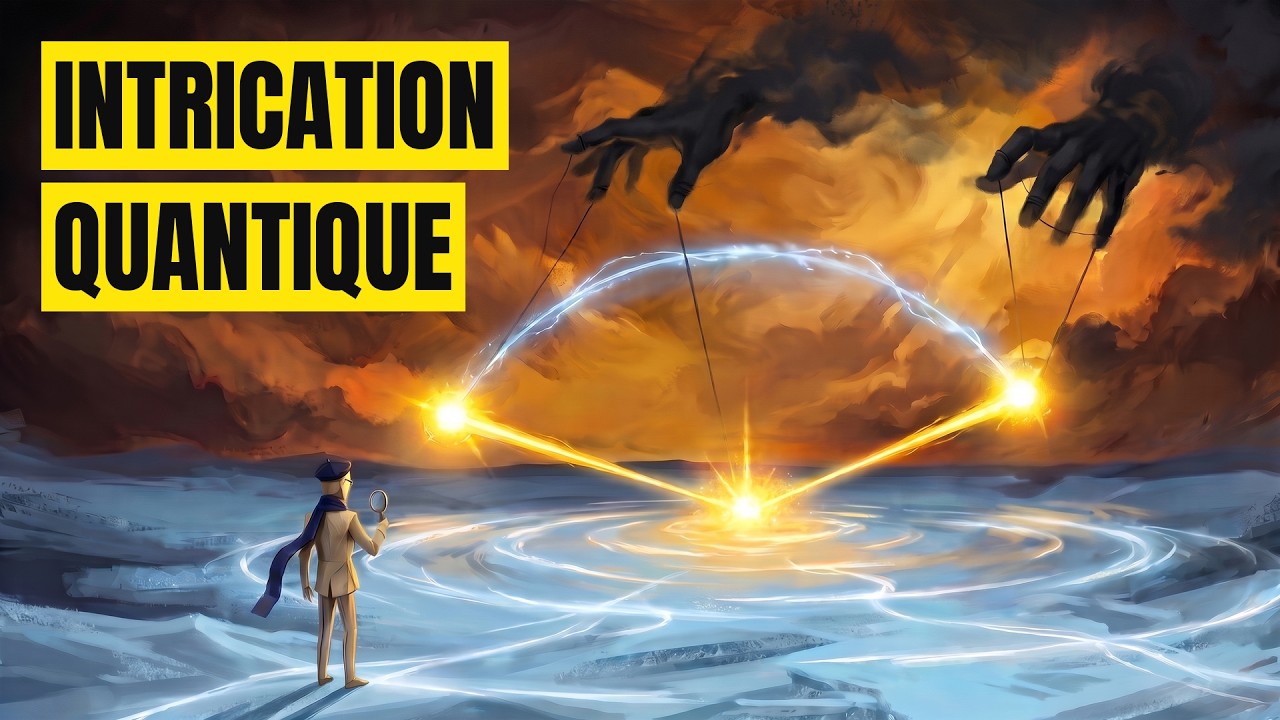
L'intrication quantique : l'explication complète (le fantôme qui a donné tort à Einstein)
Quantum entanglement: the complete explanation (the ghost that proved Einstein wrong)
Title history
- L'intrication quantique : l'explication complète (le fantôme qui a donné tort à Einstein) — observed on 20261110-0239 UTC (YouTube)
Keywords
Summary
176 words
Critical Evaluation
Value of the Information & Strength of the Argument
The video provides significant value in its accurate and accessible recounting of the quantum entanglement story, weaving together historical context, key experiments, and conceptual clarity. The argumentation is solid: it presents the EPR argument, Bohr’s rebuttal, Bell’s theorem, and experimental tests in a logical sequence, emphasizing how each step addresses potential loopholes. It carefully explains the statistical meaning of Bell inequalities and correctly stresses that entanglement does not permit superluminal communication. The narrative is well-structured and engaging, using analogies like socks and coin flips to aid comprehension without compromising scientific accuracy.
Scientific Rigor, Source Quality, Title Accuracy
The scientific rigor is high. The video cites primary source papers (EPR 1935, Bell 1964, Aspect 1982, Hensen 2015, etc.) and accurately represents their content. It clearly distinguishes between what is experimentally demonstrated (violation of Bell inequalities) and what remains interpretive (e.g., the choice between abandoning realism versus locality). The title adequately matches the content: it promises a complete explanation and delivers a comprehensive historical and conceptual overview. No obvious biases or misinformation are present; the presentation is measured and well-documented.
187 words
Title / Content Match
The title accurately reflects the content, promising a comprehensive explanation of quantum entanglement and its challenge to Einstein, delivered in full.
Quality & Reliability
9/10
The video is meticulously researched, cites original papers, and accurately presents the historical and experimental development of quantum entanglement, including Bell's theorem and subsequent tests.
Chapters
- Le fantôme d'Einstein
- Princeton, 1935
- L'argument des deux gants
- La réponse de Bohr
- Schrödinger donne un nom à la chose
- L'action fantôme à distance
- Taisez-vous et calculez
- Le passe-temps du CERN
- Les chaussettes de Bertlmann
- Le jeu de Bell
- Le sous-sol de Berkeley
- Einstein perd la première manche
- Un physicien au Cameroun
- « Avez-vous un poste fixe ? »
- Orsay, 1982
- Ce que ça veut dire vraiment
- Ce que l'intrication n'est pas
- Les dernières failles
- La téléportation, la vraie
- Un satellite nommé Micius
- Les clés impossibles à voler
- Les ordinateurs quantiques
- Stockholm, 2022
- Ce que personne ne sait encore
- Ce que l'on sait vraiment
- Le fil invisible
- La bonne question
Cited Sources
- A. Einstein, B. Podolsky, N. Rosen, Physical Review 47, 777 (1935) — The original EPR paper questioning the completeness of quantum mechanics.
- N. Bohr, Physical Review 48, 696 (1935) — Bohr's response defending quantum mechanics.
- E. Schrödinger, Proc. Cambridge Phil. Soc. 31, 555 (1935) — Schrödinger's paper introducing the term 'entanglement'.
- J. S. Bell, Physics 1, 195 (1964) — Bell's theorem providing a testable inequality.
- J. Clauser, M. Horne, A. Shimony, R. Holt, Physical Review Letters 23, 880 (1969) — Experimental setup proposal for testing Bell inequalities.
- A. Aspect, J. Dalibard, G. Roger, Physical Review Letters 49, 1804 (1982) — The Orsay experiment closing the locality loophole.
- B. Hensen et al., Nature 526, 682 (2015) — Delft experiment closing major loopholes simultaneously.
- The BIG Bell Test Collaboration, Nature 557, 212 (2018) — Global citizen science test of Bell inequalities.
- D. Bouwmeester et al., Nature 390, 575 (1997) — First quantum teleportation experiment.
- J. Yin et al., Science 356, 1140 (2017) — Satellite-based distribution of entangled photons (Micius).
- Nobel Prize in Physics 2022, Nobelprize.org — Official announcement of the 2022 Nobel Prize in Physics.
Concurring Sources
- Quantum Entanglement (Wikipedia) — General overview confirming the video's claims.
- Bell Test experiments (Wikipedia) — Overview of experimental tests of Bell inequalities.
Contribution & Novelties
This video contributes an exceptionally clear and well-structured explanation of quantum entanglement, tracing the intellectual journey from the EPR paradox to modern experiments and applications. It excels in distinguishing between established facts and open interpretations, and clarifies common misconceptions about entanglement (e.g., no faster-than-light communication). The narrative is enriched with personal anecdotes (e.g., Aspect’s visit to Bell, Clauser’s bet) that make the science relatable.
Pour aller plus loin :
- Bell’s theorem - Wikipedia — Core concept and mathematical derivation.
- EPR paradox - Wikipedia — Foundational thought experiment.
- Quantum entanglement - Stanford Encyclopedia of Philosophy — Philosophical and physical analysis.
- Alain Aspect - Nobel Prize biography — Biographical information on the main experimentalist.
112 words
Radar Profile
The radar profile shows high scores across all dimensions, indicating a comprehensive and reliable educational resource. The quantity and quality of information are balanced, with a strong technical level achieved without sacrificing clarity.