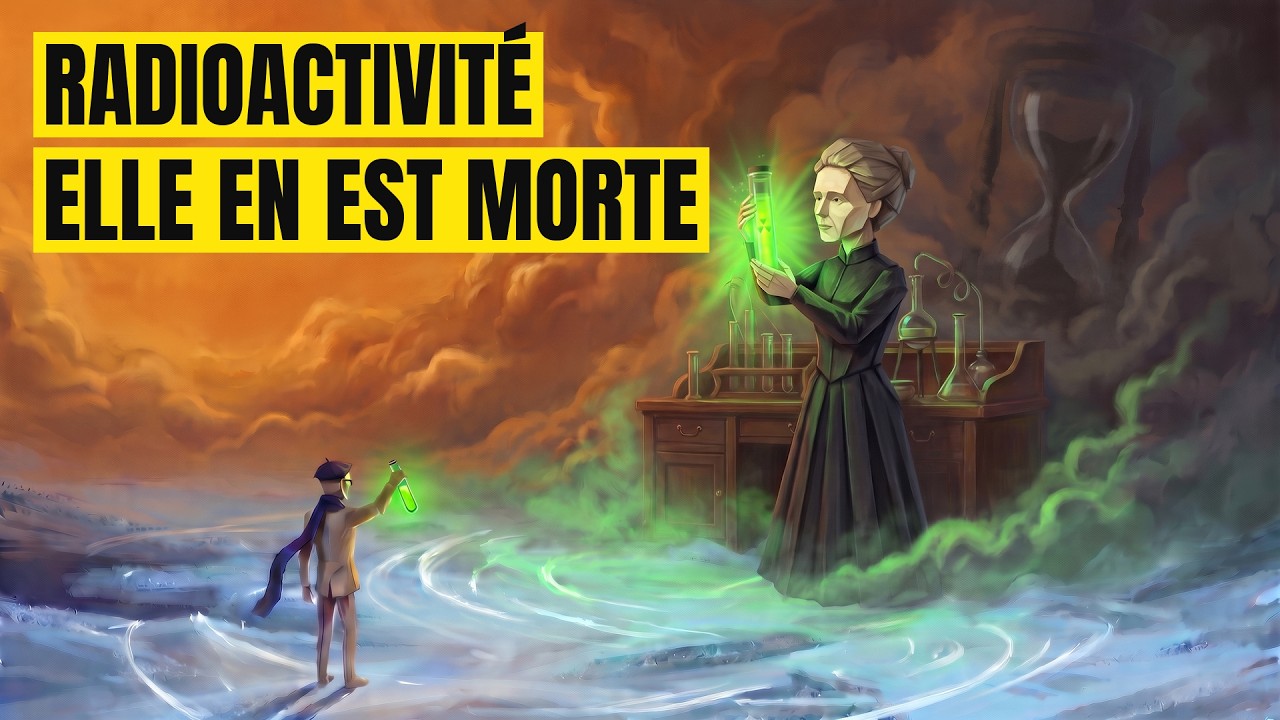
La radioactivité : l'explication complète (elle en est morte)
Radioactivity: the complete explanation (she died of it)
Title history
- La radioactivité : l'explication complète (elle en est morte) — observed on 20261110-0239 UTC (YouTube)
Keywords
Summary
123 words
Critical Evaluation
Value of the Information & Strength of the Argument
The video’s informational value is high: it condenses a century of scientific progress into a coherent narrative that is both accessible and accurate. The argumentation is solid; it builds from the observational evidence (Becquerel’s photographic plates, Curie’s measurements) to theoretical explanations (nuclear structure, random decay) and places discoveries in their historical context. The reasoning is clear, and the scientific concepts are explained with effective analogies (e.g., coin flips for half-life) without losing accuracy. The narrative’s strength lies in its integration of primary sources and its transparency about the human cost, which reinforces credibility.
Scientific Rigor, Source Quality, Title Accuracy
The video explicitly cites primary scientific publications (Comptes rendus, Philosophical Magazine, Annalen der Physik) and authoritative institutional sources (Nobel Foundation, Musée Curie). The historical facts are cross-checked with Marie Curie’s own writings and biographies. The title/content match is excellent: the title promises a complete explanation, and the video delivers, covering the discovery, the physics, the social impact, and the personal story. No significant bias or sensationalism was detected; the dramatic title is justified by the content. The absence of comments prevents audience analysis, but the content itself demonstrates a rigorous, source-based approach.
200 words
Title / Content Match
The title accurately reflects the comprehensive coverage of radioactivity's history, with a dramatic hook about Marie Curie's death that is consistent with the video's focus.
Quality & Reliability
9/10
Content is well-structured, historically accurate, based on primary sources (Curie's theses, Comptes rendus, Nobel archives), and transparent about its narrative frame. The scientific explanations are simplified but correct, and the biographical and historical details are carefully sourced.
Chapters
- Les carnets dans la boîte en plomb
- Le tiroir de Becquerel
- Une trace dans le noir
- La gouvernante de Varsovie
- Une mansarde au Quartier latin
- Le sujet que personne ne voulait
- Plus fort que l'uranium
- Polonium
- Radium
- Le hangar de la rue Lhomond
- Les petites lumières dans la nuit
- La brûlure de Pierre
- Le prix Nobel qui a failli l'oublier
- Trois sortes de rayons
- L'alchimie de Rutherford
- Pourquoi un atome se casse
- La demi-vie
- D'où vient l'énergie
- La folie du radium
- Les filles du radium
- Rue Dauphine
- Le scandale
- Le deuxième Nobel
- Les petites Curie
- Le noyau de Rutherford
- Irène et Frédéric
- Sancellemoz
- Ce que la radioactivité fait pour nous
- Le Panthéon
Cited Sources
- H. Becquerel, Comptes rendus de l'Académie des sciences, 122 (1896) — Original discovery of uranium rays
- P. Curie, M. Curie, Comptes rendus 127, 175 (juillet 1898) ; P. Curie, M. Curie, G. Bémont, Comptes rendus 127, 1215 (décembre 1898) — Discovery of polonium and radium
- M. Curie, « Recherches sur les substances radioactives », thèse de doctorat, Paris (1903) — Marie Curie's doctoral thesis
- M. Curie, Pierre Curie (1923) — notes autobiographiques — Autobiographical notes
- E. Rutherford, F. Soddy, « The Cause and Nature of Radioactivity », Philosophical Magazine (1902) — Explanation of transmutation
- E. Rutherford, Philosophical Magazine 21, 669 (1911) — Nuclear model of the atom
- A. Einstein, Annalen der Physik 18, 639 (1905) — E=mc² paper
- I. Curie, F. Joliot, Comptes rendus 198, 254 (1934) — Discovery of artificial radioactivity
- Fondation Nobel (nobelprize.org) — Nobel prizes 1903, 1911, 1935
- Musée Curie (Paris) et Bibliothèque nationale de France — fonds Curie — Archival sources on the Curies
- K. Moore, The Radium Girls (2017) — Historical account of radium poisoning in factories
Contribution & Novelties
The video’s original contribution lies in its narrative synthesis: it weaves together the scientific discoveries, the personal biographies, and the societal impacts into a single flowing story, making complex physics accessible to a broad audience. It emphasizes the often-overlooked human cost and the ethical questions around early radiation use. For a deeper dive, several concepts and references are suggested.
Pour aller plus loin :
- Half-life — Explains the statistical nature of radioactive decay, central to the video’s discussion.
- Nuclear fission — A later consequence of the discovered transmutation, leading to energy production.
- Marie Curie’s biography — The Nobel Foundation’s official account, with primary documentation.
- Radium Girls — The story of the factory workers, a key case mentioned in the video.
120 words
Radar Profile
The radar profile shows a strong emphasis on information quantity and reliability, with moderate technical depth. This reflects the video’s goal of comprehensive storytelling rather than advanced technical instruction. The balance between narrative and science is well-judged, making it ideal for a general audience seeking a thorough introduction.