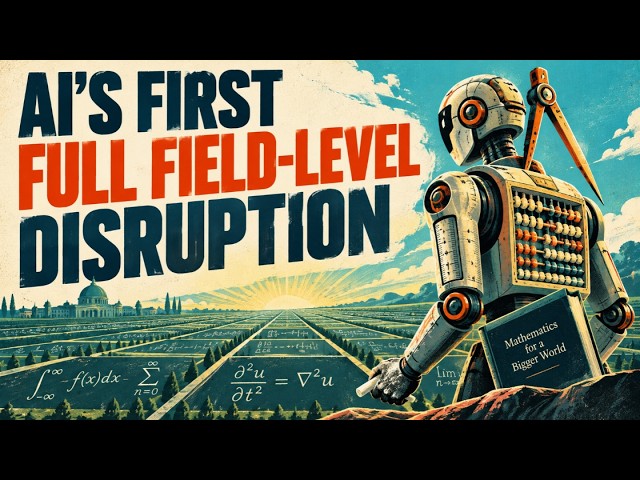
AI’s First Full Field-Level Disruption
Title history
- AI’s First Full Field-Level Disruption — observed on 20261025-1527 UTC (YouTube)
Keywords
Summary
159 words
Critical Evaluation
Value of the Information & Strength of the Argument
The video provides substantial value by synthesizing a complex AI breakthrough into accessible terms, highlighting both the technical achievements and the societal consequences. The argumentation is generally solid: NLW presents multiple viewpoints, including enthusiastic, skeptical, and cautionary perspectives, which strengthens the analysis. He effectively contextualizes the speed of progress (e.g., the efficiency gain in compute from Navier-Stokes to this release) and raises pertinent questions about verification and the role of human scientists. However, some claims rely on anecdotal social media posts without rigorous sourcing, and the financial analysis, while interesting, could benefit from more nuance. Overall, the value lies in its timely synthesis and balanced presentation of a rapidly evolving situation.
Scientific Rigor, Source Quality, Title Accuracy
The video references credible outlets like the Financial Times and The Information, but does not provide direct links in the description, relying instead on the channel’s website and podcast feed. The title is accurate and appropriately provocative, matching the content’s emphasis on a ‘full-field disruption’ in mathematics. Scientifically, the episode distinguishes between results that are verifiable but not yet fully peer-reviewed, and it notes that many problems lack immediate practical application, though matrix multiplication improvements are highlighted. The inclusion of expert comments from mathematicians and physicists adds rigor, yet the lack of primary sources limits the ability to independently verify all claims. The title’s alignment with the content is strong, and the discussion covers key aspects without overhyping, though the tone occasionally borders on sensationalism.
251 words
Title / Content Match
The title accurately reflects the main focus of the episode: AI's first major disruption of an academic field, specifically mathematics, and the broader implications for other disciplines.
Quality & Reliability
7/10
The video is a well-structured news review that accurately reports on recent AI developments, but it relies heavily on secondary sources and personal commentary without direct links to primary research. The inclusion of multiple expert opinions adds credibility, though some statements are not independently verifiable from the provided materials.
Key Moments
Markers derived by PSI from the transcript: the creator did not define chapters.
- Introduction to the episode and headlines overview
- Discussion of OpenAI's revenue discrepancy, comparing gross and net figures
- Analysis of The Information's survey on AI ROI and platform usage
- Anthropic's new policy on abusive behavior and feature updates (Dashboards, Motion)
- Transition to main episode: OpenAI's release of 372 mathematical proofs
- Details on the proofs, including progress on Riemann hypothesis and Hodge conjecture
- Reactions from mathematicians, including Alex Kontorovich and Darren Liht
- Discussion of verification challenges and the 'lettera morta' concern raised by Franchesco Maggie
- Speculation on which fields are next, with Payman Milanfar's entropy-based roadmap
- Concluding thoughts on the future of mathematics as a human field and the role of AI
Cited Sources
- The AI Daily Brief - Official Website — Channel's official site for more information and episodes
- The AI Daily Brief - Podcast — Podcast version of the show, referenced for further listening
Contribution & Novelties
The video uniquely frames OpenAI’s mathematical results as a ‘field-level disruption,’ a perspective not widely covered in mainstream media at the time. It synthesizes technical breakthroughs with sociological implications, offering a holistic view of AI’s potential to reshape academia. The inclusion of compute efficiency comparisons (3 hours per proof vs. 88 hours for Navier-Stokes) and the debate on verification limits provides fresh insights.
Pour aller plus loin :
- Navier–Stokes existence and smoothness — Relevant because OpenAI solved a related problem, and this Wikipedia article explains the millennium prize problem’s significance.
- Riemann hypothesis — Directly referenced as one of the partially solved problems; central to number theory and the discussion.
- AlphaGo — Source of the ‘Move 37’ analogy, representing AI’s unexpected strategic moves, used to contextualize the mathematical results.
128 words
Radar Profile
The radar profile is high on quantity and quality of information, with moderately high technical level and reliability. This indicates a well-informed episode that balances depth with accessibility. The lower reliability score reflects reliance on secondary sources and social media comments rather than primary literature. Overall, the video is a rich source of news and analysis, suitable for an audience seeking timely AI developments.