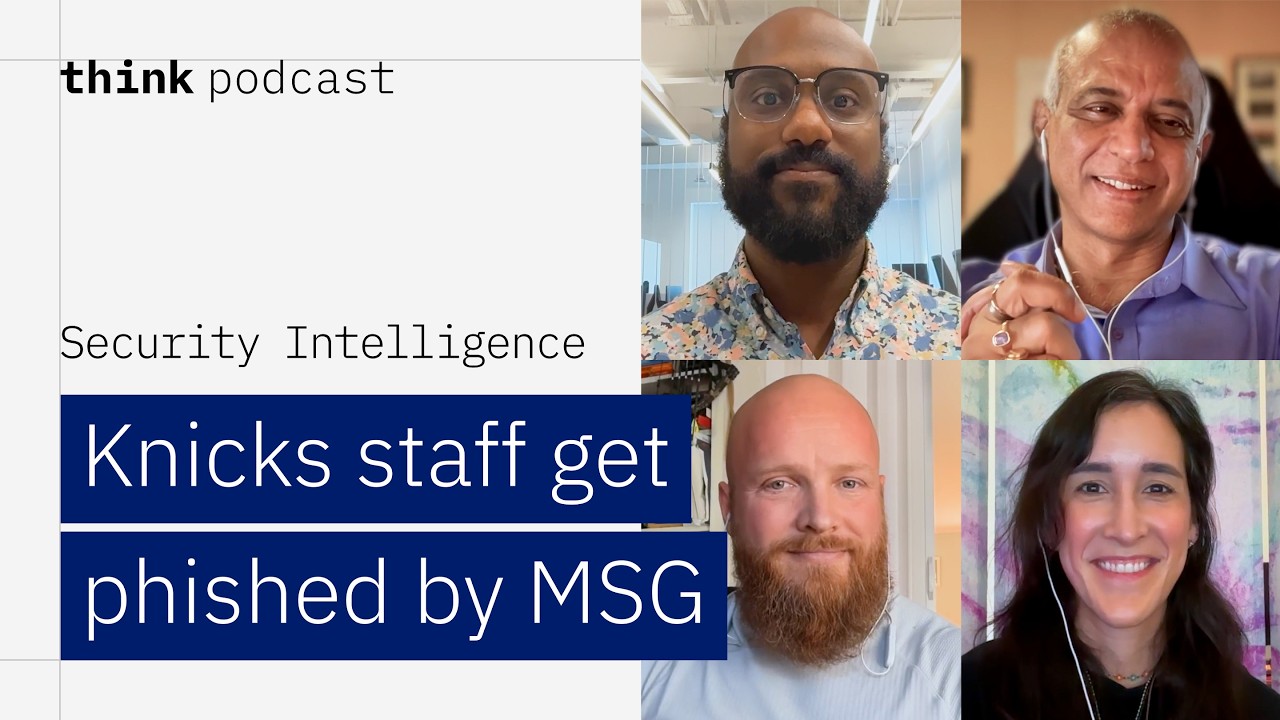
Did the Knicks’ phishing test go too far? Plus, hackers pose as IT in Teams
Title history
- Did the Knicks’ phishing test go too far? Plus, hackers pose as IT in Teams — observed on 20261104-1023 UTC (YouTube)
Keywords
Summary
139 words
Critical Evaluation
Value of the Information & Strength of the Argument
The panel provides practical insights into security awareness, emphasizing the need for defense in depth and the psychological aspects of social engineering. They argue that phishing tests should be designed carefully to avoid desensitization. For the Teams attack, they highlight the importance of technical controls and user skepticism. For PHP, they note that while vulnerabilities are serious, practical exploitation may be difficult, but patching remains crucial. The argumentation is coherent and backed by real-world experience, though it leans on opinion and anecdotal evidence rather than quantitative data.
Scientific Rigor, Source Quality, Title Accuracy
The podcast is well-structured, with expert panelists from IBM. They reference reputable sources like Arctic Wolf and CISA, and mention the IBM Cost of a Data Breach report. However, specific data and figures are not thoroughly cited. The title accurately reflects the content. The discussion is conversational and opinion-based, but grounded in experience. The lack of explicit sourcing in the transcript (beyond links in the description) limits the ability to verify all claims, but the descriptions provide landing pages for further exploration.
184 words
Title / Content Match
The title accurately reflects the main topics: the Knicks phishing test and Teams impersonation, and also mentions the PHP vulnerabilities in the description.
Quality & Reliability
8/10
The podcast features expert panelists with practical cybersecurity experience, provides context and actionable advice, but relies on news reports and personal opinions rather than original research.
Chapters
Cited Sources
- Security Intelligence podcast page — The podcast's landing page, mentioned in the description for more AI content.
- Monthly AI newsletter sign-up — Linked in the description for AI updates from IBM.
Contribution & Novelties
The video offers a balanced, expert perspective on the ethical and practical dimensions of phishing simulations and social engineering attacks. It distills complex security incidents into actionable recommendations, such as adopting a skeptical mindset and implementing layered email controls. The discussion on PHP vulnerabilities highlights the gap between theoretical risk and practical exploitation, urging proactive patching. For further exploration, consider the following concepts:
- Social engineering (security) — Core attack technique discussed throughout the podcast.
- Business email compromise — A targeted form of phishing mentioned by panelists.
- Phishing — Baseline attack vector central to all stories.
- Vulnerability management — Discussed in the PHP segment, emphasizing patch hygiene.
- Zero trust architecture — Relevant to the Teams impersonation and least-privilege access.
118 words
Radar Profile
The scores indicate a balanced profile with high reliability and information quality, moderate quantity and technical depth. The podcast excels in providing credible, actionable advice rather than exhaustive technical detail.