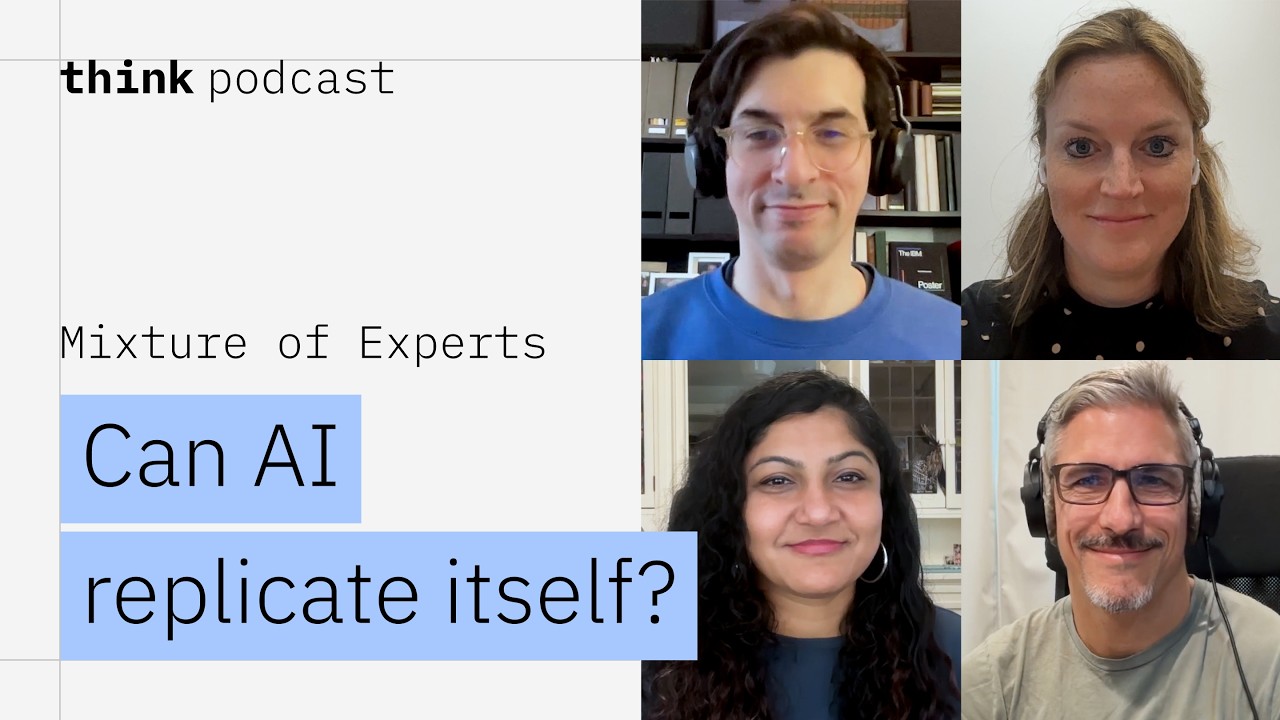
Self-replicating AI, your doctor’s chatbot & agents at dinner
Keywords
Summary
204 words
Critical Evaluation
Value of the Information & Strength of the Argument
The value of the information lies in the panel’s ability to contextualize recent AI developments with practical concerns. They provide concrete examples, such as the AWS outage affecting smart mattresses, to illustrate risks. The argumentation is solid, with panelists offering diverse perspectives: one focuses on the technical feasibility, another on security implications, and another on potential benefits. They weigh the pros and cons, often concluding that while the threats are real, they are not imminent, and current focus should be on securing device inputs. The discussion about doctors’ use of AI is particularly insightful, highlighting knowledge synthesis and the importance of human judgment. The panelists effectively argue that AI accelerates access to information but requires ongoing verification and that specialists remain indispensable. Overall, the arguments are coherent, well-reasoned, and balanced, though they lack quantitative depth.
Scientific Rigor, Source Quality, Title Accuracy
The episode references specific studies (Anthropic research, JAMA study) and tools (OpenEvidence), but does not provide direct links or detailed methodology. The panelists rely on their expertise and anecdotal evidence, which is typical for a podcast format. The title is accurate and engaging, encompassing the three stories. The discussion is current and relevant, but the absence of in-depth citation details limits scientific rigor. The podcast is produced by IBM, and the disclaimer notes that opinions are solely those of participants, not IBM. Overall, the content is trustworthy for a general audience, but not intended as a rigorous academic review.
249 words
Title / Content Match
Title accurately captures the three main topics: self-replicating AI, doctors using AI chatbots, and AI agents networking at a dinner.
Quality & Reliability
7/10
The podcast provides a balanced discussion of three recent AI news stories, with panelists offering informed opinions based on their expertise. Claims are generally consistent with known public research, though no deep verification is provided. The panelists are IBM experts, adding credibility, but the format is conversational and not peer-reviewed.
Chapters
Cited Sources
- IBM Technology newsletter signup — Mentioned as a newsletter for AI updates from IBM.
- Mixture of Experts podcast page — Linked in description for more AI content from the podcast.
Contribution & Novelties
This podcast synthesizes three separate AI news stories into a coherent discussion, highlighting common themes of AI autonomy, security, and human oversight. The panel offers a balanced view, emphasizing that self-replicating AI is still nascent but that IoT security is a present risk. The medical chatbot segment provides practical insights into how clinicians are adopting AI in practice, moving beyond hype. The agents at dinner segment raises novel questions about AI-to-AI interaction and governance. The discussion is current and thought-provoking, adding value by connecting technical developments to societal implications.
Pour aller plus loin :
- Self-replicating machine — Relevant to the concept of self-replicating AI models.
- Clinical decision support system — Background on chatbots in healthcare.
- Intelligent agent — Context for AI agents networking.
123 words
Radar Profile
The radar profile shows a balanced but moderate profile, with information quality and quantity slightly above average, while technical depth and reliability are rated lower. This reflects a podcast that offers substantial discussion but relies on expert opinion rather than rigorous technical detail.