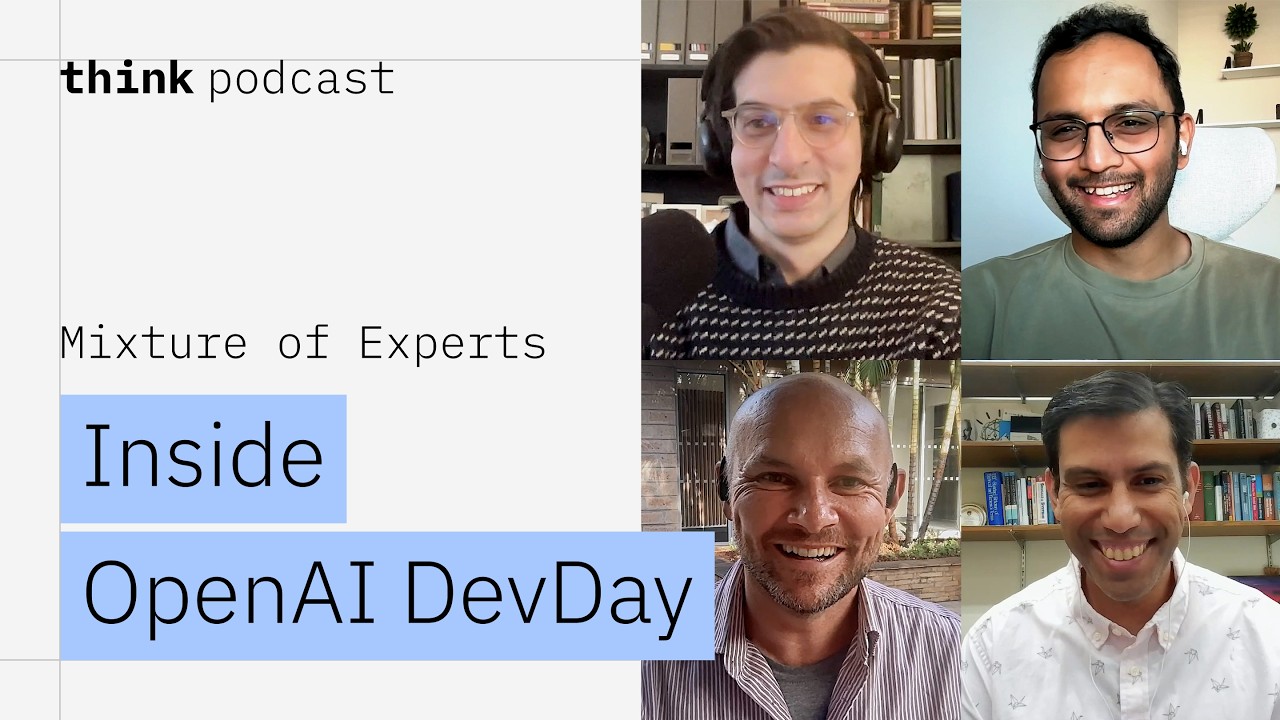
OpenAI's always-on agents, 700+ math manuscripts & HackerRank's AI interviewer
Keywords
Summary
167 words
Critical Evaluation
Value of the Information & Strength of the Argument
The discussion provides valuable insights into the practical use and implications of recent AI developments. The panel members offer diverse perspectives, from Utsav’s hands-on experience with Dots to Kush’s emphasis on ethics and bias mitigation. They argue convincingly that AI tools like Chakra can expand opportunity, though they also acknowledge potential biases and the need for careful implementation. The mathematical segment raises profound questions about the nature of mathematical understanding and the role of human verification, referencing Terence Tao’s stance. The explanations of mixture of experts are clear and analogical, making complex concepts accessible. The argumentation is well-structured, with each speaker building on the others’ points while maintaining a balanced view.
Scientific Rigor, Source Quality, Title Accuracy
The podcast maintains a good level of rigor by referencing specific sources such as Quanta Magazine and the HackerRank CEO’s statement. However, the primary reliance is on expert opinion rather than extensive citations. The title accurately corresponds to the content, covering all three major topics. The panel’s approach is professional, and they explicitly note that opinions are their own and not necessarily those of IBM. No formal citations are provided in the video transcript, but the discussion is informed and reasonable.
207 words
Title / Content Match
The title accurately summarizes the three main discussed topics: OpenAI's Dots agents, the release of 722 AI-generated math manuscripts, and HackerRank's AI interviewer. It is concise and matches the content well.
Quality & Reliability
7/10
The panel consists of IBM experts who discuss AI news with a balanced mix of technical insight and societal perspective. They reference specific sources like Quanta Magazine and cite a quote from HackerRank's CEO, but the reliability relies heavily on expert opinion and interpretation rather than peer-reviewed evidence.
Chapters
Cited Sources
- IBM AI Newsletter — Mentioned in description as a way to get AI updates, likely related to the discussions.
- Mixture of Experts Podcast Page — The podcast page for more AI content, referenced in the description.
Concurring Sources
- Quanta Magazine article on mathematicians as interpreters — Referenced in discussion about the changing role of mathematicians in verifying AI proofs.
Contribution & Novelties
The video provides an expert panel’s real-time analysis of several recent AI developments, offering insights that go beyond typical news coverage. It connects trends like persistent agents across different companies and raises critical questions about the future of mathematics in the age of AI. The explanations of mixture of experts architecture are clear and accessible, filling a gap for non-technical audiences. Overall, it synthesizes information and adds interpretive value.
Pour aller plus loin :
- Mixture of experts — Overview of the architecture discussed in the last segment.
- OpenAI DevDay — Context for the launch of Dots and other announcements.
- Terrance Tao on AI mathematics — Discussion of mathematician’s views on AI contributions.
- HackerRank — Company background for the AI interviewer product.
- Reflection AI — Startup behind the Beam model mentioned.
130 words
Radar Profile
The radar profile shows high scores in quantity and quality of information, moderate technical level, and reasonable reliability. This indicates a well-rounded discussion with depth but relies more on expert commentary than formal evidence.