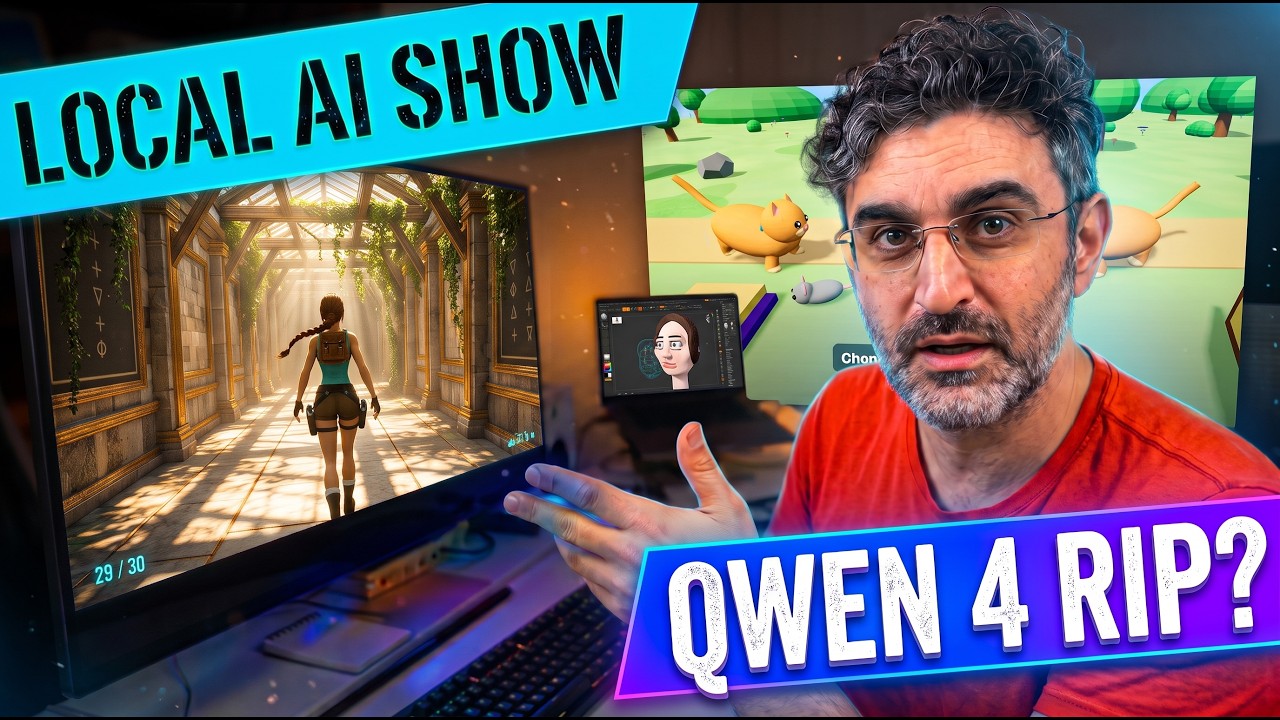
Is Qwen 4 Already RIP? I Tested Hy4 Flash for 24 Hours... 🤯
Keywords
Summary
324 words
Critical Evaluation
Value of the Information & Strength of the Argument
The informational payload is real and fairly dense for a review format: the viewer gets concrete figures for memory footprint (roughly 85 GB for the dynamic four-bit build, 105 GB for five-bit, up against a 128 GB machine), token counts per generation, and a clear demonstration that quantization strategy changes output quality as much as bit-width does. The distinction between a naive four-bit build and a dynamic four-bit build that allocates extra precision to sensitive layers is the most genuinely instructive element, and the side-by-side website comparison makes the point visually.
The argument, however, is built on single observations presented as general findings. Each prompt is run once per configuration; no seeds, sampling parameters or repetition are reported, yet a nine-bit run that produced a different and arguably weaker Age of Empires scene is immediately attributed to ’not thinking as deeply’ rather than to sampling variance, and the presenter concedes he ‘got lucky with the mathematics’. The headline comparison against Qwen Flash Next is confounded: Qwen is run at six bits with a modified attention-window setting, and the presenter himself demonstrates that changing that setting shifts Qwen’s output substantially, so the two models are not evaluated under matched conditions. Quantitative-sounding claims such as the gain from ‘bad’ to ‘good’ four-bit being ’like an extra 50’ and from four-bit to nine-bit being ’that extra 10 percent of glory’ are impressionistic, not measured. Judgements of quality lean heavily on aesthetics (‘gorgeous’, ‘beautiful’, ‘basic’), which conflates visual taste with capability. The strongest and most defensible claim is narrow and repeated: a single prompt producing runnable code with no runtime errors is a meaningful practical advantage for local use, because extra agentic turns are expensive without a datacentre. That claim is supported by the demonstrated outputs, but it remains anecdotal evidence from one operator on one machine with one model snapshot, and the acknowledged failures (runtime errors on the car side-view, Blender and theme-park prompts, mirrored controls, reversed cat-and-mouse roles) are reported honestly rather than suppressed, which is the review’s main credibility asset.
Scientific Rigor, Source Quality, Title Accuracy
No external source is cited verbally at any point. The performance framing early in the video comes from the vendor’s own benchmark charts, displayed on screen and accepted without discussion of methodology, task composition or comparison conditions; the model is then pitted against a rival under settings that differ from the rival’s defaults. The description links resolve to the presenter’s own uploaded quantized weights on Hugging Face, to the local inference application used for the tests, to three companion videos on the same channel, and to affiliate purchase links for hardware; there is no link to an independent evaluation, to the model card’s own evaluation suite, or to any third-party benchmark. The licensing statement (Apache 2.0 with a revenue threshold clause requiring separate negotiation) is asserted from reading the licence rather than quoted, which is broadly plausible for this kind of carve-out but unverified here. The testing methodology is transparent in the sense that the operator shows his settings and memory readouts, but absent in the sense that nothing is repeated, blinded, or controlled.
On title-content fit: the title’s central question about Qwen 4 is never answered, because Qwen 4 is described as an unreleased and unknown quantity; the tested comparison is against Qwen Flash Next, and the ‘24 hours’ framing has no counterpart in the transcript. The thumbnail-and-title promise therefore outruns the delivered content, which is a competent but narrower two-model comparison plus a quantization tour.
591 words
Title / Content Match
The title asks whether 'Qwen 4' is finished, but Qwen 4 is never tested and is explicitly described as an unreleased mystery; the actual comparison is against Qwen Flash Next. The '24 hours' framing is also not substantiated anywhere in the transcript. Clickbait-leaning framing over an otherwise real hands-on test.
Quality & Reliability
4/10
Hands-on demonstrations on real hardware give concrete, checkable traces (quantization sizes, memory footprints, token counts), but the evaluation is entirely anecdotal: single generations per prompt, no repetition, no seeds, no fixed decoding settings across conditions, aesthetic judgements presented as performance verdicts, and vendor benchmark charts accepted at face value. No independent measurement protocol or third-party replication is offered.
Key Moments
Markers derived by PSI from the transcript: the creator did not define chapters.
- Framing of Hy4 Flash as a Tencent release positioned against Qwen Flash Next and GLM 5.3 Flash, with a recap of the vendor's benchmark charts.
- First head-to-head: a Tomb Raider-style 3D level generated from a reference image, Qwen Flash Next at six bits with a wide context window versus Hy4 Flash at four bits streamed from storage.
- Cat-and-mouse game prompt: Qwen needs repeated attempts and 165,000 cumulative context tokens and still has a broken camera; Hy4 Flash delivers a playable build in one 43,000-token pass with mirrored controls.
- Core quantization demonstration: a naive four-bit build fails or degrades, while a dynamic four-bit build protecting sensitive layers adds roughly two gigabytes of memory and produces a rendered 3D face and a far richer website.
- Age of Empires-style prompt across four-, five- and nine-bit builds, showing diminishing returns and a nine-bit run that diverges for reasons the presenter cannot attribute confidently.
- Multimodal image description, a Python 3D solar system, and face rendering compared across thinking-disabled, high and max thinking modes.
- 3D helicopter that takes off, explodes, reassembles and offers x-ray and wireframe modes, produced in a single 45,000-token pass without runtime errors.
- Game-generation battery: Mario, a GTA-style clone, a Red Dead-style cut scene, a theme park that finally produces a runtime error, and a go-kart racer.
- Closing remarks on licensing, on the simple three-level thinking control, and on the value of competition pending an actual Qwen 4 release.
Cited Sources
- Hy4-flash-MLX-Q4s (dynamic four-bit quantized weights) — Quantized build used for the four-bit streaming tests, including the improved site and 3D face generations.
- Hy4-flash-MLX-Q5s (five-bit quantized weights) — Five-bit build used for the head-to-head against Qwen Flash Next on the cat-and-mouse game and Age of Empires prompt.
- Hy4-flash-MLX-Q9s (nine-bit quantized weights) — Higher-precision build referenced in the quantization comparison.
- Hy4-flash-MLX-Q9 (full nine-bit quantized weights) — Nine-bit build used for the multimodal, Python solar-system and website quality ceiling tests.
- Inferencer v2.5.4 local inference application — Application used to run the models locally, with streaming of expert weights from storage and thinking-mode control.
- Companion video: DeepSeek 4.1 Streaming — Previous test on the same channel, referenced as a comparison point for generation quality.
- Companion video: Kimi K3.1 — Previous test on the same channel cited when discussing earlier local-model capabilities.
- Companion video: GLM 5.3 — Previous test on the same channel used as a reference for game and 3D generation quality.
External References
Contribution & Novelties
The video’s genuine contribution is not the model announcement but the demonstration that quantization strategy, rather than raw bit-width, dominates perceived quality once a large mixture-of-experts model is squeezed onto a single high-memory workstation. Running identical prompts through a naive four-bit build and a dynamic four-bit build that reserves higher precision for quantization-sensitive layers, for roughly two gigabytes of extra memory, produces a qualitative jump from a runtime error and a bare webpage to a rendered 3D character and a fully composed site. The second contribution is a practical observation about local agentic coding: because additional self-correction turns are expensive without datacentre hardware, a model that returns runnable code on the first attempt has outsized value even when its ceiling is below larger models. The third is a rare public side-by-side of a streaming open-weight model against a contemporaneous closed competitor under realistic consumer hardware constraints, including honest reporting of failures.
Further reading:
- Large language model — Background on the model class, training and evaluation framing that the review assumes.
- Mixture of experts — Explains the sparse architecture that makes streaming expert weights from storage viable at this parameter count.
- GPTQ: Accurate Post-Training Quantization for Generative Pre-trained Transformers — The canonical post-training quantization method underlying the four-bit versus nine-bit trade-offs discussed.
- AWQ: Activation-aware Weight Quantization for LLM Compression and Acceleration — Alternative approach that specifically protects salient weights, closely related to the ‘intelligent’ quantization argument made in the video.
- Post-training quantization and per-layer sensitivity, cited by concept only — the review’s central claim rests on the idea that a few layers are far more quantization-sensitive than the rest.
268 words
Radar Profile
The profile is lopsided: information quantity and technical level are respectable because the operator shows real memory readouts, token counts and a systematic quantization sweep, while qualitative and global reliability scores stay low because every conclusion rests on single, non-repeated generations judged largely on aesthetics. The result reads as a knowledgeable enthusiast's field report rather than an evaluation, strong on practical texture and weak on measurement discipline.