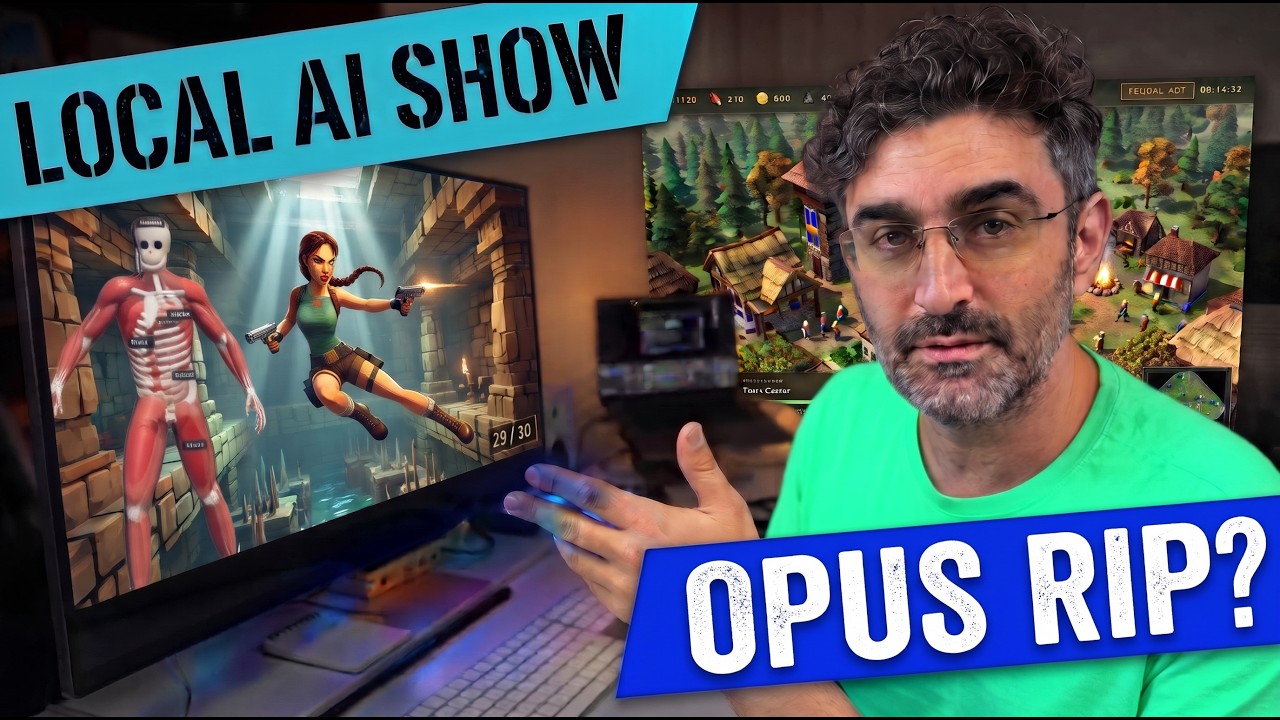
Is Claude Opus & DeepSeek RIP? Testing ERNIE 5.5 160GB Local AI 🤯
Keywords
Summary
229 words
Critical Evaluation
Value of the Information & Strength of the Argument
The informational value is high for tracking local open-weight models: the video provides concrete token counts, approximate generation speed, quantization sensitivity, thinking-mode behaviour and a broad set of one-shot generation demos covering 3D faces, anatomy, physics simulations, web applications and games. It also records failure modes such as thinking loops and a runtime error, which is more informative than a pure highlight reel. The argumentation is weaker because most conclusions rest on single runs and visual impressions, without a controlled baseline, repeated trials or quantitative scoring across models. Comparisons with Opus, DeepSeek, Qwen and GLM are asserted from selected benchmarks or prior experience rather than from a matched, reproducible test. The discussion of temperature and context attention is plausible and grounded in observed behaviour, but it remains a practical heuristic rather than a demonstrated causal explanation.
Scientific Rigor, Source Quality, Title Accuracy
Scientific rigour is limited: this is a demonstrative product test rather than a reproducible benchmark. The description supplies the Hugging Face model page and the Inferencer tool, but the benchmark figures are presented as screenshots or claims without independent verification, seeds, full prompts or evaluation scripts. Several product links are affiliate links, and the test setup is only partly described. The title’s ‘RIP’ framing overstates the evidence; the content does test ERNIE 5.5 locally and compares it with Opus and DeepSeek, but the comparison is selective and does not establish general superiority. The title is therefore broadly aligned with the subject while remaining clickbait in tone.
257 words
Title / Content Match
The video does test ERNIE 5.5 Flash Preview locally and compares it with Opus and DeepSeek, so the core subject matches the title. However, the 'RIP' framing is clickbait because the comparison is selective and does not amount to a definitive head-to-head.
Quality & Reliability
5/10
Hands-on local testing with concrete observations, but the evidence is largely anecdotal: single-run demos, selective benchmark screenshots, subjective visual judgments, and no reproducible protocol. The video is transparent about some test conditions, including quantization, temperature and thinking loops, but it does not independently validate the headline comparisons.
Chapters
- Introduction to Ernie 5.5
- Forensic accounting test
- Inference and generation
- Thinking modes and loops
- Temperature and parameter tuning
- 3D anatomy and animation
- Physics simulations
- Procedural modeling
- Web development and apps
- Music and sound generation
- Game development
- Advanced gameplay demos
- Logic and coding tests
- Conclusion and model outlook
Cited Sources
- ERNIE 5.5 Flash Preview MLX model card (Inferencer Labs) — Linked in the description as the local model used for testing; source for the model name, packaging and claimed capabilities.
- Inferencer v2.5.5 — Linked as the local inference test system used in the video.
- Companion video: DeepSeek 4.1 Streaming — Prior xCreate test referenced as comparator context for the ERNIE evaluation.
- Companion video: Kimi K3.1 — Prior xCreate model test listed in the description as related viewing.
- Companion video: GLM 5.3 — Prior xCreate model test listed in the description as related viewing.
External References
Contribution & Novelties
The video’s main novelty is an early hands-on local evaluation of Baidu’s ERNIE 5.5 Flash Preview, with concrete observations about quantization sensitivity, thinking-mode loops, token budgets, generation speed and one-shot 3D and game demos. It also offers practical workarounds such as thinking-loop detection, temperature changes and context-attention scaling, though these are anecdotal rather than controlled.
Further reading:
- ERNIE 5.5 Flash Preview MLX model card — primary model artifact used in the video.
- Mixture of experts — architectural concept relevant to large sparse models.
- Large language model — background on local inference, quantization and sampling.
- DeepSeek — comparator model family named in the video.
- Claude (language model) — comparator model family named in the video.
114 words
Radar Profile
The profile shows high information quantity and a solid technical level, driven by many concrete demos and local-inference details. Information quality and overall reliability are moderate because the evidence is based on single-run, subjective tests and selectively presented benchmarks. The result is a useful practical preview rather than a rigorous comparative evaluation.